Last checked 25 September 2026
Sending to a bKash wallet has a cost almost nobody sending from abroad ever sees, because it lands on the person receiving. The transfer arrives, and then it costs money to take out — and depending on where your recipient withdraws it, that cost varies by a factor of two and a half. There is also 2.5% of free money attached to sending through a legal channel, which the informal route quietly forfeits.
Both of those are published by bKash. Neither appears on any remitter’s landing page, because neither is about the remitter.
The 2.5% incentive, and what it is actually for
Bangladesh pays a 2.5% government cash incentive on inward wage remittance sent through legal channels — authorised banks, listed money transfer organisations and money exchange houses. bKash states it plainly: recipients of remittances sent through legal channels receive it, and in some cases a further 2.5% bank incentive on top.
The rate went to 2.5% on 1 January 2022, up from 2%. It is not a bKash promotion and not a provider’s offer, however some remitters advertise it — it is national policy, and it applies whichever legal channel you use.
Which is the point people miss. The incentive exists precisely to make the formal channel beat the informal one. A hundi arrangement offering a slightly better rate is not competing with the official rate — it is competing with the official rate plus 2.5%, and sometimes plus 5%. Very often it loses, and the sender never runs the comparison because the incentive is paid to somebody else, in another country, days later.
It is also the reason to keep the paperwork. The incentive attaches to remittance that arrived through a channel that can prove it.
What you can send
bKash states a ceiling of BDT 2.5 lakh (250,000) in a single transaction, and says expatriate Bangladeshis can send that amount as many times as they want. So the per-transaction cap is real; a frequency cap is not something bKash publishes.
To send, the bank, exchange house or MTO needs two things from you: the recipient’s bKash account number, and their full name exactly as given when the bKash account was opened. Not the name you call them. Not a shortened version. The sending agent is required to confirm the account is registered and valid and that the name matches before the transfer goes through.
This is the same failure mode that stops transfers in every other corridor we cover, and it is the single most common reason a transfer is rejected rather than delayed.
Now the part that costs money: getting it out
Money in a bKash wallet is not yet cash. Withdrawing it has a charge, and bKash publishes four different ones.
| How your recipient withdraws | Charge per BDT 1,000 | On BDT 50,000 |
|---|---|---|
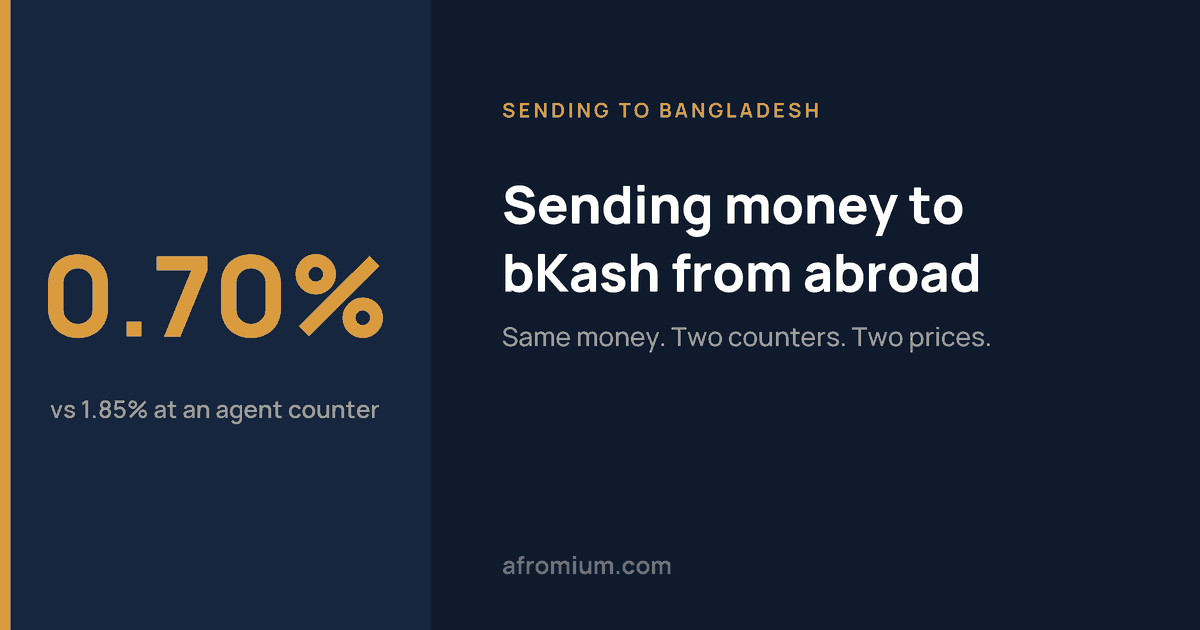
| Remittance money, at a partner ATM | 7.00 (0.70%) | BDT 350 |
| Priyo Agent (up to 50,000/month, 2 agents set) | 13.95 | BDT 697.50 |
| Any partner ATM, ordinary balance | 14.90 | BDT 745 |
| Any other agent | 18.50 | BDT 925 |
Read the first and last rows together. The same money, withdrawn two different ways, costs BDT 350 or BDT 925.
Agents are how most people in Bangladesh withdraw from bKash — they are everywhere, they are open, and they do not require finding a specific bank’s ATM. So the default behaviour is the expensive one, and the discounted rate only applies if your recipient knows it exists and goes out of their way to use it.
That is the whole reason this page exists. You chose a provider carefully to save a few hundred taka on the exchange rate, and then 575 of them went back out at the withdrawal counter.
How the discounted rate actually works
The 0.70% rate is a service bKash calls Discounted Remittance ATM Cash Out. The details matter, because several of them are traps:
- It applies to all kinds of international remittance, regardless of type.
- It covers the remittance balance including the government and bank incentives — so the 2.5% comes out at the cheap rate too.
- There is no expiry. It lasts as long as there is remittance balance in the account.
- It works at BRAC Bank, City Bank and certain Q-Cash ATMs, through the bKash app or by dialling
*247#. - It is ATM only. Withdraw the same remittance money from any agent, including a Priyo Agent, and ordinary agent charges apply instead.
That last one is the trap. The discount is not a property of the money — it is a property of the machine.
The rule that catches people: do not overdraw the remittance balance
If a withdrawal is larger than the remittance balance, the discounted rate does not apply to the remittance part and ordinary charges to the rest. The ordinary charge applies to the whole withdrawal.
bKash publishes worked examples. With BDT 7,000 of remittance in the wallet:
| Withdrawing | Which rate applies | Fee |
|---|---|---|
| BDT 5,000 — less than the balance | Discounted, 0.70% | BDT 35 |
| BDT 7,000 — exactly the balance | Discounted, 0.70% | BDT 49 |
| BDT 10,000 — more than the balance | Regular agent charge, on the full amount | Considerably more |
So the advice to your recipient is precise: withdraw up to the remittance balance, never past it. Going BDT 1 over does not cost a little more. It reprices the entire transaction.
Where a wallet holds several kinds of money, bKash applies cash-out rates in a set order — Savings, then Payroll, then Remittance.
The practical limits at the machine
Worth knowing before promising anyone their money this afternoon. For this ATM service bKash says a withdrawal must be a multiple of 500, within BDT 3,000 to 10,000 — no fractional amounts like 2,100 or 2,223.
Which puts an honest limit on the cheap route. A BDT 250,000 remittance cannot be withdrawn at 0.70% in one movement; at BDT 10,000 a time it is twenty-five separate withdrawals. For a large transfer the discounted rate is real but slow, and for an urgent large sum your recipient may reasonably choose to pay more. That is a genuine trade-off, and we would rather set it out than pretend the cheap option is always the right one.
The ATM process itself uses a one-time password, not the bKash PIN. bKash sends a security code by SMS, it is valid for five minutes, generating it is free, and there is a 30-second wait before another can be generated. Nobody should ever be entering their bKash PIN at an ATM for this.
If the money is freelance income, read this
bKash supports pulling Payoneer balances into a bKash account, minimum BDT 1,000, with no paperwork. Two things are true about that money and they point in opposite directions:
- It does qualify for the 0.70% ATM cash-out rate.
- It does not qualify for the 2.5% government incentive. bKash says so explicitly.
For a freelancer earning in dollars, that 2.5% is worth real money over a year, and the routing decision — Payoneer to bKash, versus a bank or MTO remittance — is worth making deliberately rather than by habit.
Bangladesh is not alone in charging for this last step, and the pricing differs sharply by country. We compare what it costs to take remittance money out of bKash, GCash and easypaisa in what it costs to take money out of a mobile wallet.
What to tell your recipient
The sender does the choosing, but the recipient does the withdrawing, and the savings live entirely on their side. Three sentences cover it:
- Withdraw remittance money at a BRAC Bank, City Bank or Q-Cash ATM, not at an agent.
- Never withdraw more than the remittance balance in one go.
- Use the security code from SMS, never the bKash PIN.
They can find the nearest enabled ATM in the bKash app under bKash Map, and request a remittance statement from the app showing what arrived and when.
Questions people ask
Does the recipient really get 2.5% extra?
On remittance sent through legal channels, yes — that is the published government incentive, and bKash says a further 2.5% bank incentive applies in some cases. It does not apply to Payoneer transfers.
How much can be sent at once?
BDT 2.5 lakh in a single transaction, and bKash says it can be sent as many times as you want.
What does it cost to take the money out?
7 taka per thousand — 0.70% — at a partner ATM, for remittance money. Up to 18.50 per thousand at an ordinary agent. The difference is the recipient’s choice, not yours.
Does the discount expire?
No. bKash says it lasts as long as there is remittance balance in the account.
What if the name does not match?
The sending agent is meant to verify the account number and the full name as registered at bKash account opening before completing the transfer. A mismatch is a reason for rejection, so confirm the registered name rather than assuming.
How we checked this
Read on 25 September 2026: bKash’s Remittance and Money Transfer Service pages, for the 2.5% government incentive, the possible 2.5% bank incentive, the BDT 2.5 lakh per-transaction ceiling, the sending requirements and the note that the remittance cash-out charge applies from 19 March 2024; bKash’s Discounted Remittance ATM Cash Out FAQ, for the 0.70% rate, its application to all remittance types including incentives, the absence of an expiry, the agent exclusion, the charge priority order, the OTP process and validity, the multiple-of-500 rule within BDT 3,000–10,000, and the worked overdraw examples; bKash’s Cash Out page, for the 13.95, 14.90 and 18.50 per thousand rates; and Bangladesh Bank’s published policy record, for the increase of the cash incentive to 2.5% with effect from 1 January 2022 and the provision for banks to add a further incentive.
What we left out
Several guides state an annual ceiling on the government incentive per recipient. We could not confirm a current figure from bKash or Bangladesh Bank, so we have not printed one. Incentive schemes are set by national policy and can change with the budget — if a large amount is involved, confirm the current terms with the receiving bank before relying on the 2.5%.
We have also not published a list of which providers serve which countries. bKash lists authorised partners itself and that list changes; check it there rather than here.
Afromium does not make test transfers. Every figure on this page was read from bKash’s own pages or Bangladesh Bank’s published policy record on the date given, and is quoted rather than estimated. Charges and incentive rates change — check the current figure before acting on anything here.