Category: Sending to India

Guides for sending money to India: account types, UPI, and what the rules actually say.

  • Is Money Sent to India Taxable? The ₹50,000 Cliff and the Relative List

    Is Money Sent to India Taxable? The ₹50,000 Cliff and the Relative List

    Last checked 25 September 2026

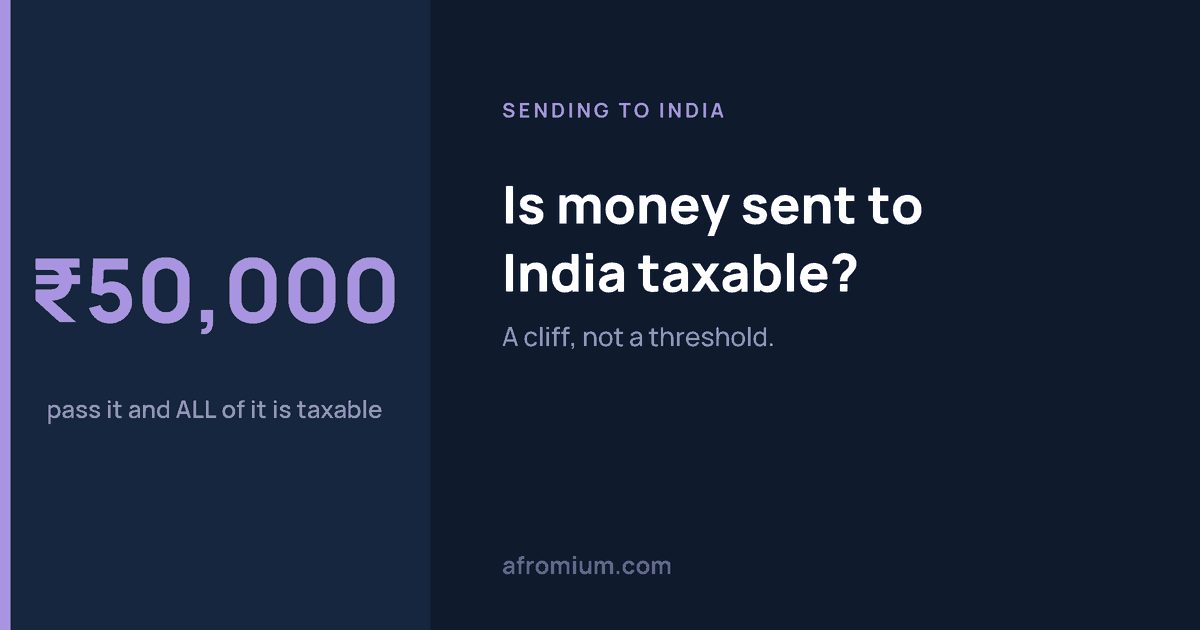
    Money you send to a close relative in India is exempt, with no upper limit. Money sent to anyone outside that definition is taxable in their hands once the year’s total passes ₹50,000 — and past that line the entire amount is taxable, not just the excess. Whether your relationship counts is decided by a list, and the list is shorter and stranger than most people assume.

    This page explains what India’s Income Tax Department publishes about money received as a gift. It is not tax advice, and it does not tell you what to do. For anything substantial, take professional advice.

    First, the thing that causes most of the worry

    Sending money to India does not create a tax bill simply by being an international transfer. The provision people are worried about — section 56(2)(x) — taxes money received without consideration: a gift, in ordinary language. It falls on the person receiving, not the person sending.

    Two features of it matter before anything else.

    It applies regardless of residential status. The Department states that the provision applies notwithstanding the residential status or class of the assessee, and that donor or donee may be resident or non-resident. Being an NRI sending from Germany does not put you outside it, and it does not put your recipient outside it either.

    And the exemption for relatives has no ceiling. If the relationship qualifies, the amount is irrelevant.

    The ₹50,000 cliff

    For money from someone who is not a relative, the Department’s wording is unusually direct:

    “The limit of Rs. 50,000 is not transaction-wise, and it shall be checked in aggregate for all transactions that happened during the year. If the aggregate of all transactions exceeds Rs. 50,000, the entire amount shall be chargeable to tax and not the amount in excess of Rs. 50,000.”

    Two traps in one paragraph.

    It is a cliff, not a threshold. ₹50,000 received is not taxable. ₹60,000 received does not make ₹10,000 taxable — it makes ₹60,000 taxable. There is no tapering and no allowance carved out below the line.

    It aggregates across the year. Five separate payments of ₹15,000, each comfortably under the limit, total ₹75,000 — and the whole ₹75,000 is chargeable. People who would never send ₹75,000 at once assume small regular amounts are safe. On this provision they are not.

    The chargeable amount is taxed under the head income from other sources.

    Who counts as a relative

    Everything turns on this list. It is set out by the Income Tax Department, and these persons are treated as a relative:

    • Spouse of the individual
    • Brother or sister of the individual
    • Brother or sister of the spouse of the individual
    • Brother or sister of either of the parents of the individual
    • Any lineal ascendant or descendant of the individual
    • Any lineal ascendant or descendant of the spouse of the individual
    • Spouse of any of the persons in the four categories above

    So parents, grandparents, children, grandchildren, siblings, parents-in-law, siblings-in-law, uncles and aunts are all in. The ordinary case — sending money home to a parent, a spouse or a sibling — is exempt, with no limit, and most readers can stop here.

    Two things about that list nobody expects

    Cousins are not on it. A cousin is neither a sibling, nor a sibling of a parent, nor a lineal ascendant or descendant. However close the relationship in life, it does not appear in the definition.

    And the list is not symmetrical. This is the genuinely counter-intuitive part, and it follows from the list being written from the point of view of the person receiving.

    “Brother or sister of either of the parents” means your uncle or aunt is your relative. So money from an uncle to a nephew is received from a relative.

    Now reverse it. Is a nephew on an uncle’s list? A nephew is not a sibling, not a sibling of a parent, and not a lineal descendant — a lineal descendant is a child or grandchild, not a sibling’s child. So the same pair of people can be relatives in one direction and not the other.

    Money flowsIs the sender a relative of the recipient?
    Uncle or aunt → nephew or nieceYes — sibling of a parent
    Nephew or niece → uncle or auntNo — not on the recipient’s list
    Parent ↔ childYes, both directions
    Sibling ↔ siblingYes, both directions
    Cousin → cousinNo

    An NRI supporting an elderly uncle is in a different position from an NRI uncle supporting a student nephew, on the same facts and the same amounts. That is not an oversight in our reading — it is what the definition says, and it is the single most useful thing on this page.

    What is not caught at all

    The provision taxes money received without consideration. That word is doing real work.

    Money that is not a gift is not in scope of this provision in the first place. Paying someone for work done, repaying a loan, settling an invoice, or moving your own money into your own Indian account are all different transactions with different treatment. Sending money to your own NRE or NRO account is not a gift to anybody — you have not given it away. Which account you send it to has consequences of its own, and we set those out in NRE or NRO: which account should the money go to.

    The Department’s guidance also describes exceptions beyond the relative exemption, including gifts on the occasion of an individual’s marriage and amounts received under a will or by inheritance. If one of those applies to you, read the exception itself rather than relying on a summary.

    What we are not telling you

    Three limits on this page, stated plainly.

    It says nothing about tax where you live. Whether sending money creates any obligation for you in Germany, the UK, the US or Canada is a separate question under a different country’s law, and this page does not touch it.

    It is not the whole of Indian tax law. Section 56(2)(x) also covers immovable property and specified movable property, with different thresholds and different aggregation rules. We have deliberately confined this to money, because that is what our readers send.

    We publish no worked calculations. Rates, slabs and surcharges depend on the recipient’s total income and circumstances, and a worked example would look like advice about a situation we know nothing about.

    Questions people ask

    Is money I send to my parents in India taxable?

    Parents are lineal ascendants and therefore relatives, so a gift to them is exempt under the relative exemption, with no upper limit stated.

    Is there a limit on sending to a relative?

    Not for this provision. The ₹50,000 figure is the threshold for money from people outside the definition of relative. It does not cap what may be received from a relative.

    What if I send ₹60,000 to a friend?

    The aggregate for the year exceeds ₹50,000, so the whole ₹60,000 is chargeable in their hands as income from other sources — not ₹10,000.

    Do several small transfers avoid it?

    No. The Department states the limit is not transaction-wise and is checked in aggregate across the year.

    Is a cousin a relative?

    Not under this definition. Nor, in that direction, is a nephew or niece sending to an uncle or aunt — although an uncle or aunt sending to a nephew or niece does qualify.

    Does being an NRI change it?

    Not for this provision. It applies notwithstanding residential status, and donor or donee may be resident or non-resident.

    How we checked this

    Read on 25 September 2026, both from the Income Tax Department of India: its page on Deemed Income [Section 56(2)(x)], last updated 30 April 2026, for the application notwithstanding residential status, the resident or non-resident status of donor and donee, the ₹50,000 monetary threshold, the aggregation rule across the year, and the statement that the entire aggregate rather than the excess is chargeable; and its FAQ answer on gifts received from relatives, last reviewed 22 September 2026, for the seven categories of relative quoted above.

    We have used the Department’s own pages rather than any bank’s, broker’s or advisory firm’s summary of them, and we have quoted the aggregation rule directly because paraphrasing it is how the cliff gets lost.

    Afromium is not a tax adviser and this page is not tax advice. It sets out what the Income Tax Department of India publishes about money received without consideration, read on the date above. Tax law changes, individual circumstances differ, and your own country’s rules are a separate matter. Take professional advice before acting, particularly where a large sum, a property or an inheritance is involved.

  • Can You Actually Use UPI From Abroad? The Country List Nobody Leads With

    Can You Actually Use UPI From Abroad? The Country List Nobody Leads With

    Last checked 25 September 2026

    Yes, you can use UPI with a foreign mobile number — but the list of countries is short, it differs from bank to bank, and Germany is not on it at either of the two banks we checked. Before reading any guide on how to activate it, check whether your country is supported at all. Most articles put that at the bottom.

    There is also a more basic misunderstanding worth clearing up first, because it sends people down the wrong path entirely.

    UPI from abroad is not a way to send money to India

    This is the single most common confusion, and it matters because the two things solve different problems.

    UPI for NRIs lets you operate an Indian bank account from abroad — scan an Indian QR code, pay a UPI ID, send to an Indian mobile number or bank account. The money moves within India, in rupees, from an account you already hold there.

    It is not a remittance channel. It does not convert euros or pounds. It does not move money across a border. If your money is in a German or British account and needs to get to India, UPI is not the mechanism — you need an ordinary international transfer, and then UPI becomes useful for spending what has arrived.

    What you want to doIs UPI the answer?
    Send money from your German salary to family in IndiaNo — that is an international transfer
    Pay an Indian bill from money already in your Indian accountYes
    Pay a shop or a person in India while you are visiting or abroadYes
    Move money from an Indian account to another Indian accountYes

    Put plainly: UPI from abroad is a spending tool for money already in India, not a sending tool for money that is not.

    Which countries are actually supported

    Here is where the published guides quietly diverge, because the list is set by your bank, not by one national rule.

    CountryICICI BankIDFC FIRST Bank
    AustraliaYesYes
    CanadaYesYes
    France—Yes
    Hong KongYesYes
    Malaysia—Yes
    OmanYesYes
    QatarYesYes
    Saudi ArabiaYesYes
    SingaporeYesYes
    UAEYesYes
    United KingdomYesYes
    United StatesYesYes
    Germany——

    ICICI publishes ten countries. IDFC FIRST publishes twelve — the same ten plus France and Malaysia.

    Germany appears on neither. Nor does Ireland, Italy, Spain, the Netherlands or any other EU country except France at one bank. For a reader in Germany — the largest group this site serves — that is the answer, and it is not a matter of following the right activation steps more carefully.

    There is a small irony in it: ICICI runs a Germany country website. Having a banking relationship with a German presence does not put a German mobile number on the supported list.

    Both lists were read from each bank’s own current page on 25 September 2026. Other banks publish their own lists, and they may differ again — so check your bank’s list rather than a general article, including this one.

    What you need before any of this works

    Two requirements, and the second is where most attempts fail.

    1. An NRE or NRO account with a participating Indian bank. An ordinary resident savings account is not eligible.
    2. Your international mobile number registered to that account, from a country on your bank’s list.

    The second is not the same as merely owning a foreign number. The number the bank has on file has to be the foreign number. People try to activate UPI with a number the bank has never seen, and nothing works, and no error message explains why.

    Which of NRE or NRO you hold is a decision with consequences well beyond UPI — repatriation and tax treatment differ sharply between them. If you are choosing, or you are not sure which you have, read NRE or NRO: which account should the money go to before you set anything up.

    The rough sequence

    Steps vary by bank, so follow your own bank’s instructions rather than a generic list. Broadly:

    1. Hold an NRE or NRO account at a bank offering the facility.
    2. Have your international number registered against that account.
    3. Use a UPI app that accepts international numbers — often your own bank’s app.
    4. Link the account, create a UPI ID, set a UPI PIN.

    If it fails, the cause is almost always one of the first two, not the last two. Check the country and check the registered number before reinstalling anything.

    If your country is not on the list

    There is no workaround worth pursuing, and some of what gets suggested is a bad idea.

    Keeping an Indian SIM alive purely to hold a UPI registration is a common suggestion. It works, in the narrow sense, but it means your banking security sits on a number you are not carrying and may not receive — and an unused Indian number can eventually be recycled to somebody else, which is a problem we have watched play out in another market.

    What to do instead depends on the actual goal:

    • Sending money to family — an ordinary international transfer, which is what you wanted anyway. UPI was never the tool.
    • Paying Indian bills — net banking on the Indian account, which does not depend on a mobile number’s country.
    • Paying while visiting India — a different question, with options for foreign visitors that do not need an NRE or NRO account.

    Questions people ask

    Does UPI work from abroad?

    With an international mobile number, only from countries your bank supports, and only with an NRE or NRO account. ICICI publishes ten countries; IDFC FIRST publishes twelve.

    Can I use UPI from Germany?

    Not with a German mobile number at either bank we checked — Germany is on neither list. France appears at IDFC FIRST only. Check your own bank’s current list before concluding either way.

    Can I send money to India using UPI?

    No. UPI moves rupees between Indian accounts. Getting foreign currency into India is an international transfer, and a separate thing entirely.

    Do I need an Indian mobile number?

    Not if your country is supported — that is the point of the facility. Your international number has to be the one registered against the account, though.

    Will my bank charge foreign exchange fees?

    There is no currency conversion involved, because the payment is rupees out of an Indian account. Check your own bank’s schedule for any charges it applies to the facility itself.

    How we checked this

    Read on 25 September 2026: ICICI Bank’s NRI article on using an international mobile number for UPI payments, for its list of ten countries — Australia, Canada, Hong Kong, Oman, Qatar, Saudi Arabia, Singapore, UAE, UK, USA — and its description of what the facility can do; and IDFC FIRST Bank’s NRI guide, for its list of twelve — USA, UK, UAE, Canada, Australia, Singapore, Saudi Arabia, Oman, Qatar, Hong Kong, Malaysia, France — and the NRE/NRO account requirement. Account definitions come from the Reserve Bank of India’s FAQ on accounts for non-residents.

    What we left out

    We have not published a master list of every supported country, because there is no single list — each bank publishes its own and they differ, as the table above shows. Nor have we reproduced activation screens, which change with each app release and would be wrong within months.

    We checked two banks. A bank we did not check may well support a country neither of these does, so treat the Germany conclusion as “not at ICICI or IDFC FIRST on this date” rather than as a national impossibility, and ask your own bank directly.

    Afromium does not make test transfers. Both country lists on this page were read from the banks’ own pages on the date given and are quoted, not estimated. Supported-country lists change as banks extend the facility — check the current list with your bank before making plans around it.

  • NRE or NRO? Which Indian Account the Money Should Go To

    NRE or NRO? Which Indian Account the Money Should Go To

    Last checked 25 September 2026

    If you are sending money to India and your recipient has given you a choice of two account numbers, this is the most consequential decision in the whole transfer — more than the provider, more than the rate. NRE money can come back out of India freely and its interest is tax-exempt. NRO money cannot and is not. Send to the wrong one and no provider, rate or complaint fixes it afterwards.

    The good news is that the rule is short, and it is set by the Reserve Bank of India rather than by any bank, so it does not vary between them.

    The difference in one table

    NRE — Non-Resident ExternalNRO — Non-Resident Ordinary
    What it is forMoney earned outside IndiaMoney earned inside India
    Can the money leave India again?Yes, freelyNot freely — see the USD 1 million rule below
    Tax on interestExempt from income taxTaxable
    Who can open oneNRIs and PIOsAny person resident outside India

    Two rows of that table are the reason this page exists. Everything else follows from them.

    The short answer

    If you are sending money you earned abroad, and there is any chance that money may need to come back out of India later — send it to the NRE account.

    That is the default, and most people sending from Germany, the UK, the US or Canada want it. It is money that started outside India, and NRE is the account designed to let it leave again.

    NRO is the right answer in one main situation: the money is destined for Indian expenses, or it will mix with income arising in India — rent from a flat, a pension, dividends, a share of a family business. Those things are NRO money by nature, and RBI’s permitted credits for an NRO account are exactly that: inward remittances, legitimate dues in India, and transfers from other NRO accounts.

    Repatriation: the part that bites years later

    RBI’s position on an NRE account is that the balance is repatriable. Principal and interest, out of India, without asking anyone.

    An NRO account is not repatriable except for current income. There is a route out, but it is a capped and documented one: an NRI or PIO may remit up to USD 1 million per financial year — April to March — from NRO balances, and that allowance is shared with their other eligible Indian assets.

    For most families sending ordinary support, a million dollars a year is not a live constraint, and this all sounds academic. It stops being academic the moment someone sells a property, settles an estate, or decides to move savings back after a decade abroad. Money that went into NRO because it was easier at the time now has to come out through a capped, paperwork-heavy channel — and money that went into NRE does not.

    That asymmetry costs nothing to respect on the day you send, and it cannot be undone cheaply later.

    Tax: exempt versus taxable

    Interest earned on an NRE account is exempt from income tax, and RBI notes the balances are exempt from wealth tax. Income in an NRO account is taxable.

    On a balance that sits for a year or more, that is not a rounding difference. Two accounts at the same bank, the same rate, the same deposit — one keeps the interest, the other does not.

    This is about the tax treatment of the account, not about whether your transfer is taxable. Whether money you send is itself taxed in the recipient’s hands is a separate question with separate rules, and it is not what this page answers.

    What can legitimately go into each

    Worth knowing, because it explains why the accounts are not interchangeable rather than simply differently taxed.

    • NRE permitted credits — inward remittance from outside India, interest accruing on the account, transfers from other NRE or FCNR(B) accounts, and current income such as rent, dividend and pension.
    • NRO permitted credits — inward remittances from outside India, legitimate dues in India, transfers from other NRO accounts, and rupee gifts or loans from residents within the Liberalised Remittance Scheme limits.

    Notice that an inward remittance is permitted into both. That is precisely why the mistake is so easy to make: nothing rejects your transfer, nothing warns anyone, and the money lands exactly as expected. The consequences are entirely downstream.

    Notice also what is not a permitted NRE credit: Indian income. Rent from an Indian flat belongs in NRO. Trying to route it through NRE to make it repatriable is not a clever workaround, it is outside the rules.

    One more rule worth knowing before you send

    RBI’s FAQ notes that individuals and entities of Pakistan and Bangladesh require prior approval of the Reserve Bank of India to open these accounts. If that applies to anyone in your situation, resolve it before money is in motion rather than afterwards.

    How to make sure it lands in the right one

    The two accounts have different account numbers. Your recipient may have both at the same bank, and the numbers may look alike.

    1. Ask which account type the number belongs to. Do not infer it, and do not accept “my account at HDFC” as an answer.
    2. Ask for it in writing — a screenshot of the account summary in their banking app naming NRE or NRO.
    3. Check that the name on the account matches what you are entering.
    4. If you send regularly, save the beneficiary once, correctly, and reuse it.

    If money has already gone to the wrong one, this is not a transfer problem and your provider cannot help — the money arrived where you told it to go. It is a banking question for the account holder, and banks do offer NRO to NRE transfer processes, subject to documentation and the repatriation rules above. Start there, and start early.

    A separate question people often fold into this one is whether the money is taxable when it arrives. It usually is not, because gifts from close relatives are exempt — but the definition of “relative” is narrower than most people assume. See is money sent to India taxable.

    A note on UPI

    If your reason for asking is that you want to pay things in India directly from abroad rather than send money to someone, that runs on these same two account types — and it is available in far fewer countries than people assume. We set out which, and what it can and cannot do, in can you actually use UPI from abroad.

    Questions people ask

    Which account should I send my salary savings to?

    NRE, in almost every case. It is money earned outside India, and NRE keeps it freely repatriable with tax-exempt interest.

    Can I send an international transfer to an NRO account?

    Yes — inward remittances are a permitted credit to NRO. The question is not whether you can, but whether you should, given the money then loses free repatriability and the interest becomes taxable.

    How much can come out of an NRO account?

    Current income is remittable. Beyond that, an NRI or PIO may remit up to USD 1 million per financial year from NRO balances together with their other eligible assets.

    Is NRE interest really tax-free?

    RBI states that income earned in NRE accounts is exempt from income tax and the balances are exempt from wealth tax. How that interacts with tax where you live is a separate matter and depends on your own country’s rules.

    My relative only has one account — does this matter?

    Then find out which type it is. If it is a resident savings account rather than NRE or NRO, that is a different question again and one for them to raise with their bank, because account status is supposed to follow residential status.

    How we checked this

    Read on 25 September 2026: the Reserve Bank of India’s FAQ on accounts for non-residents, for who may open each account type, the permitted credits to each, the repatriability of NRE balances, the position that NRO balances are not repatriable except for current income, the USD 1 million per financial year allowance shared with other eligible assets, the tax exemption on NRE income and wealth, the taxability of NRO income, and the prior-approval requirement for individuals and entities of Pakistan and Bangladesh.

    We have used RBI’s own wording rather than any bank’s summary of it, because banks describe their products and RBI describes the rule.

    Afromium does not make test transfers and does not give tax or investment advice. This page sets out what RBI publishes about two account types, read on the date above. Rules and limits change, and your own country’s tax treatment is a separate matter — check the current position with the receiving bank, and take professional advice where a large sum or a property sale is involved.