Last checked 25 September 2026
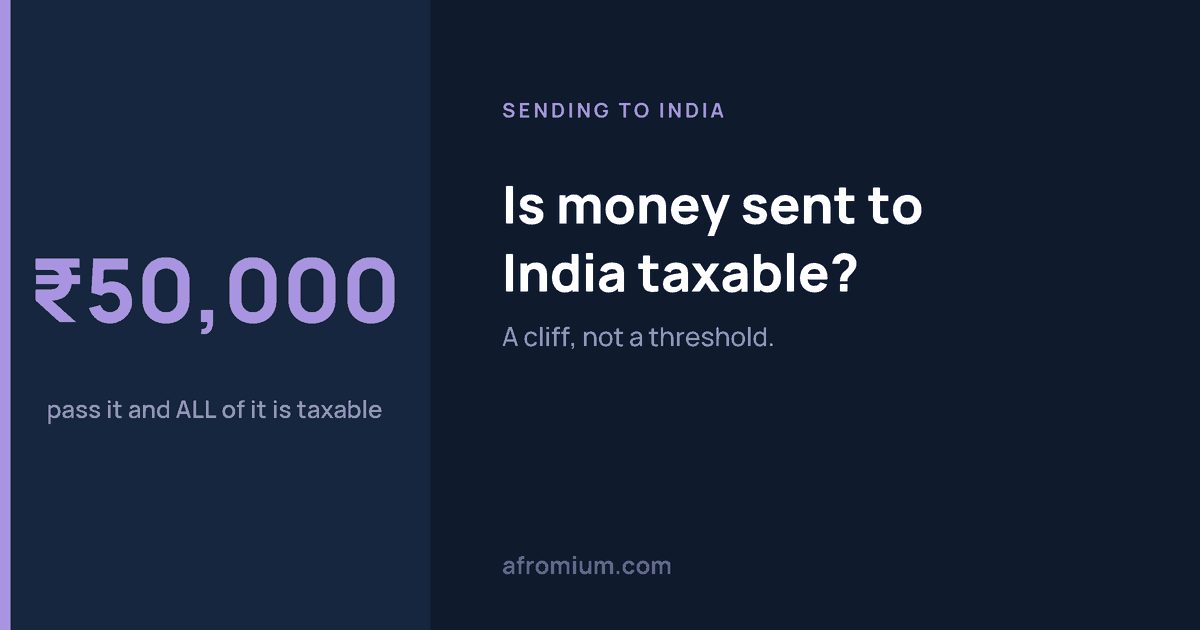
Money you send to a close relative in India is exempt, with no upper limit. Money sent to anyone outside that definition is taxable in their hands once the year’s total passes ₹50,000 — and past that line the entire amount is taxable, not just the excess. Whether your relationship counts is decided by a list, and the list is shorter and stranger than most people assume.
This page explains what India’s Income Tax Department publishes about money received as a gift. It is not tax advice, and it does not tell you what to do. For anything substantial, take professional advice.
First, the thing that causes most of the worry
Sending money to India does not create a tax bill simply by being an international transfer. The provision people are worried about — section 56(2)(x) — taxes money received without consideration: a gift, in ordinary language. It falls on the person receiving, not the person sending.
Two features of it matter before anything else.
It applies regardless of residential status. The Department states that the provision applies notwithstanding the residential status or class of the assessee, and that donor or donee may be resident or non-resident. Being an NRI sending from Germany does not put you outside it, and it does not put your recipient outside it either.
And the exemption for relatives has no ceiling. If the relationship qualifies, the amount is irrelevant.
The ₹50,000 cliff
For money from someone who is not a relative, the Department’s wording is unusually direct:
“The limit of Rs. 50,000 is not transaction-wise, and it shall be checked in aggregate for all transactions that happened during the year. If the aggregate of all transactions exceeds Rs. 50,000, the entire amount shall be chargeable to tax and not the amount in excess of Rs. 50,000.”
Two traps in one paragraph.
It is a cliff, not a threshold. ₹50,000 received is not taxable. ₹60,000 received does not make ₹10,000 taxable — it makes ₹60,000 taxable. There is no tapering and no allowance carved out below the line.
It aggregates across the year. Five separate payments of ₹15,000, each comfortably under the limit, total ₹75,000 — and the whole ₹75,000 is chargeable. People who would never send ₹75,000 at once assume small regular amounts are safe. On this provision they are not.
The chargeable amount is taxed under the head income from other sources.
Who counts as a relative
Everything turns on this list. It is set out by the Income Tax Department, and these persons are treated as a relative:
- Spouse of the individual
- Brother or sister of the individual
- Brother or sister of the spouse of the individual
- Brother or sister of either of the parents of the individual
- Any lineal ascendant or descendant of the individual
- Any lineal ascendant or descendant of the spouse of the individual
- Spouse of any of the persons in the four categories above
So parents, grandparents, children, grandchildren, siblings, parents-in-law, siblings-in-law, uncles and aunts are all in. The ordinary case — sending money home to a parent, a spouse or a sibling — is exempt, with no limit, and most readers can stop here.
Two things about that list nobody expects
Cousins are not on it. A cousin is neither a sibling, nor a sibling of a parent, nor a lineal ascendant or descendant. However close the relationship in life, it does not appear in the definition.
And the list is not symmetrical. This is the genuinely counter-intuitive part, and it follows from the list being written from the point of view of the person receiving.
“Brother or sister of either of the parents” means your uncle or aunt is your relative. So money from an uncle to a nephew is received from a relative.
Now reverse it. Is a nephew on an uncle’s list? A nephew is not a sibling, not a sibling of a parent, and not a lineal descendant — a lineal descendant is a child or grandchild, not a sibling’s child. So the same pair of people can be relatives in one direction and not the other.
| Money flows | Is the sender a relative of the recipient? |
|---|---|
| Uncle or aunt → nephew or niece | Yes — sibling of a parent |
| Nephew or niece → uncle or aunt | No — not on the recipient’s list |
| Parent ↔ child | Yes, both directions |
| Sibling ↔ sibling | Yes, both directions |
| Cousin → cousin | No |
An NRI supporting an elderly uncle is in a different position from an NRI uncle supporting a student nephew, on the same facts and the same amounts. That is not an oversight in our reading — it is what the definition says, and it is the single most useful thing on this page.
What is not caught at all
The provision taxes money received without consideration. That word is doing real work.
Money that is not a gift is not in scope of this provision in the first place. Paying someone for work done, repaying a loan, settling an invoice, or moving your own money into your own Indian account are all different transactions with different treatment. Sending money to your own NRE or NRO account is not a gift to anybody — you have not given it away. Which account you send it to has consequences of its own, and we set those out in NRE or NRO: which account should the money go to.
The Department’s guidance also describes exceptions beyond the relative exemption, including gifts on the occasion of an individual’s marriage and amounts received under a will or by inheritance. If one of those applies to you, read the exception itself rather than relying on a summary.
What we are not telling you
Three limits on this page, stated plainly.
It says nothing about tax where you live. Whether sending money creates any obligation for you in Germany, the UK, the US or Canada is a separate question under a different country’s law, and this page does not touch it.
It is not the whole of Indian tax law. Section 56(2)(x) also covers immovable property and specified movable property, with different thresholds and different aggregation rules. We have deliberately confined this to money, because that is what our readers send.
We publish no worked calculations. Rates, slabs and surcharges depend on the recipient’s total income and circumstances, and a worked example would look like advice about a situation we know nothing about.
Questions people ask
Is money I send to my parents in India taxable?
Parents are lineal ascendants and therefore relatives, so a gift to them is exempt under the relative exemption, with no upper limit stated.
Is there a limit on sending to a relative?
Not for this provision. The ₹50,000 figure is the threshold for money from people outside the definition of relative. It does not cap what may be received from a relative.
What if I send ₹60,000 to a friend?
The aggregate for the year exceeds ₹50,000, so the whole ₹60,000 is chargeable in their hands as income from other sources — not ₹10,000.
Do several small transfers avoid it?
No. The Department states the limit is not transaction-wise and is checked in aggregate across the year.
Is a cousin a relative?
Not under this definition. Nor, in that direction, is a nephew or niece sending to an uncle or aunt — although an uncle or aunt sending to a nephew or niece does qualify.
Does being an NRI change it?
Not for this provision. It applies notwithstanding residential status, and donor or donee may be resident or non-resident.
How we checked this
Read on 25 September 2026, both from the Income Tax Department of India: its page on Deemed Income [Section 56(2)(x)], last updated 30 April 2026, for the application notwithstanding residential status, the resident or non-resident status of donor and donee, the ₹50,000 monetary threshold, the aggregation rule across the year, and the statement that the entire aggregate rather than the excess is chargeable; and its FAQ answer on gifts received from relatives, last reviewed 22 September 2026, for the seven categories of relative quoted above.
We have used the Department’s own pages rather than any bank’s, broker’s or advisory firm’s summary of them, and we have quoted the aggregation rule directly because paraphrasing it is how the cliff gets lost.
Afromium is not a tax adviser and this page is not tax advice. It sets out what the Income Tax Department of India publishes about money received without consideration, read on the date above. Tax law changes, individual circumstances differ, and your own country’s rules are a separate matter. Take professional advice before acting, particularly where a large sum, a property or an inheritance is involved.