Author: Mohammed D

  • Bank Deposit, Cash Pickup, or Mobile Wallet: How Should Money Arrive in Nigeria?

    Bank Deposit, Cash Pickup, or Mobile Wallet: How Should Money Arrive in Nigeria?

    Last reviewed 19 September 2026 · Sources checked on the publication date

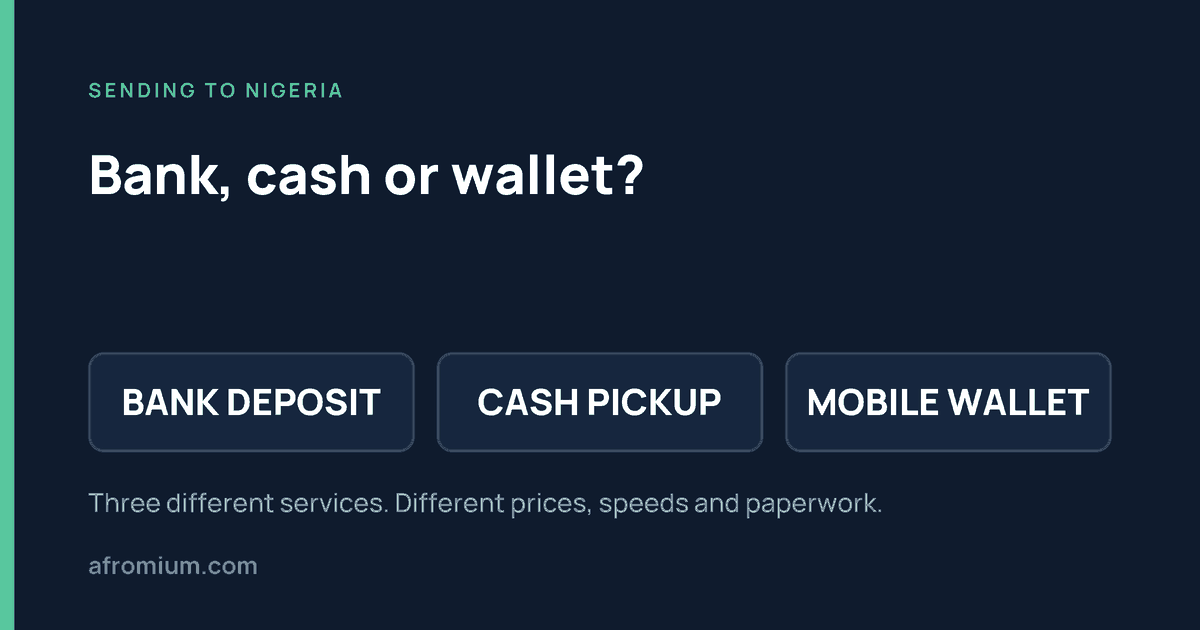
    Before comparing exchange rates for a transfer to Nigeria, ask the recipient a more basic question: How can they receive the money comfortably? Bank deposit, cash pickup, and mobile wallet are different services. Their availability, requirements, prices, and delivery estimates may differ even within the same provider.

    Remitly lists all three delivery categories for transfers from Germany to Nigeria. That does not mean every category is available for every recipient or location. Check the provider’s live quote and payout network for the exact transfer you intend to make.

    Bank deposit

    With bank deposit, the provider sends the payout to an eligible account in Nigeria. This may be convenient for a recipient who already uses that account: they do not need to travel to collect cash. It also creates a clear account record for the recipient to check.

    The main preparation is getting the bank details right. Ask the recipient to confirm the account holder’s name, bank, and account number. Requirements vary by provider. As one example, Wise’s NGN guide lists a full name, bank code, and 10-digit account number for its bank payouts. A typo can delay a transfer or cause it to be returned; Wise explains what happens when recipient bank details are wrong.

    Bank deposit is a sensible first option when the recipient has a usable account and does not need physical cash immediately. Check the provider’s supported banks and current estimated arrival time before paying.

    Cash pickup

    Cash pickup allows a recipient to collect money at a participating location. It can be useful when they prefer cash or cannot conveniently receive a bank deposit. The practical details matter: the pickup location must be reachable, open when the recipient can visit, and able to pay out through the provider’s network.

    The recipient generally needs valid identification and transfer information. Remitly’s explanation of cash pickup says a recipient typically presents photo ID and a tracking number, with the name on the ID matching the transfer details. Requirements can vary by partner and location, so confirm them in the sending flow and share the collection instructions with the recipient securely.

    Ask about travel time and any inconvenience before choosing a quote that looks better by a small amount. A higher payout on paper may be less useful if collecting it is difficult.

    Mobile wallet

    A mobile wallet payout goes to a supported wallet rather than directly to a conventional bank account or a cash counter. In Nigeria, the wallets people commonly use are fintech accounts such as OPay, PalmPay, Moniepoint and Kuda rather than telecom-run mobile money. Which of them a transfer service can pay out to varies by provider and can change, so this option only exists when the service supports that exact wallet for the chosen route and the recipient has the details required to receive the funds.

    Do not assume that “mobile money available in Nigeria” means every wallet, phone number, or recipient is eligible. Confirm the exact wallet in the provider’s checkout flow. Ask the recipient whether they can use or withdraw the funds in the way they need; that practical step can matter as much as the quoted payout.

    Compare like with like

    Pick the method that works for the recipient, then compare providers within that method — same total EUR paid, same funding method — and record the final NGN payout and the delivery estimate. Transfer fee vs exchange rate explains how to read those numbers, and first-transfer offers why a welcome rate should be judged separately.

    If one method is unavailable, run the comparison again for the alternative. The answer can change when you switch from bank deposit to cash pickup or from a bank-funded payment to a card-funded one. The best delivery method is the one the recipient can actually use, at a cost and speed both of you understand.

    Related

  • Is a First-Transfer Offer Really the Cheapest Way to Send Money?

    Is a First-Transfer Offer Really the Cheapest Way to Send Money?

    Last reviewed 19 September 2026 · Sources checked on the publication date

    Money-transfer services sometimes offer new customers a special exchange rate, a reduced fee, or both. These offers can be valuable. They can also make a provider look cheaper in a comparison that a repeat customer cannot actually use.

    For example, Remitly’s Germany → Nigeria page advertises a new-customer offer and links to its conditions. The rate, eligible amount, funding method, and offer period can change. Read the current terms and the final checkout quote rather than relying on a screenshot from another date.

    Start with the question: Am I eligible?

    An introductory offer may apply only to a new account, the first qualifying transfer, a particular currency route, or a limited portion of the amount sent. A fee waiver may have different conditions from a promotional exchange rate. The provider’s promotion terms and your checkout summary determine what applies to you.

    Avoid assuming that a welcome rate covers the entire transfer. If the promotion has an amount cap, the provider may apply its standard rate to the remainder. Also check whether changing the payment or payout method changes eligibility.

    Compare the first transfer separately

    Request a quote using your actual customer status: new customer if you qualify, existing customer if you do not. Then compare the way Transfer fee vs exchange rate describes — same total paid, same funding and delivery method, judged by the NGN the recipient is shown to receive.

    You can still display the introductory offer in a comparison, but label it plainly. A reader should never mistake a limited first-transfer rate for the regular price. If an offer expires or the provider changes its terms, update or remove the quoted figures promptly.

    Then consider the next transfer

    If you expect to send money regularly, request a standard-rate quote as well. The provider with the highest payout on your first transfer may be different from the provider with the highest payout next month.

    Here is a hypothetical illustration, not a current provider quote:

    NGN received for the same total EUR paidService AService B
    First transfer810,000795,000
    Second transfer at standard rate770,000795,000
    Total across two transfers1,580,0001,590,000

    Service A wins the first comparison in this example, while Service B delivers more across two transfers. You are free to compare again and use a different service next time; the table simply shows why “best for a first transfer” and “best for regular transfers” are different questions.

    A five-point offer check

    1. Who qualifies? Check new-customer and location requirements.
    2. What is covered? Look for an amount cap, eligible route, funding method, and payout method.
    3. What happens above the cap? Check the standard rate and any fee on the remainder.
    4. When does it end? Offers can have an expiry date or change before you send.
    5. What reaches the recipient? Compare the final payout for the same total amount you pay.

    A good deal is the one shown in your final quote for a transfer you are eligible to make. Save that quote before sending, and make a fresh comparison when you send again.

    Related

  • Why Is My International Money Transfer Taking Longer Than Expected?

    Why Is My International Money Transfer Taking Longer Than Expected?

    Last reviewed 19 September 2026 · Sources checked on the publication date

    An estimated delivery time helps you plan, but it is not the same as a guaranteed arrival time for every transfer. A payment from Germany to Nigeria can pass through several stages before the recipient sees it. Knowing which stage is delayed makes it easier to decide what to do next.

    The three stages to check

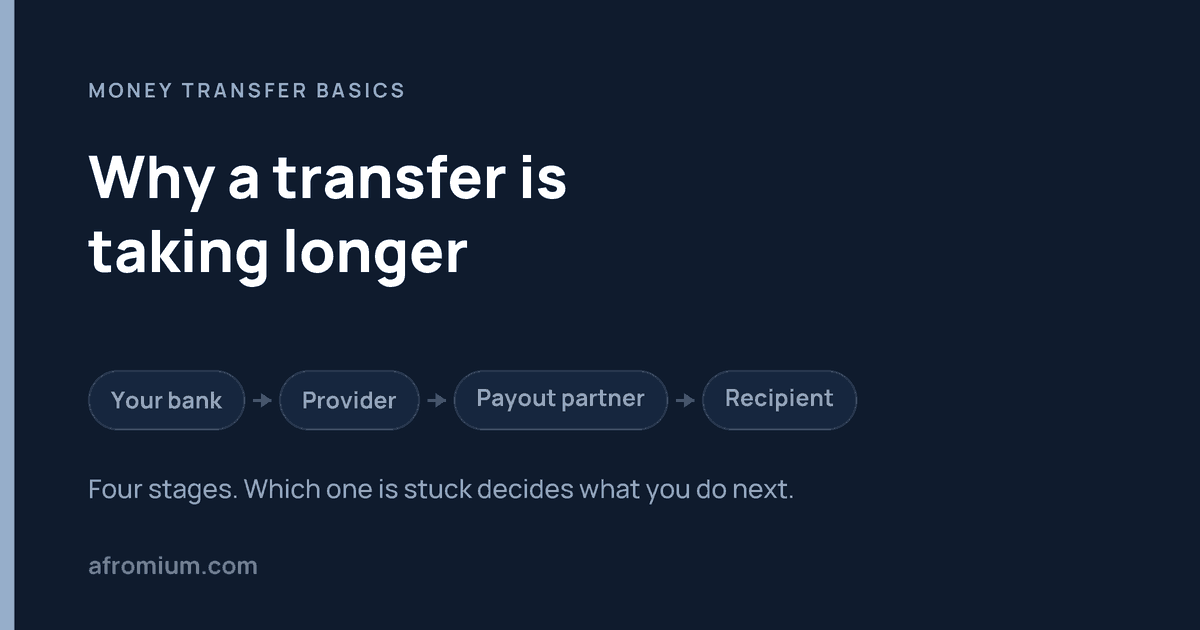
    First, your payment must reach the transfer provider. If you funded the transfer from a bank account, the provider may still be waiting for that payment. Second, the provider processes the transfer, including currency conversion and any required checks. Third, the payout goes to the recipient’s bank, wallet, or pickup partner.

    Wise describes these stages in its explanation of delayed transfers. Your provider’s tracker may use different labels, but the question is the same: Has it received your money, processed the transfer, and sent the payout?

    Common reasons for a delay

    The funding method takes time. A bank-funded payment may take longer to reach a provider than a card payment. Faster funding can have a different fee, so compare both price and timing before choosing it.

    Additional checks are needed. A service may request identity documents or other information before completing a transfer. Watch for a notification in your account or an email from the provider, and respond through its official app or website.

    Banks and payout partners have their own processing time. A provider can mark the transfer as sent before the recipient’s bank credits the account. Weekends and public holidays can also affect processing. Wise notes these factors; Remitly says its delivery times depend on payment and delivery methods, transaction review, and system availability.

    Recipient details are incorrect. A name or account-number error can cause extra checks, rejection, or a return. Wise explains that a mistaken recipient bank detail may need to be corrected or may result in a returned payment. This is why checking with the recipient before sending is easier than fixing details afterward.

    What to do if the money has not arrived

    1. Open the transfer in the provider’s official app or website and read its latest status and delivery estimate.
    2. Check whether the provider is waiting for your payment or has asked you for information.
    3. Confirm the recipient details against what the recipient provided. For bank deposit, ask the recipient to check their account activity; for cash pickup, check whether the payout is ready and which location can release it.
    4. Keep the transfer confirmation or receipt. If the provider says the money was sent but the recipient’s bank cannot find it, the receipt may help the bank trace it. Wise gives this advice in its transfer-status guide.
    5. If the latest estimate has passed, contact the provider through its official support channel with the transfer reference. Avoid sending another transfer until you understand what happened to the first one.

    If you have not yet sent and arrival time is important, compare the estimate shown for your exact amount, payment method, and payout method. Allow some room for checks or bank processing. The quickest advertised transfer is not automatically the quickest option available to your recipient today.

    Related