Last checked 30 September 2026
Once you have chosen a transfer service, it asks how you want to pay. Bank transfer is usually the cheapest. A debit card can be worth a little more when speed matters. A credit card needs the most care, because your card issuer may add charges that never appear in the transfer service’s quote.
Do not decide on the fee line alone. Compare three things: the total that leaves your account, how quickly the transfer can start, and how much the recipient will receive.
The same transfer, five prices
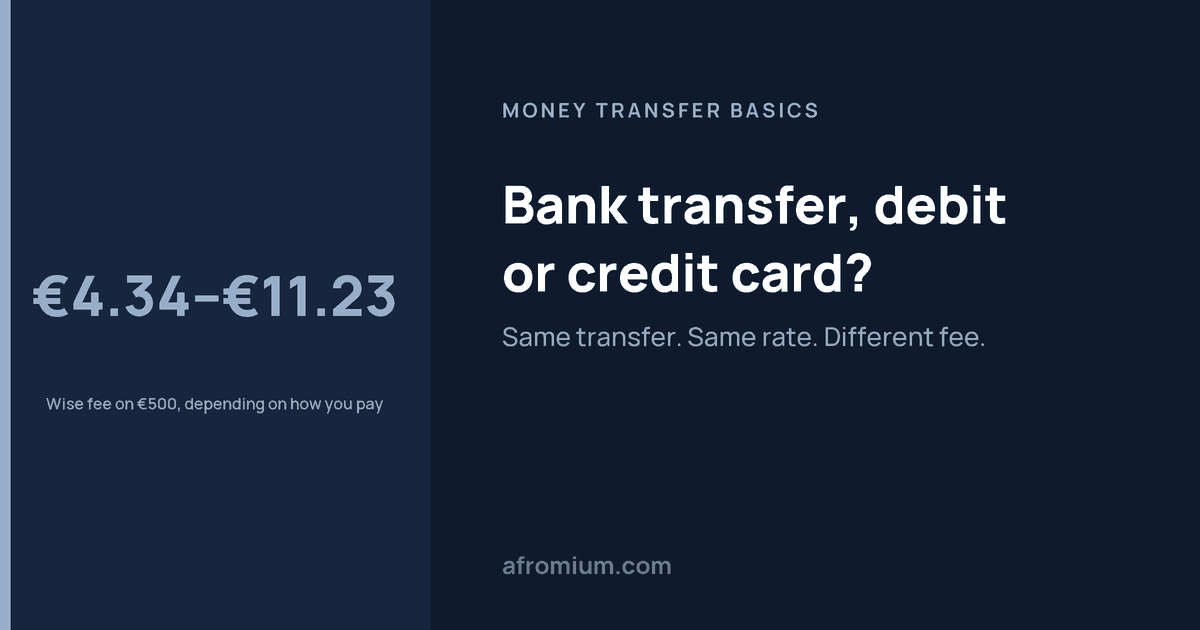
Here is what Wise’s own price data showed on 30 September 2026 for one transfer: €500 from Germany to a Nigerian bank account, with only the payment method changed.
| Paid by | Wise’s total fee | Recipient gets |
|---|---|---|
| Bank transfer | €4.34 | ₦768,297.78 |
| Visa debit card | €6.10 | ₦765,569.70 |
| Mastercard debit card | €8.25 | ₦762,237.09 |
| Visa credit card | €9.61 | ₦760,129.02 |
| Mastercard credit card | €11.23 | ₦757,617.94 |
The exchange rate was the same, ₦1,550.05 per euro, whichever way you paid. Only the fee changed. Paying by Mastercard credit card instead of bank transfer cost the recipient about ₦10,680. Even the card network mattered: on this transfer, a Visa debit card was €2.15 cheaper than a Mastercard debit card.
These are one provider’s prices at one moment. Other services price payment methods differently, and Wise’s own prices change. Business cards cost far more: a Mastercard business debit card was €22.42 on the same transfer. At Wise, the final fee for your card is shown at the payment step, before you pay.
Bank transfer: usually cheapest, sometimes slower
If the money is already in your bank account and there is no rush, price the bank-transfer option first. Wise says on its Germany to Nigeria page that bank transfers “are usually the cheapest option”, though it adds that bank transfers “can be slower than debit or credit cards”.
The catch is timing, because there are two transfers:
- your bank sends the money to the transfer service;
- the transfer service pays it out to the recipient.
The second usually does not start until the first has arrived. For euro transfers, Wise says it “usually takes 1–2 working days” for your money to reach it, “depending on how you pay”. So a service advertising delivery “in minutes” is not promising minutes from the moment you pay by bank transfer. Go by the estimate shown for the payment method you selected.
Some services let you pay straight from your online banking inside their app. Wise calls this PISP, and offers it in Germany and several other EU countries. On the transfer above, it cost the same as a bank transfer. Why a transfer takes longer than expected covers the other common delays.
Debit card: the practical middle option
A debit card helps when you want to send now without waiting for a bank payment to arrive. The service knows at once whether the card payment was approved. You usually pay a little more for that convenience: €1.76 to €3.91 more than a bank transfer in the Wise example above.
Put the difference into what the recipient gets. In the example, the Mastercard debit card cost the recipient about ₦6,060 compared with a bank transfer. That is the price of the faster start. If the recipient needs the money today, it may be worth it. If the money can arrive tomorrow, you are paying for nothing.
Credit card: check the card’s own charges first
The transfer service can tell you what it charges. It cannot tell you what your card issuer will charge. Wise explains why. It marks card payments for transfers with a merchant code meaning a wire or money order. Some banks then treat the payment as a “cash advance” or “cash withdrawal”, and “this could come with an extra charge”. Wise adds that this is “totally at the discretion of the bank that issued your card”.
Cash advances on credit cards often carry their own fee, and interest can start straight away rather than after a grace period. The exact terms depend on your card. So if the service shows a €11.23 fee on €500, do not assume your total cost is €511.23 until you have checked your card’s terms, or called the issuer. Do not choose a credit card just because the service says it is fast.
One more trap: pay with a card in the currency you are sending from. Wise warns that if your card is in a different currency, your bank converts the payment first. “It’s likely to add an extra cost on top of your Wise fee.”
Compare the recipient amount, not the payment fee
For each payment method, compare:
- the amount you pay;
- the service’s fee;
- the exchange rate;
- any charge from your bank or card issuer;
- what the recipient finally receives.
At Wise the rate stayed the same across payment methods, but not every service works that way. If a service offers a better rate for one method and a higher fee, only the recipient amount tells you which is cheaper. Transfer fee vs exchange rate explains how the two combine.
Speed has a price, so make sure you need it
“Instant” sounds better than “one working day”, but it is not worth paying for every time. If bank payment costs €1 and a card costs €6, you pay €5 for speed. Twice a month, that is €120 a year.
If the recipient needs the money every Friday, the cheaper fix may be to start the transfer a day or two earlier rather than paying for speed each time. Speed is worth paying for when something is genuinely urgent. When bad timing makes it urgent every month, it becomes an expensive habit.
The payment method can change how much you can send
Limits often differ by payment method. For euro transfers, Wise allows up to €10,000 per transfer by card, and far more by some other methods, such as Trustly or money already in a Wise account. Your own bank may also cap card payments. If you need to send €12,000 and a card will only cover €10,000, a bank transfer may be the practical choice.
Do not split a payment into smaller ones to get around a service’s verification checks, compliance controls or reporting rules. If the service asks for documents on a larger transfer, provide them. One large transfer or several small ones? covers the legitimate reasons to split, and the costs.
Your bank can decline a legitimate card payment
A service can accept cards while your bank still declines the payment. Banks run their own fraud checks. A foreign company, an unusually large payment, repeated attempts, or spending unlike your usual pattern can all trigger a decline. That does not mean the transfer service has rejected your transfer.
Before trying again and again, read the message from the service and check with your bank. Repeated attempts can leave several pending or failed payments on your account, which makes it harder to see what happened.
A manual bank transfer needs exact details
A card payment is linked to your transfer automatically. A manual bank transfer may mean sending money to the service’s own bank account, with a reference the service gives you. Use that reference exactly. If it is missing or wrong, the service may not be able to match your payment to your transfer.
Before you send, check the account name the service gave you, the bank details, the reference, the exact amount and the currency. Copy them rather than typing from memory.
Card rewards rarely justify a credit card
Points, miles or cashback can make a credit card tempting. Do the sum first. A €3 reward does not help if the card adds €10 in fees or interest. Your card may not give rewards for this kind of payment at all; its terms will say. Treat rewards as a possible discount after checking the costs, not as a reason to use credit.
Compare services using the same payment method
This is easy to miss. If you price service A by bank transfer and service B by debit card, the comparison is not fair. Compare bank transfer with bank transfer, or card with card. A hypothetical example:
| Service A | Service B | |
|---|---|---|
| You spend | €500 | €500 |
| Paid by | Debit card | Debit card |
| Total fees | €4 | €6 |
| Recipient gets | ₦780,000 | ₦786,000 |
B charges €2 more but delivers ₦6,000 more. Then repeat the comparison with bank payment, if both services offer it. The cheapest service can change when the payment method changes. For the wider comparison with your own bank, see bank transfer or money transfer app.
Which to choose
- Bank transfer: when the transfer is planned, the recipient can wait, and it is the cheaper option.
- Debit card: when timing matters enough to justify the difference. Check whether a different card network is cheaper.
- Credit card: only after checking both the service’s fee and how your card issuer treats the payment.
For a regular transfer, check again from time to time, because prices change. The check takes less than a minute. On the quote screen, switch the payment method and watch what happens to the total you pay and the amount the recipient gets. If you are also thinking of changing service, see whether to keep using your app or switch.
How we checked this
The Wise figures come from the public price data behind Wise’s calculator. We retrieved them at 12:02 UTC on 30 September 2026, for a personal customer in Germany sending €500 to a Nigerian bank account, and kept a copy on file. We did not make a transfer. Each recipient amount matches (€500 minus the fee) × ₦1,550.05.
We also read, on the same day:
- Wise’s help article on unexpected card charges, for the merchant code, cash-advance treatment and card-currency conversion;
- Wise’s help article on paying by card;
- Wise’s guide to EUR transfers, for the time it takes money to reach Wise, the €10,000 card limit and PISP;
- Wise’s Germany to Nigeria page, for its description of each payment method.
The Service A and B example is hypothetical.
Sources
- Wise help centre: Why was I charged extra?
- Wise help centre: How to pay by card
- Wise help centre: Guide to EUR transfers
- Wise: Send money to Nigeria from Germany
Afromium does not make test transfers and does not give financial advice. Card fees, limits and exchange rates change. Your card issuer decides how it treats a payment to a transfer service, so check your card’s terms before paying by credit card.