Last checked 30 September 2026
You need to send €1,000. One transfer, or four of €250? Start with how the provider charges. When every transfer carries a fixed fee, one larger transfer usually costs less. When the fee is mostly a percentage, splitting costs about the same. Recipient limits, cash-out charges, timing and whether you have used that account before can all change the answer.
There is also one good reason to split that has nothing to do with price: a small first payment proves the recipient details work before the large one goes.
What a real fee schedule does to a split
These are Wise’s own quotes for Germany to Nigeria, captured for our Germany to Nigeria comparison on 29 September 2026. The fee is taken out of the amount you send, and the rate was the same at every amount, ₦1,556.50:
| Plan for €1,000 | Fees paid | Recipient gets in total | Compared with one transfer |
|---|---|---|---|
| One transfer of €1,000 | €7.62 | ₦1,544,639.47 | — |
| Two transfers of €500 | €8.68 (2 × €4.34) | ₦1,542,989.58 | ₦1,650 less |
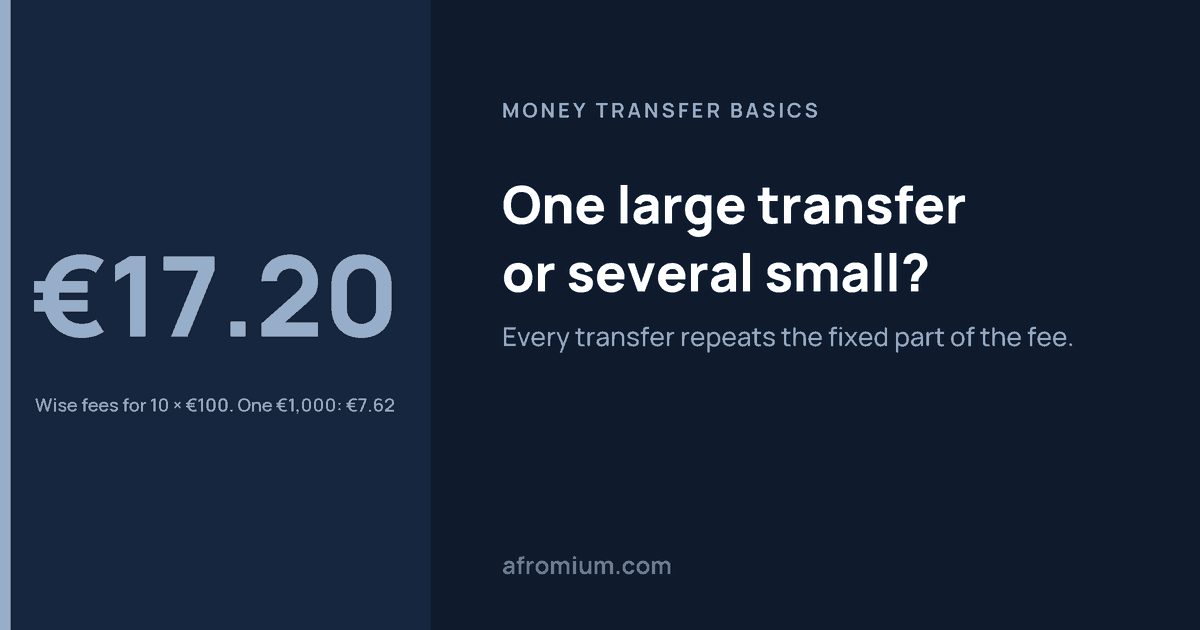
| Ten transfers of €100 | €17.20 (10 × €1.72) | ₦1,529,728.20 | ₦14,911 less |
The fee does not grow in step with the amount — €1.72 on €100, €7.62 on €1,000 — because part of it is a fixed charge that repeats on every transfer. Splitting into two costs little. Splitting into ten costs the recipient nearly ₦15,000. The totals assume the rate holds between transfers, which in real life it would not; the fee effect is what the table shows.
Fixed fees and percentage fees behave differently
With a flat €3 per transfer — an illustration — the arithmetic is blunt:
| Plan | Transfers | Fees paid |
|---|---|---|
| €1,000 once | 1 | €3 |
| €500 twice | 2 | €6 |
| €250 four times | 4 | €12 |
| €100 ten times | 10 | €30 |
With a pure 1% fee and no minimum, €1,000 once costs €10, and four transfers of €250 cost €2.50 each — also €10. Splitting changes nothing. Most real schedules are a mix, like Wise’s above, and some also vary by payment method or change the rate at certain amounts. So compare actual quotes, not the fee formula: quote the full amount, then quote the smaller amount and multiply what the recipient gets by the number of transfers.
The rate can change with the amount
Do not assume a €100 quote scales to €1,000. On the same afternoon, Ria’s calculator gave ₦1,528.19 per euro at €100 and ₦1,546.12 from €500 upward — and at €100 it added a €1.00 fee on top, waived only for a first transfer. At Ria, ten small transfers would have been worse on both counts.
It can occasionally run the other way. An illustration:
| One €1,000 transfer | Four €250 transfers | |
|---|---|---|
| Fee per transfer | €5 | €2 |
| Total fees | €5 | €8 |
| Rate | 1,565 | 1,570 |
| Amount converted | €995 | €248 × 4 |
| Recipient gets | 1,557,175 | 1,557,440 |
More fees, better rate, and the split wins — by 265 units of the recipient’s currency. That is why fees alone are a weak comparison. Compare the final amount received; our “Recipient gets” calculator does the sum for each quote.
A test transfer is worth paying for with a new recipient
This is the one case where an extra fee is money well spent. Sending a large amount to an account or wallet you have never used? A small first transfer confirms that:
- the account or wallet details were entered correctly;
- the provider accepts the receiving bank or wallet;
- the recipient can see and identify the payment;
- the payout method works as expected.
Send €20 or €50, wait until the recipient confirms it has arrived, then send the rest. It costs a little more than one transfer, and far less than a large payment to a wrong account — which is often very hard to get back. Our guides to Nigerian account numbers and sending to the wrong GCash number show why. Once the route is proven, repeating test payments stops being useful.
Check the receiving side’s limits first
The sender’s app is only half the transfer. The receiving wallet, bank or provider may cap what can arrive, and a single large transfer can fail even when the sender’s provider allows it. Two limits we have checked on this site:
- GCash: Wise and WorldRemit both cap a transfer to a GCash wallet at ₱50,000, and the wallet itself has limits by account level — see sending money to GCash from abroad.
- bKash: bKash accepts up to BDT 2,50,000 per remittance, but Wise and Taptap Send cap sending to bKash at BDT 450,000 a month — see bKash remittance not received.
Limits change, so ask the recipient to check their current account level and limits in the wallet itself before a large transfer. Do this before comparing prices: a cheap quote that cannot be received is not a useful quote.
Cash-out costs can change the answer
Money arriving in a wallet is not the same as cash in hand. If the recipient pays a flat percentage to withdraw, splitting makes no difference: 2% of 100,000 is 2,000, and four withdrawals of 25,000 at 2% also cost 2,000. But many schedules are tiered, have minimums, or charge differently depending on where the money is taken out — bKash, for instance, charges far less per thousand for remittance cashed out at certain ATMs than at an agent. We compare these in what it costs to cash out a mobile wallet. If the recipient will withdraw straight away, include that cost.
Splitting buys timing flexibility — at a visible price
If you support someone with €600 a month, sending €300 twice may fit their spending better, and half the money stays with you until later in the month. But if the extra transfer costs €4, two transfers a month instead of one is €48 a year in extra fees, assuming the fee stays the same. That may well be worth it. At least it is a number you chose.
Splitting does not beat the exchange rate
Four transfers on four dates get four rates. Say €250 each went at 1,540, 1,570, 1,520 and 1,590 — an illustration. The average is 1,555. If one €1,000 transfer would have got 1,570, splitting did worse; if it would have got 1,530, splitting did better. You only find out afterwards. Split for fees, recipient needs, limits or a test payment — not as a way to outguess the market. If timing the rate is the real question, see should you wait for a better rate or send now.
Do not split to get around checks
There is a firm line here. Do not break a payment into smaller ones to avoid identity checks, transfer limits, compliance reviews, source-of-funds questions or reporting requirements. If a provider asks for documents on a €5,000 transfer, ten transfers of €500 are not a legitimate way round it — providers look at activity over time, not one payment at a time, and doing it deliberately can get an account closed. If you need to send an unusually large amount, check the provider’s limits and document requirements first and send it properly.
Compare both plans on the same total budget
Fix what you spend, including fees, and compare what arrives. With €1,000 in total, quote one transfer of €1,000 all-in; then quote €250 all-in and multiply the recipient amount by four. An illustration:
| One transfer | Four transfers | |
|---|---|---|
| Total you spend | €1,000 | €1,000 |
| Number of transfers | 1 | 4 |
| Recipient gets in total | 1,560,000 | 1,548,000 |
| Difference | 12,000 less |
Here one transfer wins by 12,000. But change one fact — the wallet cannot take the full amount, or the account has never been used — and the cheaper option on paper stops being the sensible one. Do not compare €1,000 sent once with €250 sent once; compare the totals.
When each option makes sense
- One transfer when the recipient details are proven, the full amount is needed, the payout method can take it, and the provider charges a fixed part on every transfer.
- Several transfers when the recipient needs the money at different times, a genuine receiving limit applies, or you want a small test payment before a large balance.
- Anything else: quote both versions and compare what the recipient receives in total.
How we checked this
The Wise and Ria figures are quotes from each provider’s public Germany calculator, captured for our Germany-to-Nigeria comparison between 15:05 and 15:21 UTC on 29 September 2026; the split totals are our arithmetic on those quotes, assuming the same rate for every transfer. The GCash and bKash limits come from the provider and wallet pages cited on the linked guides, read on 23 and 30 September 2026. Tables marked as illustrations use made-up round numbers; we checked each sum.
Sources
- Afromium: Germany to Nigeria comparison, quotes captured 29 September 2026
- Wise: send money to Nigeria from Germany
- Ria: send money to Nigeria from Germany
- Wise help centre: Guide to BDT transfers
- Wise help centre: Guide to PHP transfers
Afromium does not make test transfers and does not give financial advice. Quotes shown here were captured at one moment and have since changed; limits and fee schedules change too. Confirm the final amount and any limits on the provider’s own screen before you pay.