Author: Mohammed D

  • Before You Send Money from Germany to Nigeria: 6 Things to Check

    Before You Send Money from Germany to Nigeria: 6 Things to Check

    Last reviewed 19 September 2026 · Sources checked on the publication date

    Sending money to Nigeria involves more than finding the lowest advertised fee. Before choosing a service, decide how the recipient will collect the money, compare the final amount they will receive, and check when it is expected to arrive. These steps matter whether you send €50 or €500.

    This guide is the checklist. It does not rank providers or display live quotes — our Germany → Nigeria comparison will do that once our provider quotes are published. Exchange rates, fees, and delivery methods can change between the time you read this page and the time you send.

    1. Ask the recipient how they want to receive the money

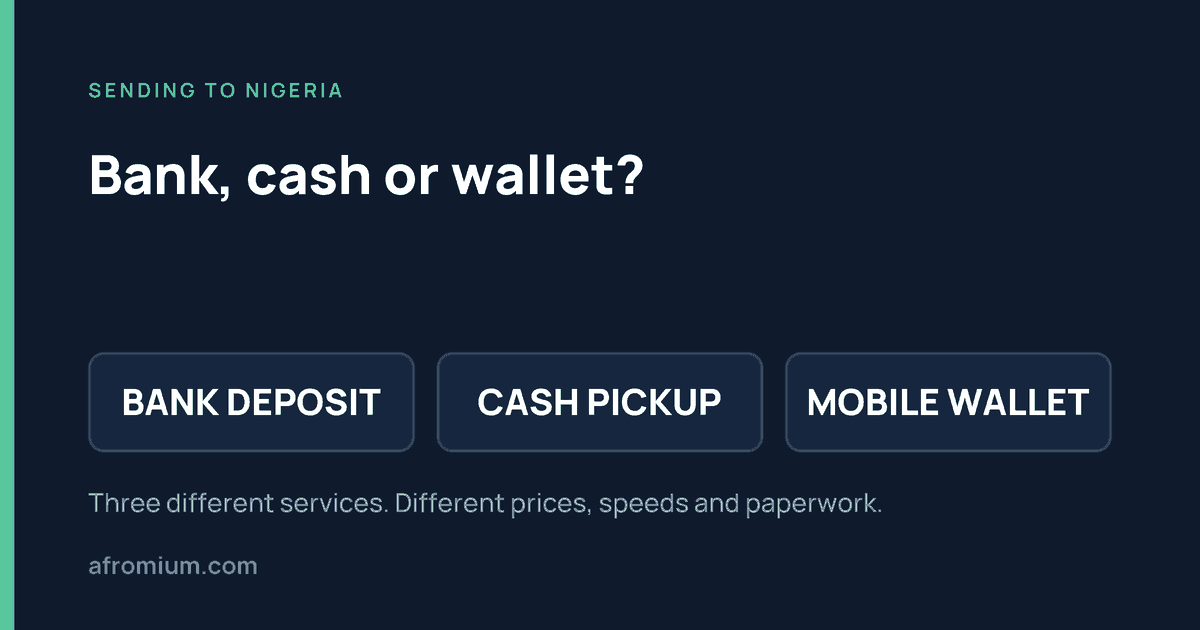
    A bank deposit may be convenient if the recipient has an account they use regularly. Cash pickup may suit someone who can reach a participating location and bring the required identification. A mobile wallet works only if the recipient has a supported wallet and the chosen service offers that payout option for the transfer.

    Provider options differ. For example, Wise describes NGN transfers to Nigerian bank accounts, while Remitly lists bank deposit, cash pickup, and mobile wallet options on its Germany → Nigeria page. Check the exact option and participating bank, wallet, or pickup network inside the provider’s quote before proceeding. Our guide to bank deposit, cash pickup and mobile wallet walks through the trade-offs.

    Choose the delivery method first. Comparing a bank deposit from one provider with a cash pickup from another may hide differences in cost and convenience.

    2. Set one total budget

    Decide how much you can spend in euros including any transfer fee. Some services include their fee within the amount you enter; others show a fee added at checkout. If you enter “€500 to send” in both places without checking the total debit, you may end up comparing two different purchases.

    The clearest figure is NGN the recipient will receive for the same total EUR paid. A low fee does not automatically mean more money arrives — the exchange rate matters as much. Transfer fee vs exchange rate shows the arithmetic with a worked example.

    3. Keep the payment method the same

    Paying by bank transfer, debit card, or another method can change the fee and delivery estimate. Compare providers using the same funding method wherever possible. If a faster card-funded transfer costs more, treat it as a separate choice: you may decide the extra cost is worthwhile, but it should be visible.

    Look closely at the quote summary immediately before confirming. The final amount can differ from an earlier marketing example or a rate shown on a provider’s home page.

    4. Separate the welcome offer from the standard rate

    New-customer rates and fee waivers are real savings on a first transfer, but they are not the price you will pay next month. Note whether a quote is a promotion or the standard rate, and if you send regularly, compare both — first-transfer offers explains why the winner can change.

    5. Check recipient details

    Ask the recipient to confirm their legal name and their bank, wallet, or pickup details. For a Wise NGN bank transfer, Wise says it needs the recipient’s full name, bank code, and 10-digit account number. Other services and payout methods have different requirements. Never assume that an old saved recipient record is still correct.

    6. Treat the arrival time as an estimate

    Funding method, identity checks, bank processing, weekends, and holidays may affect delivery. Wise explains several common reasons for delays, and Remitly says delivery times vary by payment and delivery method, transaction review, and system availability. If timing is critical, look at the estimate for your exact transfer at checkout and tell the recipient that it may change. If a transfer is already late, this guide covers what to check.

    A quick check before you press Send

    • Is the total EUR you will pay within your budget?
    • Is the NGN the recipient will receive clearly shown?
    • Does the quote use the correct payment and payout methods?
    • Are you looking at a new-customer offer or the standard rate?
    • Has the recipient confirmed the name and account, wallet, or pickup details?
    • Have you saved the provider’s final quote and expected delivery time?

    The cheapest suitable option can change with the amount, payment method, payout method, and available promotions. Take a fresh quote each time you send rather than relying on the provider that was cheapest last month.

    Related

  • Bank Deposit, Cash Pickup, or Mobile Wallet: How Should Money Arrive in Nigeria?

    Bank Deposit, Cash Pickup, or Mobile Wallet: How Should Money Arrive in Nigeria?

    Last reviewed 19 September 2026 · Sources checked on the publication date

    Before comparing exchange rates for a transfer to Nigeria, ask the recipient a more basic question: How can they receive the money comfortably? Bank deposit, cash pickup, and mobile wallet are different services. Their availability, requirements, prices, and delivery estimates may differ even within the same provider.

    Remitly lists all three delivery categories for transfers from Germany to Nigeria. That does not mean every category is available for every recipient or location. Check the provider’s live quote and payout network for the exact transfer you intend to make.

    Bank deposit

    With bank deposit, the provider sends the payout to an eligible account in Nigeria. This may be convenient for a recipient who already uses that account: they do not need to travel to collect cash. It also creates a clear account record for the recipient to check.

    The main preparation is getting the bank details right. Ask the recipient to confirm the account holder’s name, bank, and account number. Requirements vary by provider. As one example, Wise’s NGN guide lists a full name, bank code, and 10-digit account number for its bank payouts. A typo can delay a transfer or cause it to be returned; Wise explains what happens when recipient bank details are wrong.

    Bank deposit is a sensible first option when the recipient has a usable account and does not need physical cash immediately. Check the provider’s supported banks and current estimated arrival time before paying.

    Cash pickup

    Cash pickup allows a recipient to collect money at a participating location. It can be useful when they prefer cash or cannot conveniently receive a bank deposit. The practical details matter: the pickup location must be reachable, open when the recipient can visit, and able to pay out through the provider’s network.

    The recipient generally needs valid identification and transfer information. Remitly’s explanation of cash pickup says a recipient typically presents photo ID and a tracking number, with the name on the ID matching the transfer details. Requirements can vary by partner and location, so confirm them in the sending flow and share the collection instructions with the recipient securely.

    Ask about travel time and any inconvenience before choosing a quote that looks better by a small amount. A higher payout on paper may be less useful if collecting it is difficult.

    Mobile wallet

    A mobile wallet payout goes to a supported wallet rather than directly to a conventional bank account or a cash counter. In Nigeria, the wallets people commonly use are fintech accounts such as OPay, PalmPay, Moniepoint and Kuda rather than telecom-run mobile money. Which of them a transfer service can pay out to varies by provider and can change, so this option only exists when the service supports that exact wallet for the chosen route and the recipient has the details required to receive the funds.

    Do not assume that “mobile money available in Nigeria” means every wallet, phone number, or recipient is eligible. Confirm the exact wallet in the provider’s checkout flow. Ask the recipient whether they can use or withdraw the funds in the way they need; that practical step can matter as much as the quoted payout.

    Compare like with like

    Pick the method that works for the recipient, then compare providers within that method — same total EUR paid, same funding method — and record the final NGN payout and the delivery estimate. Transfer fee vs exchange rate explains how to read those numbers, and first-transfer offers why a welcome rate should be judged separately.

    If one method is unavailable, run the comparison again for the alternative. The answer can change when you switch from bank deposit to cash pickup or from a bank-funded payment to a card-funded one. The best delivery method is the one the recipient can actually use, at a cost and speed both of you understand.

    Related

  • Is a First-Transfer Offer Really the Cheapest Way to Send Money?

    Is a First-Transfer Offer Really the Cheapest Way to Send Money?

    Last reviewed 19 September 2026 · Sources checked on the publication date

    Money-transfer services sometimes offer new customers a special exchange rate, a reduced fee, or both. These offers can be valuable. They can also make a provider look cheaper in a comparison that a repeat customer cannot actually use.

    For example, Remitly’s Germany → Nigeria page advertises a new-customer offer and links to its conditions. The rate, eligible amount, funding method, and offer period can change. Read the current terms and the final checkout quote rather than relying on a screenshot from another date.

    Start with the question: Am I eligible?

    An introductory offer may apply only to a new account, the first qualifying transfer, a particular currency route, or a limited portion of the amount sent. A fee waiver may have different conditions from a promotional exchange rate. The provider’s promotion terms and your checkout summary determine what applies to you.

    Avoid assuming that a welcome rate covers the entire transfer. If the promotion has an amount cap, the provider may apply its standard rate to the remainder. Also check whether changing the payment or payout method changes eligibility.

    Compare the first transfer separately

    Request a quote using your actual customer status: new customer if you qualify, existing customer if you do not. Then compare the way Transfer fee vs exchange rate describes — same total paid, same funding and delivery method, judged by the NGN the recipient is shown to receive.

    You can still display the introductory offer in a comparison, but label it plainly. A reader should never mistake a limited first-transfer rate for the regular price. If an offer expires or the provider changes its terms, update or remove the quoted figures promptly.

    Then consider the next transfer

    If you expect to send money regularly, request a standard-rate quote as well. The provider with the highest payout on your first transfer may be different from the provider with the highest payout next month.

    Here is a hypothetical illustration, not a current provider quote:

    NGN received for the same total EUR paidService AService B
    First transfer810,000795,000
    Second transfer at standard rate770,000795,000
    Total across two transfers1,580,0001,590,000

    Service A wins the first comparison in this example, while Service B delivers more across two transfers. You are free to compare again and use a different service next time; the table simply shows why “best for a first transfer” and “best for regular transfers” are different questions.

    A five-point offer check

    1. Who qualifies? Check new-customer and location requirements.
    2. What is covered? Look for an amount cap, eligible route, funding method, and payout method.
    3. What happens above the cap? Check the standard rate and any fee on the remainder.
    4. When does it end? Offers can have an expiry date or change before you send.
    5. What reaches the recipient? Compare the final payout for the same total amount you pay.

    A good deal is the one shown in your final quote for a transfer you are eligible to make. Save that quote before sending, and make a fresh comparison when you send again.

    Related

  • Why Is My International Money Transfer Taking Longer Than Expected?

    Why Is My International Money Transfer Taking Longer Than Expected?

    Last checked 21 November 2026

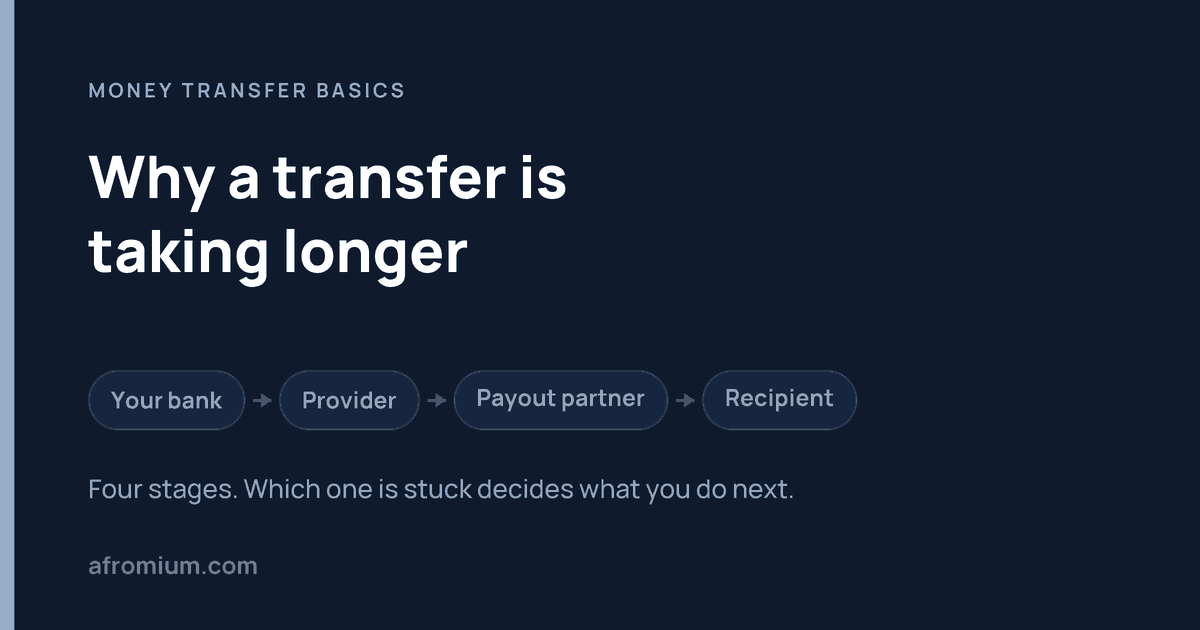
    A late international transfer is stuck in one of three places: on its way to the provider, with the provider, or on its way to the recipient. Which one it is decides who can fix it and how long it is reasonable to wait. Find the stage first, then go to the section for your provider or payout method below.

    Jump to: the three stages · common reasons · how long to wait · Wise · Remitly · Western Union · GCash and Maya · bank transfer · what to do now

    The three stages

    Wise describes every transfer in three stages, and the idea works for any provider even when the labels in the app are different. Your provider’s tracker should tell you which stage you are in.

    StageWhat is happeningWho can move it
    1. On its way to the providerYour bank or card is paying the provider. Wise says this depends on how fast your bank sends the money.You and your bank
    2. With the providerThe provider has your money, converts it and runs any checks. Wise says this is usually where security checks happen.The provider, sometimes waiting for information from you
    3. On its way to the recipientThe recipient’s bank, wallet or cash pickup partner is processing the payout.The provider and the recipient’s bank or wallet, together

    Stage 3 causes the most confusion. A provider can mark a transfer as sent, delivered or complete while the recipient’s bank is still processing it. Wise says that at this stage the recipient can ask their bank to check on the payment, and that sharing a transfer confirmation helps.

    Common reasons for a delay

    The way you paid. Some payment methods reach the provider faster than others. Wise gives these times for money to reach it:

    How you payTime to reach Wise
    Card paymentUsually instant
    Bank transfer1 to 4 working days
    Swift transfer1 to 6 working days

    Those are Wise’s figures. Other providers publish their own, and a faster payment method can cost more, so compare the price and the timing before you choose it.

    Weekends and public holidays. Wise says banks do not process transfers on weekends or public holidays, and its estimates count only working days, Monday to Friday. Money sent on a Friday or before a holiday might not move until the next working day, and that applies to banks in the sending country and the receiving country. Remitly lists weekends, bank holidays and local events such as severe weather among the reasons a transfer can take longer.

    Security checks. Regulated providers sometimes check a transfer before releasing it. Wise says it emails you if it needs more information, such as ID or proof of where the money came from, and that it cannot speed the checks up. Remitly says a review normally takes less than 24 hours and that it might contact you with questions. Answer only through the provider’s own app or website.

    Mistakes in the recipient’s details. Wise says a typo in the recipient’s name or account number can make their bank reject the payment and send it back. Its advice is to check your activity list: if the status says the money is coming back, you can fix the details or cancel, and refunds can take a few days. Checking the details with the recipient before you send is quicker than fixing them afterwards.

    The payout partner. Remitly says a delivery provider may still be processing the transfer, may need more information, or may be closed or short of cash. Cash pickup locations can run out of money or change their hours.

    How long to wait before contacting the provider

    Some providers say how long a delay can normally last before you should get in touch. These are their published figures, read on 21 November 2026:

    Provider and statusWhat the provider says
    Remitly: In ProgressMost issues resolve on their own in 24 to 48 hours. Contact Remitly if it has been more than 48 hours after the promised delivery time.
    Remitly: DeliveredThe recipient’s bank or delivery provider may still be processing it. The money usually reaches the account within 48 hours; after that, Remitly says it can help.
    Remitly: In ReviewNormally less than 24 hours.
    Western Union: In ProgressSend Western Union a query if the status has shown In Progress for more than 48 hours.
    Western Union: deliveryTypically up to 1 to 2 business days after the transfer is processed for the money to be ready for pickup or credited, varying with the receiving country and the amount.
    Wise: security checksNo fixed time given. Wise emails you if it needs information and says it cannot speed the checks up.

    Western Union’s figures come from its UK help page and Remitly’s from its help centre for senders in Germany. Your own transfer’s estimate is the figure that counts, so start from that.

    Find the guide for your provider

    Each guide below goes through one provider or payout method in detail, with the sources we read and the date we read them.

    Wise

    Wise’s tracker shows the three stages above, so start there. Why a Wise transfer takes longer than usual works through what to do at each stage, including transfers to Nigeria. What each Wise status means explains the labels, and its section on a Complete transfer that has not arrived covers the trace you can ask the recipient’s bank to run.

    Remitly

    Two Remitly statuses need you to act. Pending Funds means Remitly is still waiting for you to pay, and On Hold means it needs you to do something, such as upload a document or edit the transfer, before it can be delivered. What each Remitly status means covers all of them. For a specific problem:

    Western Union

    Track a Western Union transfer with its MTCN, the 10-digit tracking number. Western Union says the status is typically updated within 2 hours, so a status that has not changed for a few minutes is not yet a delay. How to track a Western Union transfer explains where to find the number and what each status means.

    GCash and Maya wallets

    A wallet can refuse money the provider has already sent, because of the recipient’s own limits. On GCash’s limits page, read on 21 November 2026, a Basic profile can receive only ₱5,000 a month. When a limit is reached, GCash says some services stop until it resets on the first day of the following month or the profile is upgraded. A transfer that looks ordinary can fail because the month is already full.

    A bank transfer

    If you sent the money from your own bank rather than through a money transfer service, the bank can trace it. For a payment that went through Swift, ask the sending bank for the UETR, a reference every bank in the chain can use to find the same payment. How to track an international bank transfer covers the trace step by step, and Swift gpi status codes explained decodes the ACSP, ACCC and RJCT codes some banks show.

    What to do if the money has not arrived

    1. Open the transfer in the provider’s official app or website and read its latest status and delivery estimate. Everything else depends on whether that estimate has passed.
    2. Check whether the provider is waiting for your payment or has asked you for information. Look in the app and in your email, including the spam folder.
    3. Confirm the recipient details against what the recipient gave you. For a bank deposit, ask the recipient to check their account activity. For a wallet, ask them to check the transaction history and their remaining limit. For cash pickup, check whether the payout is ready and which location can release it.
    4. Keep the transfer confirmation. If the provider says the money was sent and the recipient’s bank cannot find it, share the confirmation with the recipient so their bank can look for it.
    5. If the estimate, plus any waiting time the provider publishes, has passed, contact the provider through its official support channel with the transfer reference.
    6. Do not send a second transfer until you know what happened to the first. If the first one lands later, you will have paid twice, and getting the second one back is usually slower.

    If you have not sent yet and arrival time matters, compare the estimate shown for your exact amount, payment method and payout method, and leave some room for checks or bank processing. The quickest advertised transfer is not always the quickest one for your recipient today.

    How we checked this

    Read on 21 November 2026: Wise’s help article on why a transfer takes longer than the estimate, for the three stages, the payment-method times, security checks, weekends and holidays, and mistakes in recipient details; Remitly’s help article for senders in Germany on why money has not been delivered, for the reasons it lists and the waiting time for each status; Western Union’s UK help page on checking a transfer’s status, for the 2-hour status update, the 48-hour In Progress advice and the 1 to 2 business days; and GCash’s help page on wallet and transaction limits, for the Basic profile’s monthly limit and the reset. The provider sections summarise our own guides, each of which lists its sources and the date they were read. We made no test transfers. This page was first published on 19 September 2026 and rewritten on 21 November 2026 as a guide to all our delay articles.

    Sources

    Related

    Afromium does not make test transfers and has no commercial relationship with any provider named here. The waiting times are the providers’ own published figures, read on the date above. Providers change their processes without notice, so the estimate on your own transfer and the provider’s current help page come first.