Author: Mohammed D

  • bKash Remittance Not Received? What to Check Before Anyone Sends It Again

    bKash Remittance Not Received? What to Check Before Anyone Sends It Again

    Last checked 30 September 2026

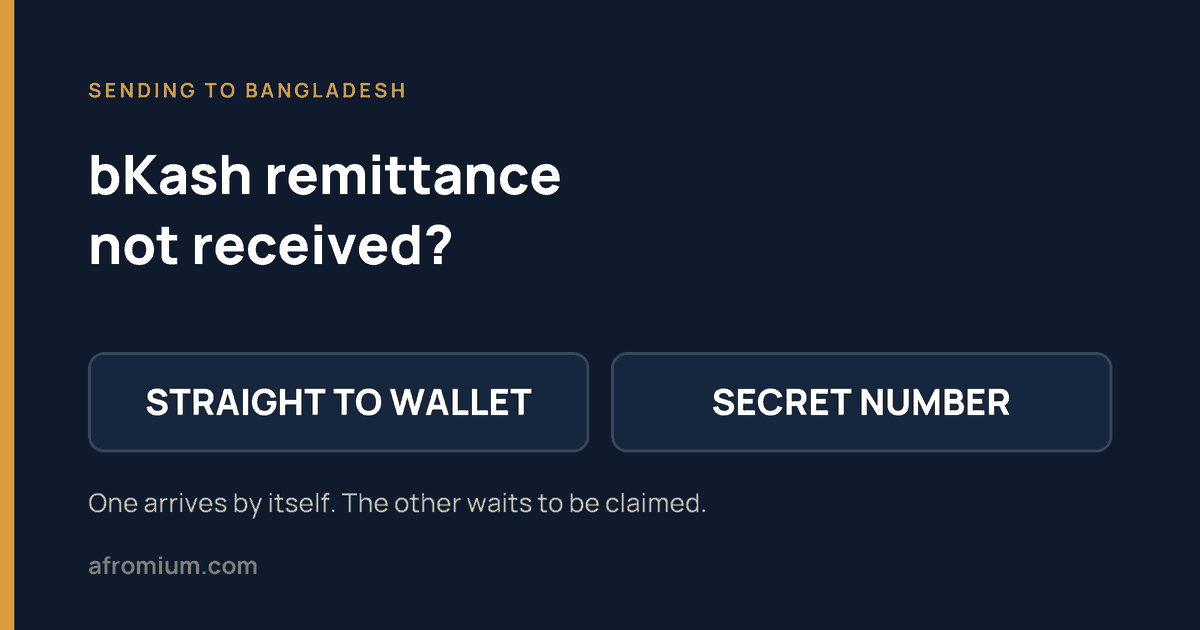
    Money was sent to a bKash account from abroad and it has not shown up. Before anyone calls anyone, answer one question: did the sender get a secret number to pass on? If they did, the money is almost certainly waiting to be claimed, and nothing will arrive until the recipient claims it. If they did not, it was meant to land by itself — and that fails for different reasons.

    This page takes the two routes one at a time, then covers who to contact and how to escalate. If you have not sent yet, start with sending money to bKash from abroad instead.

    First: which kind of transfer was it?

    Sent straight to the walletSent with a secret number
    Typical providersWise, Remitly, WorldRemit, Taptap Send and the other partners on bKash’s listWestern Union, Ria and Mastercard (claimed in the bKash app); MoneyGram and National Exchange (claimed at a bKash agent)
    What the sender gives the recipientNothing neededA secret number (for Western Union, the MTCN) and the exact amount in taka
    What the recipient has to doNothing — it should appear in the accountClaim it: in the bKash app, or in person at a designated bKash agent
    Where it usually goes wrongWrong number format, name mismatch, account not fully verified, a provider’s monthly capNot claimed yet, number or amount entered wrongly, name on the transfer not matching the recipient’s national ID

    Western Union, Ria and MoneyGram also appear on bKash’s list of partners that pay straight into the wallet — they offer both. So the test is not the company’s name. It is whether the sender was handed a secret number. Which providers can pay into bKash from which country is on bKash’s partner list, and in the bKash app under Remittance.

    If the sender chose cash pickup, nothing will land in bKash by itself. If the company is one on bKash’s secret-number list above, the recipient may be able to claim it into bKash with the secret number, as described below; otherwise it is collected where the sender chose. Ask the sender to open the receipt and read which delivery method it shows, rather than remembering.

    If it was sent straight to the wallet

    These transfers are meant to be fast. WorldRemit describes delivery to bKash as “Instant”; Taptap Send says “Under 5 minutes”, 24 hours a day. So a gap of hours is itself a signal that something has stopped, not that the money is on its way.

    1. Read the sender’s status first

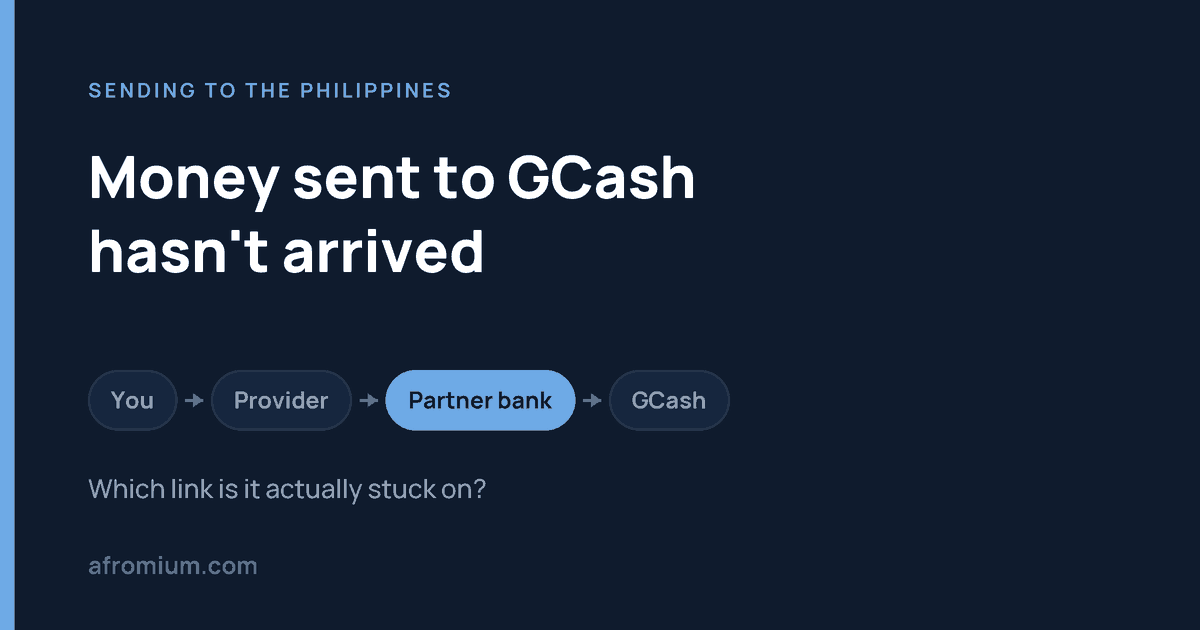
    The sender should open the transfer in their app, not their bank statement. A card charge proves only that the provider took the money. If the transfer says pending or in review, the money has not left the provider, and bKash has nothing to find — that is a question for the provider. We explain what the usual statuses mean in money sent to GCash hasn’t arrived; the logic is identical for bKash.

    2. Check the bKash statement, not the notifications

    If the sender’s app says completed, the recipient should look at the statement in the bKash app. Notifications and SMS can go missing; the statement does not. bKash also lets remittance customers request a separate remittance statement from the app, listing every remittance received into the account.

    3. Check the number the way the provider wanted it

    Taptap Send says the mobile number “must match exactly” what is registered with the recipient’s bKash account. Wise asks for it in international form with the leading zero dropped: a number written locally as 01234567890 is entered as 8801234567890. A single digit out is a different wallet, or no wallet at all.

    4. Check the name and the account’s status

    bKash’s own instructions to senders are to give the account number and the full name as given when the bKash account was opened, and its partners are required to confirm the account is “registered and valid” before sending. WorldRemit says the account must be “fully registered” and “active”, and that the name should match the name registered on it. Taptap Send goes further: the account must be fully verified, and “unverified accounts may not be able to receive international remittances”.

    If the recipient’s details are out of date, they can update them in the bKash app under Information Update, or at a bKash Customer Care Center with their national ID card. An account opened with a different photo ID has to be updated at a Customer Care Center.

    5. Check the amount against two different sets of limits

    bKash’s own limits page allows an international remittance of BDT 50 to BDT 2,50,000 per transaction, not counting the government and bank incentive, with no daily or monthly count and no daily or monthly total. It also says the usual BDT 5,00,000 maximum account balance does not apply to remittance. A full account is not the reason money is missing.

    The providers are stricter than bKash:

    Published byPer transferPer dayPer month
    bKash (international remittance)BDT 2,50,000No limitNo limit
    Wise (to bKash and Nagad)—BDT 250,000BDT 450,000
    Taptap Send (to mobile wallets)BDT 250,00010 transfersBDT 450,000, and 50 transfers

    So a family that sends several large amounts in one month can hit a provider’s ceiling even though bKash would accept the money. That is a problem on the sending side — the sender’s app is where it will show — not money lost inside bKash.

    If it was sent with a secret number

    This is the route where “not received” most often means “not claimed”. The money sits with the transfer company until the recipient asks for it with the secret number.

    Claiming it in the bKash app

    For Western Union, Ria and Mastercard, bKash’s instructions are:

    1. Log in to the bKash app and tap Remittance.
    2. Tap the transfer company’s name.
    3. Enter the secret number and the remittance amount the sender gave you.
    4. Accept the terms and submit with your bKash PIN.

    bKash says there is no fee to receive, and that it needs the recipient’s own bKash account, registered with their national ID card.

    The three things that must match

    • The secret number. bKash lists its length for each company, which is a quick way to catch a typo before submitting:
    Transfer companySecret number lengthClaim where
    Western Union (MTCN)10 digitsbKash app or agent
    Ria Money Transfer11 digitsbKash app or agent
    Mastercard13 digitsbKash app or agent
    National Exchange12 digitsbKash agent only
    MoneyGram8 digitsbKash agent only
    • The amount, in taka, exactly. bKash requires “the accurate remittance amount (in BDT)” from the sender. The sender should read it off their receipt, not remember it.
    • The name. Western Union’s terms for this service require that the secret number is issued “in his/her name as per his/her NID card”. If the sender typed a nickname or a shortened name, the claim can fail even with the right number and amount. The fix is on the sending side: the sender asks the transfer company how to correct the name. Do not change your bKash details, or open another account, to match a wrong name.

    If bKash says the number or amount is wrong, bKash’s answer is to confirm both again with the sender. There is no way around it from the receiving side.

    When the claim says “processing”

    A claim has three possible statuses: successful, unsuccessful, and processing. bKash says a claim normally completes at once, and in some cases can take up to 15 minutes; for Western Union it adds that processing depends on Western Union’s own systems and can take a little longer.

    Do not submit it again while it says processing. Western Union’s terms for the service say not to re-submit the same amount within ten minutes, and that once a claim is submitted it “cannot be reversed or canceled”.

    If it comes back unsuccessful, bKash asks the recipient to note the Request ID from the notification and give it to the bKash helpline on 16247, or to a bKash Customer Care Center.

    Claiming it at a bKash agent

    For MoneyGram and National Exchange this is the only way, and it works for the other three too. bKash’s conditions:

    • Only designated agents offer it — ask first. bKash Customer Care Centers do not.
    • The recipient must be there in person, with their original national ID card. A photocopy or a picture of it is not accepted, and neither is a passport or birth certificate.
    • Bring the bKash account number, the secret number and the amount.
    • There is no fee. If an agent asks for one, bKash asks you to report the agent’s name, phone number and location to 16247.

    One warning bKash gives on the same page: if you get an SMS or notification saying your account information was submitted for verification and you did not do it, someone may be trying to claim remittance in your name. Call 16247 straight away.

    Who to contact, by what you see

    What you seeWho actsContact
    Sender’s app says pending, processing or in reviewSenderThe transfer provider. bKash cannot see a transfer that has not been paid out.
    Sender’s app says completed, but nothing in the bKash statementBothSender: the provider, with the transaction reference. Recipient: bKash on 16247, with the date and amount.
    Sender’s app says cancelled or refusedSenderThe provider — check the number format, the name and the provider’s monthly limit before trying again.
    Secret-number claim says the number or amount is wrongSenderRe-read the number, the exact taka amount and the recipient’s name from the receipt.
    Claim came back unsuccessfulRecipientbKash on 16247 or a Customer Care Center, with the Request ID.
    An agent asked for a feeRecipientbKash on 16247, with the agent’s name, number and location.

    bKash’s helpline, 16247 or 02-55663001, is open 24 hours. It also offers live chat on its website and email at support@bkash.com.

    What to have ready before you contact anyone

    • The provider’s transaction reference, or the secret number.
    • The exact amount in taka and the date it was sent.
    • The recipient’s bKash number, exactly as the sender entered it.
    • The recipient’s name exactly as the sender entered it, and as it appears on their national ID card.
    • For a failed claim: the Request ID from the bKash notification.

    That turns “my remittance has not arrived” into something support can act on: “Western Union transfer, MTCN [number], sent on [date] for BDT [amount], shows as paid, but no matching credit appears in my bKash statement.”

    Escalating a bKash complaint to Bangladesh Bank

    Bangladesh Bank regulates bKash as a mobile financial services provider, and its Customer Interest Protection Centre (CIPC) takes complaints about them. It sets out three steps, in order:

    1. Raise it with bKash — the helpline, live chat or a Customer Care Center.
    2. Escalate to bKash’s Complaint Management Cell. bKash publishes its contacts on its website; they work 9:00 to 18:00, Sunday to Thursday, excluding government holidays.
    3. If that does not resolve it, go to the CIPC — hotline 16236 during office hours, email bb.cipc@bb.org.bd, or Bangladesh Bank’s online complaint form. Include a description of the problem, your contact details, a copy of bKash’s final response, and your supporting documents.

    Two conditions matter here. The CIPC does not take anonymous complaints, and it does not take complaints from a third party without the account holder’s written authorisation. So the recipient, as the bKash account holder, is the one who complains — or the sender does so with the recipient’s signed permission. The CIPC also excludes institutions outside Bangladesh Bank’s purview, so a problem that sits with the sending provider belongs with that provider, and with its regulator in the sending country.

    Do not send it again until you know what the first one did

    A second transfer does not replace the first. If the first was merely unclaimed, or delayed at the provider, both may end up arriving — and money paid into the wrong wallet is hard to recover. Taptap Send’s own help page says recalling a delivered transfer “can be difficult and take time”. Find out the first transfer’s status, then decide.

    The checklist

    1. Did the sender get a secret number? If yes, it has to be claimed.
    2. What does the sender’s app say — pending, completed or cancelled?
    3. Is it on the bKash statement, not just missing from the notifications?
    4. Was the number entered exactly, in the format the provider asked for?
    5. Does the name match the bKash account and the national ID card?
    6. Is the account active and fully verified?
    7. Has the sender gone over their provider’s monthly limit?
    8. For a failed claim: do you have the Request ID?

    Questions people ask

    How long should a remittance to bKash take?

    Sent straight to the wallet, minutes: WorldRemit says instant and Taptap Send says under five minutes. A secret-number claim normally completes at once, and bKash says up to 15 minutes in some cases. Delays measured in hours usually mean the transfer is still with the provider.

    Is there a limit on how much bKash can receive from abroad?

    bKash’s limit is BDT 2,50,000 per transaction, excluding incentives, with no daily or monthly cap. Some providers set lower ones — Wise and Taptap Send both publish a BDT 450,000 monthly limit for sending to bKash.

    I was given an MTCN. Do I need to go to a bank?

    Not for bKash. A Western Union MTCN can be claimed into your own bKash account in the bKash app, or at a designated bKash agent.

    Can the sender complain to Bangladesh Bank for me?

    Only with your written authorisation. Bangladesh Bank’s complaint centre does not accept third-party complaints without it, so it is usually simpler for the account holder to file.

    Is the 2.5% incentive paid separately?

    bKash says the 2.5% government incentive is added with every remittance transaction, and that its per-transaction limit excludes the incentive. On an eligible BDT 100,000 remittance, 2.5% is BDT 2,500, so the credit can be larger than the amount the sender quoted. Use the amount on the actual transaction rather than assuming. What the recipient does with it afterwards — and what it costs to take out — is covered in sending money to bKash from abroad and what it costs to cash out a mobile wallet.

    How we checked this

    Read on 30 September 2026: bKash’s Money Transfer Service page, for the sender requirements, the per-transaction limit, the remittance statement and the list of partners by country; bKash’s two Bangla-language pages on receiving remittance with a secret number — in the app and at an agent — for the claim steps, the partner companies, the secret-number lengths, the national ID and in-person rules, the statuses, the 15-minute processing note, the Request ID instruction, the no-fee rule and the verification-fraud warning; bKash’s terms for the app-based service with Western Union, for the name rule, the ten-minute resubmission rule and the no-reversal rule; bKash’s limits page, for the remittance limits and the balance-cap exception; bKash’s contact and Complaint Management Cell pages; Bangladesh Bank’s CIPC page, for the three-step procedure, the contact routes and the third-party rule; Wise’s guide to BDT transfers, for the number format and its limits; Taptap Send’s Bangladesh help page, for its speed, verification requirement and limits; WorldRemit’s page for mobile money to Bangladesh, for its speed and account requirements; and Remitly’s bKash page.

    Sources

    What we left out

    bKash does not publish what happens to money sent straight to a wrong but valid bKash number, or how long a reversal takes, so we have not guessed. Nor does it say how long a Western Union claim can stay in “processing” beyond its 15-minute note. We have not covered Nagad or Rocket. And the partner list changes; check it in the bKash app or on bKash’s site for your own sending country rather than relying on this page.

    We could not tell from the public pages why Wise and Taptap Send both set a BDT 450,000 monthly limit for bKash when bKash’s own page sets none. We report both as published.

    Afromium does not make test transfers and has no access to any bKash account or provider system. This page sets out what bKash, Bangladesh Bank and the named providers publish, read on the date above. Limits, partners and procedures change — check the current terms in the bKash app and with your provider before acting.
  • Is Money Sent to India Taxable? The ₹50,000 Cliff and the Relative List

    Is Money Sent to India Taxable? The ₹50,000 Cliff and the Relative List

    Last checked 25 September 2026

    Money you send to a close relative in India is exempt, with no upper limit. Money sent to anyone outside that definition is taxable in their hands once the year’s total passes ₹50,000 — and past that line the entire amount is taxable, not just the excess. Whether your relationship counts is decided by a list, and the list is shorter and stranger than most people assume.

    This page explains what India’s Income Tax Department publishes about money received as a gift. It is not tax advice, and it does not tell you what to do. For anything substantial, take professional advice.

    First, the thing that causes most of the worry

    Sending money to India does not create a tax bill simply by being an international transfer. The provision people are worried about — section 56(2)(x) — taxes money received without consideration: a gift, in ordinary language. It falls on the person receiving, not the person sending.

    Two features of it matter before anything else.

    It applies regardless of residential status. The Department states that the provision applies notwithstanding the residential status or class of the assessee, and that donor or donee may be resident or non-resident. Being an NRI sending from Germany does not put you outside it, and it does not put your recipient outside it either.

    And the exemption for relatives has no ceiling. If the relationship qualifies, the amount is irrelevant.

    The ₹50,000 cliff

    For money from someone who is not a relative, the Department’s wording is unusually direct:

    “The limit of Rs. 50,000 is not transaction-wise, and it shall be checked in aggregate for all transactions that happened during the year. If the aggregate of all transactions exceeds Rs. 50,000, the entire amount shall be chargeable to tax and not the amount in excess of Rs. 50,000.”

    Two traps in one paragraph.

    It is a cliff, not a threshold. ₹50,000 received is not taxable. ₹60,000 received does not make ₹10,000 taxable — it makes ₹60,000 taxable. There is no tapering and no allowance carved out below the line.

    It aggregates across the year. Five separate payments of ₹15,000, each comfortably under the limit, total ₹75,000 — and the whole ₹75,000 is chargeable. People who would never send ₹75,000 at once assume small regular amounts are safe. On this provision they are not.

    The chargeable amount is taxed under the head income from other sources.

    Who counts as a relative

    Everything turns on this list. It is set out by the Income Tax Department, and these persons are treated as a relative:

    • Spouse of the individual
    • Brother or sister of the individual
    • Brother or sister of the spouse of the individual
    • Brother or sister of either of the parents of the individual
    • Any lineal ascendant or descendant of the individual
    • Any lineal ascendant or descendant of the spouse of the individual
    • Spouse of any of the persons in the four categories above

    So parents, grandparents, children, grandchildren, siblings, parents-in-law, siblings-in-law, uncles and aunts are all in. The ordinary case — sending money home to a parent, a spouse or a sibling — is exempt, with no limit, and most readers can stop here.

    Two things about that list nobody expects

    Cousins are not on it. A cousin is neither a sibling, nor a sibling of a parent, nor a lineal ascendant or descendant. However close the relationship in life, it does not appear in the definition.

    And the list is not symmetrical. This is the genuinely counter-intuitive part, and it follows from the list being written from the point of view of the person receiving.

    “Brother or sister of either of the parents” means your uncle or aunt is your relative. So money from an uncle to a nephew is received from a relative.

    Now reverse it. Is a nephew on an uncle’s list? A nephew is not a sibling, not a sibling of a parent, and not a lineal descendant — a lineal descendant is a child or grandchild, not a sibling’s child. So the same pair of people can be relatives in one direction and not the other.

    Money flowsIs the sender a relative of the recipient?
    Uncle or aunt → nephew or nieceYes — sibling of a parent
    Nephew or niece → uncle or auntNo — not on the recipient’s list
    Parent ↔ childYes, both directions
    Sibling ↔ siblingYes, both directions
    Cousin → cousinNo

    An NRI supporting an elderly uncle is in a different position from an NRI uncle supporting a student nephew, on the same facts and the same amounts. That is not an oversight in our reading — it is what the definition says, and it is the single most useful thing on this page.

    What is not caught at all

    The provision taxes money received without consideration. That word is doing real work.

    Money that is not a gift is not in scope of this provision in the first place. Paying someone for work done, repaying a loan, settling an invoice, or moving your own money into your own Indian account are all different transactions with different treatment. Sending money to your own NRE or NRO account is not a gift to anybody — you have not given it away. Which account you send it to has consequences of its own, and we set those out in NRE or NRO: which account should the money go to.

    The Department’s guidance also describes exceptions beyond the relative exemption, including gifts on the occasion of an individual’s marriage and amounts received under a will or by inheritance. If one of those applies to you, read the exception itself rather than relying on a summary.

    What we are not telling you

    Three limits on this page, stated plainly.

    It says nothing about tax where you live. Whether sending money creates any obligation for you in Germany, the UK, the US or Canada is a separate question under a different country’s law, and this page does not touch it.

    It is not the whole of Indian tax law. Section 56(2)(x) also covers immovable property and specified movable property, with different thresholds and different aggregation rules. We have deliberately confined this to money, because that is what our readers send.

    We publish no worked calculations. Rates, slabs and surcharges depend on the recipient’s total income and circumstances, and a worked example would look like advice about a situation we know nothing about.

    Questions people ask

    Is money I send to my parents in India taxable?

    Parents are lineal ascendants and therefore relatives, so a gift to them is exempt under the relative exemption, with no upper limit stated.

    Is there a limit on sending to a relative?

    Not for this provision. The ₹50,000 figure is the threshold for money from people outside the definition of relative. It does not cap what may be received from a relative.

    What if I send ₹60,000 to a friend?

    The aggregate for the year exceeds ₹50,000, so the whole ₹60,000 is chargeable in their hands as income from other sources — not ₹10,000.

    Do several small transfers avoid it?

    No. The Department states the limit is not transaction-wise and is checked in aggregate across the year.

    Is a cousin a relative?

    Not under this definition. Nor, in that direction, is a nephew or niece sending to an uncle or aunt — although an uncle or aunt sending to a nephew or niece does qualify.

    Does being an NRI change it?

    Not for this provision. It applies notwithstanding residential status, and donor or donee may be resident or non-resident.

    How we checked this

    Read on 25 September 2026, both from the Income Tax Department of India: its page on Deemed Income [Section 56(2)(x)], last updated 30 April 2026, for the application notwithstanding residential status, the resident or non-resident status of donor and donee, the ₹50,000 monetary threshold, the aggregation rule across the year, and the statement that the entire aggregate rather than the excess is chargeable; and its FAQ answer on gifts received from relatives, last reviewed 22 September 2026, for the seven categories of relative quoted above.

    We have used the Department’s own pages rather than any bank’s, broker’s or advisory firm’s summary of them, and we have quoted the aggregation rule directly because paraphrasing it is how the cliff gets lost.

    Sources

    Afromium is not a tax adviser and this page is not tax advice. It sets out what the Income Tax Department of India publishes about money received without consideration, read on the date above. Tax law changes, individual circumstances differ, and your own country’s rules are a separate matter. Take professional advice before acting, particularly where a large sum, a property or an inheritance is involved.

  • What It Costs to Take Money Out of GCash, bKash and easypaisa

    What It Costs to Take Money Out of GCash, bKash and easypaisa

    Last checked 25 September 2026

    Every comparison of money transfer services stops at the moment the money arrives. But a balance in a mobile wallet is not cash, and turning it into cash costs money — between nothing and 2% of the whole transfer, depending on the country, the amount, and which counter your recipient walks up to. That cost is invisible to you, because it is paid by somebody else, after you have stopped paying attention.

    This page compares that last step across the three wallets our readers send to most: GCash in the Philippines, bKash in Bangladesh and easypaisa in Pakistan. Every figure is from the operator’s own published schedule.

    The short version

    WalletCheapest published routeMost likely route in practice
    GCash (Philippines)2% — there is no cheaper tier2%
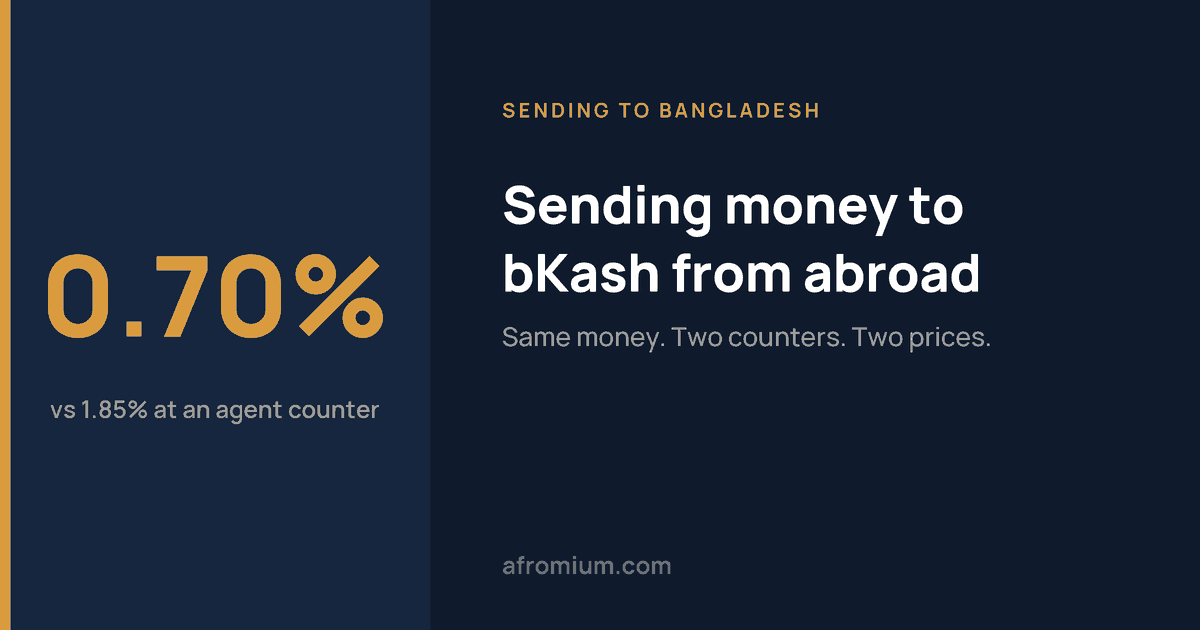
    bKash (Bangladesh)0.70% — remittance money, partner ATM only1.85% at an agent
    easypaisa (Pakistan)Free — easypaisa Bank branch ATMsTiered fee, roughly 1.4–2%

    Three countries, three completely different pricing philosophies. And in two of the three, the cheapest route is not the one your recipient will instinctively use.

    GCash: a flat 2%, and it never gets cheaper

    GCash is the simplest to describe and the least forgiving. Its help centre states it in one line: a 2% fee applies for all cash outs at partner outlets — Cebuana Lhuillier, M. Lhuillier, Puregold, SM Store, Robinsons, ECPay, PeraHUB, TrueMoney and the rest. The GCash Pera Outlet route, the sari-sari shop network, uses the same 2%.

    There is no remittance rate, no loyalty tier, no volume break. ₱1,000 costs ₱20. ₱50,000 costs ₱1,000.

    That last figure is worth sitting with. On a large transfer, GCash’s withdrawal cost can comfortably exceed everything you paid your remittance provider — fee and exchange-rate margin combined. You optimised the visible cost and left the invisible one untouched.

    Withdrawing via a GCash Card at an ATM works differently and carries the ATM’s own fee, so it is worth your recipient comparing. Money left in the wallet and spent directly — bills, QR payments, transfers — avoids the cash-out step entirely, which on GCash is the single biggest saving available.

    bKash: the only one that treats remittance money differently

    bKash publishes four rates, and the gap between the best and worst is the widest of any wallet here.

    RoutePer BDT 1,000As a percentage
    Remittance money at a partner ATM7.000.70%
    Priyo Agent (to 50,000/month, 2 agents set)13.951.395%
    Partner ATM, ordinary balance14.901.49%
    Any other agent18.501.85%

    bKash is alone among the three in giving remittance money its own discounted rate, and at 0.70% it is by a distance the cheapest paid route on this page. It also covers the government and bank incentives sitting in the wallet, and it does not expire.

    But it is ATM-only. Withdraw the same remittance money at an agent — including a Priyo Agent — and ordinary agent charges apply. Agents are how most people in Bangladesh withdraw, so the default behaviour costs more than two and a half times the discounted rate.

    There is a second trap. If a withdrawal exceeds the remittance balance, the ordinary charge applies to the entire withdrawal, not just the excess. The full mechanics, including bKash’s own worked examples and the multiple-of-500 rule, are in sending money to bKash from abroad.

    easypaisa: flat fees, which means the percentage falls

    Pakistan works on a completely different model. easypaisa charges a fixed rupee amount per band rather than a percentage, which changes the arithmetic as the amount rises.

    WithdrawalFee (incl. tax)Effective rate
    Rs 501 – 1,000Rs 202.00% at Rs 1,000
    Rs 8,001 – 10,000Rs 1801.80% at Rs 10,000
    Rs 20,001 – 25,000Rs 3801.52% at Rs 25,000
    Rs 40,001 – 50,000Rs 6901.38% at Rs 50,000
    easypaisa Bank branch ATMFree0%
    Other banks’ ATMsRs 35Falls with amount

    Two things fall out of this. First, the effective rate drops as the amount rises — the opposite of GCash, where 2% is 2% forever. Withdrawing in one go is cheaper than withdrawing in pieces, which is the reverse of the advice that suits bKash.

    Second, easypaisa is the only wallet here with a genuinely free cash-out: ATM withdrawal at easypaisa Bank Ltd. branch ATMs. The schedule also notes cash deposit and withdrawal at easypaisa branches are free for Digital Accounts. Where a branch ATM is reachable, the entire cost of this step disappears.

    The Rs 35 flat fee at other banks’ ATMs is worth knowing too — it is a poor deal on Rs 1,000 and a very good one on Rs 50,000.

    The same amount, three countries

    Comparing across currencies is not meaningful in absolute terms, so here is the percentage each wallet takes on a mid-sized and a large withdrawal, by the routes actually available.

    Best available routeTypical agent/outlet route
    GCash, any amount2.00%2.00%
    bKash, any amount0.70% (remittance, ATM)1.85%
    easypaisa, ~10,000Free (branch ATM)1.80%
    easypaisa, ~50,000Free (branch ATM)1.38%

    The spread between the best and worst column is the money nobody talks about. On a transfer worth roughly 50,000 in local currency it is around 2% in the Philippines, 1.15 percentage points in Bangladesh, and the entire fee in Pakistan.

    For context: that is the same order of magnitude as the difference between a good and a bad exchange rate, which is what everyone actually shops around for.

    What this means when you choose where to send

    Four things follow, and none of them appear on a comparison table.

    • Ask how the money will be used before choosing a wallet. If your recipient will spend it digitally — bills, shops, transfers — the cash-out cost never arises and none of this matters. If they need physical cash, it always does.
    • A wallet is not always the right destination. A bank account may cost nothing to withdraw from. On a large transfer to the Philippines in particular, 2% is a strong argument for sending to a bank instead.
    • Withdrawal strategy differs by country. On easypaisa, withdraw in one large movement. On bKash, withdraw up to the remittance balance and never past it. On GCash it makes no difference, because the rate never moves.
    • Tell your recipient which counter to use. This is the part you can control and the part almost no sender does. The cheapest route exists in two of these three countries and is not the obvious one in either.

    Questions people ask

    Which wallet is cheapest to take money out of?

    easypaisa, if a branch ATM is reachable, because that route is free. Otherwise bKash’s 0.70% remittance ATM rate is the cheapest paid route. GCash is the most expensive at any amount, at a flat 2%.

    Does the sender pay any of this?

    No, which is exactly why it goes unnoticed. It comes out of the amount your recipient receives, after the transfer is complete.

    Is it cheaper to withdraw in one go or in pieces?

    It depends on the country, which is why there is no universal advice. On easypaisa’s flat tiers, one large withdrawal is proportionally cheaper. On GCash’s flat percentage it makes no difference. On bKash the constraint is the remittance balance, not the size.

    Can the money be spent without cashing out?

    In all three cases yes, and it is the most reliable way to avoid this cost altogether. Bills, merchant payments and transfers do not go through the cash-out schedule.

    How we checked this

    Read on 25 September 2026: the GCash help centre article “How to cash out at Partner Outlets”, for the 2% fee applying to all cash outs and the list of partner outlets, and its Pera Outlet guidance for the same 2%; bKash’s Cash Out page, for the 13.95, 14.90 and 18.50 per thousand rates, and its Discounted Remittance ATM Cash Out FAQ for the 0.70% remittance rate and the agent exclusion; and easypaisa’s Schedule of Bank Charges — Branchless Banking for July to September 2026, for the full cash withdrawal fee table, the free ATM withdrawal at easypaisa Bank Ltd. branch ATMs, the Rs 35 service fee on other ATM withdrawals, and the note that cash deposit and withdrawal at easypaisa branches are free for Digital Accounts.

    Sources

    What we left out, and a warning about dates

    easypaisa’s schedule is quarterly, and the one we read runs to September 2026 — it expires within days of this page being published. The structure is unlikely to change overnight, but the numbers can. Check the current schedule on easypaisa’s own site before relying on a figure here.

    We have not published easypaisa’s charge for receiving an international home remittance. The line exists in its schedule, but the published table did not let us map the charge to that line with certainty, and a fee quoted wrongly is worse than one left out.

    We have also not covered Maya, GrabPay or ShopeePay here. They are real options; we have not read their current schedules, and we are not going to estimate. JazzCash’s cash-out charges are in how to receive money from abroad in JazzCash.

    Afromium does not make test transfers. Every fee on this page was read from the operator’s own published schedule on the date given and is quoted, not estimated. Wallet charge schedules change more often than bank ones — treat this as a guide to the structure, and check the current figure before acting.

  • Can You Actually Use UPI From Abroad? The Country List Nobody Leads With

    Can You Actually Use UPI From Abroad? The Country List Nobody Leads With

    Last checked 25 September 2026

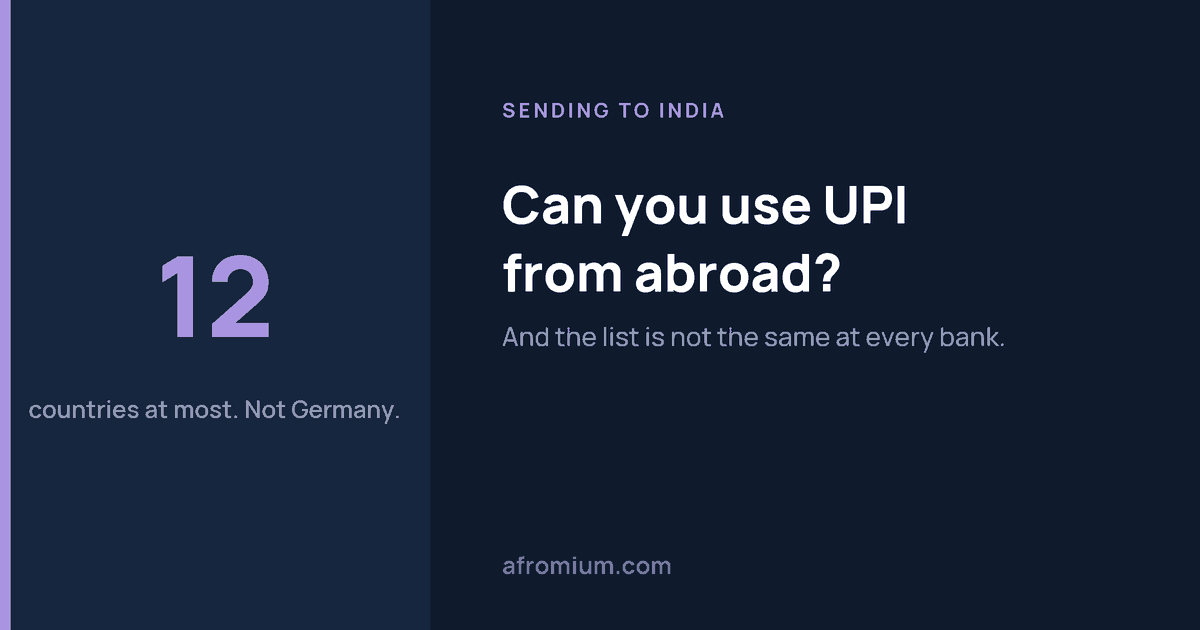
    Yes, you can use UPI with a foreign mobile number — but the list of countries is short, it differs from bank to bank, and Germany is not on it at either of the two banks we checked. Before reading any guide on how to activate it, check whether your country is supported at all. Most articles put that at the bottom.

    There is also a more basic misunderstanding worth clearing up first, because it sends people down the wrong path entirely.

    UPI from abroad is not a way to send money to India

    This is the single most common confusion, and it matters because the two things solve different problems.

    UPI for NRIs lets you operate an Indian bank account from abroad — scan an Indian QR code, pay a UPI ID, send to an Indian mobile number or bank account. The money moves within India, in rupees, from an account you already hold there.

    It is not a remittance channel. It does not convert euros or pounds. It does not move money across a border. If your money is in a German or British account and needs to get to India, UPI is not the mechanism — you need an ordinary international transfer, and then UPI becomes useful for spending what has arrived.

    What you want to doIs UPI the answer?
    Send money from your German salary to family in IndiaNo — that is an international transfer
    Pay an Indian bill from money already in your Indian accountYes
    Pay a shop or a person in India while you are visiting or abroadYes
    Move money from an Indian account to another Indian accountYes

    Put plainly: UPI from abroad is a spending tool for money already in India, not a sending tool for money that is not.

    Which countries are actually supported

    Here is where the published guides quietly diverge, because the list is set by your bank, not by one national rule.

    CountryICICI BankIDFC FIRST Bank
    AustraliaYesYes
    CanadaYesYes
    France—Yes
    Hong KongYesYes
    Malaysia—Yes
    OmanYesYes
    QatarYesYes
    Saudi ArabiaYesYes
    SingaporeYesYes
    UAEYesYes
    United KingdomYesYes
    United StatesYesYes
    Germany——

    ICICI publishes ten countries. IDFC FIRST publishes twelve — the same ten plus France and Malaysia.

    Germany appears on neither. Nor does Ireland, Italy, Spain, the Netherlands or any other EU country except France at one bank. For a reader in Germany — the largest group this site serves — that is the answer, and it is not a matter of following the right activation steps more carefully.

    There is a small irony in it: ICICI runs a Germany country website. Having a banking relationship with a German presence does not put a German mobile number on the supported list.

    Both lists were read from each bank’s own current page on 25 September 2026. Other banks publish their own lists, and they may differ again — so check your bank’s list rather than a general article, including this one.

    What you need before any of this works

    Two requirements, and the second is where most attempts fail.

    1. An NRE or NRO account with a participating Indian bank. An ordinary resident savings account is not eligible.
    2. Your international mobile number registered to that account, from a country on your bank’s list.

    The second is not the same as merely owning a foreign number. The number the bank has on file has to be the foreign number. People try to activate UPI with a number the bank has never seen, and nothing works, and no error message explains why.

    Which of NRE or NRO you hold is a decision with consequences well beyond UPI — repatriation and tax treatment differ sharply between them. If you are choosing, or you are not sure which you have, read NRE or NRO: which account should the money go to before you set anything up.

    The rough sequence

    Steps vary by bank, so follow your own bank’s instructions rather than a generic list. Broadly:

    1. Hold an NRE or NRO account at a bank offering the facility.
    2. Have your international number registered against that account.
    3. Use a UPI app that accepts international numbers — often your own bank’s app.
    4. Link the account, create a UPI ID, set a UPI PIN.

    If it fails, the cause is almost always one of the first two, not the last two. Check the country and check the registered number before reinstalling anything.

    If your country is not on the list

    There is no workaround worth pursuing, and some of what gets suggested is a bad idea.

    Keeping an Indian SIM alive purely to hold a UPI registration is a common suggestion. It works, in the narrow sense, but it means your banking security sits on a number you are not carrying and may not receive — and an unused Indian number can eventually be recycled to somebody else, which is a problem we have watched play out in another market.

    What to do instead depends on the actual goal:

    • Sending money to family — an ordinary international transfer, which is what you wanted anyway. UPI was never the tool.
    • Paying Indian bills — net banking on the Indian account, which does not depend on a mobile number’s country.
    • Paying while visiting India — a different question, with options for foreign visitors that do not need an NRE or NRO account.

    Questions people ask

    Does UPI work from abroad?

    With an international mobile number, only from countries your bank supports, and only with an NRE or NRO account. ICICI publishes ten countries; IDFC FIRST publishes twelve.

    Can I use UPI from Germany?

    Not with a German mobile number at either bank we checked — Germany is on neither list. France appears at IDFC FIRST only. Check your own bank’s current list before concluding either way.

    Can I send money to India using UPI?

    No. UPI moves rupees between Indian accounts. Getting foreign currency into India is an international transfer, and a separate thing entirely.

    Do I need an Indian mobile number?

    Not if your country is supported — that is the point of the facility. Your international number has to be the one registered against the account, though.

    Will my bank charge foreign exchange fees?

    There is no currency conversion involved, because the payment is rupees out of an Indian account. Check your own bank’s schedule for any charges it applies to the facility itself.

    If you are the sender and your service offers both a UPI ID and a bank account for an Indian recipient, we compare the two routes in UPI ID or Indian bank account: which should the sender choose?

    How we checked this

    Read on 25 September 2026: ICICI Bank’s NRI article on using an international mobile number for UPI payments, for its list of ten countries — Australia, Canada, Hong Kong, Oman, Qatar, Saudi Arabia, Singapore, UAE, UK, USA — and its description of what the facility can do; and IDFC FIRST Bank’s NRI guide, for its list of twelve — USA, UK, UAE, Canada, Australia, Singapore, Saudi Arabia, Oman, Qatar, Hong Kong, Malaysia, France — and the NRE/NRO account requirement. Account definitions come from the Reserve Bank of India’s FAQ on accounts for non-residents.

    Sources

    What we left out

    We have not published a master list of every supported country, because there is no single list — each bank publishes its own and they differ, as the table above shows. Nor have we reproduced activation screens, which change with each app release and would be wrong within months.

    We checked two banks. A bank we did not check may well support a country neither of these does, so treat the Germany conclusion as “not at ICICI or IDFC FIRST on this date” rather than as a national impossibility, and ask your own bank directly.

    Afromium does not make test transfers. Both country lists on this page were read from the banks’ own pages on the date given and are quoted, not estimated. Supported-country lists change as banks extend the facility — check the current list with your bank before making plans around it.

  • NRE or NRO? Which Indian Account the Money Should Go To

    NRE or NRO? Which Indian Account the Money Should Go To

    Last checked 25 September 2026

    If you are sending money to India and your recipient has given you a choice of two account numbers, this is the most consequential decision in the whole transfer — more than the provider, more than the rate. NRE money can come back out of India freely and its interest is tax-exempt. NRO money cannot and is not. Send to the wrong one and no provider, rate or complaint fixes it afterwards.

    The good news is that the rule is short, and it is set by the Reserve Bank of India rather than by any bank, so it does not vary between them.

    The difference in one table

    NRE — Non-Resident ExternalNRO — Non-Resident Ordinary
    What it is forMoney earned outside IndiaMoney earned inside India
    Can the money leave India again?Yes, freelyNot freely — see the USD 1 million rule below
    Tax on interestExempt from income taxTaxable
    Who can open oneNRIs and PIOsAny person resident outside India

    Two rows of that table are the reason this page exists. Everything else follows from them.

    The short answer

    If you are sending money you earned abroad, and there is any chance that money may need to come back out of India later — send it to the NRE account.

    That is the default, and most people sending from Germany, the UK, the US or Canada want it. It is money that started outside India, and NRE is the account designed to let it leave again.

    NRO is the right answer in one main situation: the money is destined for Indian expenses, or it will mix with income arising in India — rent from a flat, a pension, dividends, a share of a family business. Those things are NRO money by nature, and RBI’s permitted credits for an NRO account are exactly that: inward remittances, legitimate dues in India, and transfers from other NRO accounts.

    Repatriation: the part that bites years later

    RBI’s position on an NRE account is that the balance is repatriable. Principal and interest, out of India, without asking anyone.

    An NRO account is not repatriable except for current income. There is a route out, but it is a capped and documented one: an NRI or PIO may remit up to USD 1 million per financial year — April to March — from NRO balances, and that allowance is shared with their other eligible Indian assets.

    For most families sending ordinary support, a million dollars a year is not a live constraint, and this all sounds academic. It stops being academic the moment someone sells a property, settles an estate, or decides to move savings back after a decade abroad. Money that went into NRO because it was easier at the time now has to come out through a capped, paperwork-heavy channel — and money that went into NRE does not.

    That asymmetry costs nothing to respect on the day you send, and it cannot be undone cheaply later.

    Tax: exempt versus taxable

    Interest earned on an NRE account is exempt from income tax, and RBI notes the balances are exempt from wealth tax. Income in an NRO account is taxable.

    On a balance that sits for a year or more, that is not a rounding difference. Two accounts at the same bank, the same rate, the same deposit — one keeps the interest, the other does not.

    This is about the tax treatment of the account, not about whether your transfer is taxable. Whether money you send is itself taxed in the recipient’s hands is a separate question with separate rules, and it is not what this page answers.

    What can legitimately go into each

    Worth knowing, because it explains why the accounts are not interchangeable rather than simply differently taxed.

    • NRE permitted credits — inward remittance from outside India, interest accruing on the account, transfers from other NRE or FCNR(B) accounts, and current income such as rent, dividend and pension.
    • NRO permitted credits — inward remittances from outside India, legitimate dues in India, transfers from other NRO accounts, and rupee gifts or loans from residents within the Liberalised Remittance Scheme limits.

    Notice that an inward remittance is permitted into both. That is precisely why the mistake is so easy to make: nothing rejects your transfer, nothing warns anyone, and the money lands exactly as expected. The consequences are entirely downstream.

    Notice also what is not a permitted NRE credit: Indian income. Rent from an Indian flat belongs in NRO. Trying to route it through NRE to make it repatriable is not a clever workaround, it is outside the rules.

    One more rule worth knowing before you send

    RBI’s FAQ notes that individuals and entities of Pakistan and Bangladesh require prior approval of the Reserve Bank of India to open these accounts. If that applies to anyone in your situation, resolve it before money is in motion rather than afterwards.

    How to make sure it lands in the right one

    The two accounts have different account numbers. Your recipient may have both at the same bank, and the numbers may look alike.

    1. Ask which account type the number belongs to. Do not infer it, and do not accept “my account at HDFC” as an answer.
    2. Ask for it in writing — a screenshot of the account summary in their banking app naming NRE or NRO.
    3. Check that the name on the account matches what you are entering.
    4. If you send regularly, save the beneficiary once, correctly, and reuse it.

    If money has already gone to the wrong one, this is not a transfer problem and your provider cannot help — the money arrived where you told it to go. It is a banking question for the account holder, and banks do offer NRO to NRE transfer processes, subject to documentation and the repatriation rules above. Start there, and start early.

    A separate question people often fold into this one is whether the money is taxable when it arrives. It usually is not, because gifts from close relatives are exempt — but the definition of “relative” is narrower than most people assume. See is money sent to India taxable.

    Sending to a UPI ID instead of an account number

    Some services let the sender pay rupees to the recipient’s UPI ID instead of typing an account number and IFSC. The choice only exists when both options appear in your checkout, and many services do not offer UPI payout at all. If the NRE or NRO question above matters for this money, ask the recipient which account their UPI ID pays into before you use it.

    Wise is one service that offers both. For a bank deposit it asks for the recipient’s full name, bank account number, IFSC and the purpose of the payment. For a UPI payout it asks for the UPI ID. Wise’s INR guide says a transfer to a UPI recipient can be up to INR 200,000 instantly. To a bank account it says up to INR 500,000 instantly if the recipient’s bank is on IMPS, and up to INR 100 million per transfer to a private individual. These are Wise’s rules, not a limit set for UPI or for cross-border payments in general.

    • UPI ID: use it when the service supports UPI payout, the recipient has confirmed the ID is active, and the amount fits the service’s UPI limit. It saves collecting the account number and IFSC. Have the recipient copy the ID from their payment app, and do not guess one from a phone number or an old screenshot.
    • Bank account: use it when the recipient prefers a direct deposit, when UPI payout is not offered, or when the amount is above the UPI limit. It is also the route that lets you choose the NRE or NRO account by its number. Confirm the account number and IFSC directly with the recipient.

    To compare the two, quote the same total charge, funding method and recipient once each way, and note the rupees received and the delivery estimate. A faster estimate is not a guarantee, because verification and the receiving bank can still slow the payment. When you pay a bank account through Wise, pick the correct purpose of payment from its list: Wise says a wrong choice can mean you are asked for more information and the transfer takes longer. If a UPI ID fails validation, ask the recipient to copy it again rather than trying variations.

    Paying in India with UPI while you are abroad

    Paying for things in India from your own phone while abroad is a different question from receiving a transfer to a UPI ID. It runs on these same two account types — and it is available in far fewer countries than people assume. We set out which, and what it can and cannot do, in can you actually use UPI from abroad.

    Questions people ask

    Which account should I send my salary savings to?

    NRE, in almost every case. It is money earned outside India, and NRE keeps it freely repatriable with tax-exempt interest.

    Can I send an international transfer to an NRO account?

    Yes — inward remittances are a permitted credit to NRO. The question is not whether you can, but whether you should, given the money then loses free repatriability and the interest becomes taxable.

    How much can come out of an NRO account?

    Current income is remittable. Beyond that, an NRI or PIO may remit up to USD 1 million per financial year from NRO balances together with their other eligible assets.

    Is NRE interest really tax-free?

    RBI states that income earned in NRE accounts is exempt from income tax and the balances are exempt from wealth tax. How that interacts with tax where you live is a separate matter and depends on your own country’s rules.

    My relative only has one account — does this matter?

    Then find out which type it is. If it is a resident savings account rather than NRE or NRO, that is a different question again and one for them to raise with their bank, because account status is supposed to follow residential status.

    How we checked this

    Read on 25 September 2026: the Reserve Bank of India’s FAQ on accounts for non-residents, for who may open each account type, the permitted credits to each, the repatriability of NRE balances, the position that NRO balances are not repatriable except for current income, the USD 1 million per financial year allowance shared with other eligible assets, the tax exemption on NRE income and wealth, the taxability of NRO income, and the prior-approval requirement for individuals and entities of Pakistan and Bangladesh.

    We have used RBI’s own wording rather than any bank’s summary of it, because banks describe their products and RBI describes the rule. The section on sending to a UPI ID, merged in on 21 November 2026 from a separate page of ours, is based on Wise’s guide to INR transfers, its page on entering INR bank details and its INR purpose-code list, read on 24 October 2026.

    Sources

    Afromium does not make test transfers, has no commercial relationship with Wise and does not give tax or investment advice. This page sets out what RBI publishes about two account types, and what Wise publishes about its own UPI and bank payouts, read on the dates given. Rules and limits change, and your own country’s tax treatment is a separate matter — check the current position with the receiving bank, and take professional advice where a large sum or a property sale is involved.

  • Sending Money to bKash From Abroad: the 2.5% and the Cash-Out Trap

    Sending Money to bKash From Abroad: the 2.5% and the Cash-Out Trap

    Last checked 25 September 2026

    Sending to a bKash wallet has a cost almost nobody sending from abroad ever sees, because it lands on the person receiving. The transfer arrives, and then it costs money to take out — and depending on where your recipient withdraws it, that cost varies by a factor of two and a half. There is also 2.5% of free money attached to sending through a legal channel, which the informal route quietly forfeits.

    Both of those are published by bKash. Neither appears on any remitter’s landing page, because neither is about the remitter.

    The 2.5% incentive, and what it is actually for

    Bangladesh pays a 2.5% government cash incentive on inward wage remittance sent through legal channels — authorised banks, listed money transfer organisations and money exchange houses. bKash states it plainly: recipients of remittances sent through legal channels receive it, and in some cases a further 2.5% bank incentive on top.

    The rate went to 2.5% on 1 January 2022, up from 2%. It is not a bKash promotion and not a provider’s offer, however some remitters advertise it — it is national policy, and it applies whichever legal channel you use.

    Which is the point people miss. The incentive exists precisely to make the formal channel beat the informal one. A hundi arrangement offering a slightly better rate is not competing with the official rate — it is competing with the official rate plus 2.5%, and sometimes plus 5%. Very often it loses, and the sender never runs the comparison because the incentive is paid to somebody else, in another country, days later.

    It is also the reason to keep the paperwork. The incentive attaches to remittance that arrived through a channel that can prove it.

    What you can send

    bKash states a ceiling of BDT 2.5 lakh (250,000) in a single transaction, and says expatriate Bangladeshis can send that amount as many times as they want. So the per-transaction cap is real; a frequency cap is not something bKash publishes.

    To send, the bank, exchange house or MTO needs two things from you: the recipient’s bKash account number, and their full name exactly as given when the bKash account was opened. Not the name you call them. Not a shortened version. The sending agent is required to confirm the account is registered and valid and that the name matches before the transfer goes through.

    This is the same failure mode that stops transfers in every other corridor we cover, and it is the single most common reason a transfer is rejected rather than delayed.

    Now the part that costs money: getting it out

    Money in a bKash wallet is not yet cash. Withdrawing it has a charge, and bKash publishes four different ones.

    How your recipient withdrawsCharge per BDT 1,000On BDT 50,000
    Remittance money, at a partner ATM7.00 (0.70%)BDT 350
    Priyo Agent (up to 50,000/month, 2 agents set)13.95BDT 697.50
    Any partner ATM, ordinary balance14.90BDT 745
    Any other agent18.50BDT 925

    Read the first and last rows together. The same money, withdrawn two different ways, costs BDT 350 or BDT 925.

    Agents are how most people in Bangladesh withdraw from bKash — they are everywhere, they are open, and they do not require finding a specific bank’s ATM. So the default behaviour is the expensive one, and the discounted rate only applies if your recipient knows it exists and goes out of their way to use it.

    That is the whole reason this page exists. You chose a provider carefully to save a few hundred taka on the exchange rate, and then 575 of them went back out at the withdrawal counter.

    How the discounted rate actually works

    The 0.70% rate is a service bKash calls Discounted Remittance ATM Cash Out. The details matter, because several of them are traps:

    • It applies to all kinds of international remittance, regardless of type.
    • It covers the remittance balance including the government and bank incentives — so the 2.5% comes out at the cheap rate too.
    • There is no expiry. It lasts as long as there is remittance balance in the account.
    • It works at BRAC Bank, City Bank and certain Q-Cash ATMs, through the bKash app or by dialling *247#.
    • It is ATM only. Withdraw the same remittance money from any agent, including a Priyo Agent, and ordinary agent charges apply instead.

    That last one is the trap. The discount is not a property of the money — it is a property of the machine.

    The rule that catches people: do not overdraw the remittance balance

    If a withdrawal is larger than the remittance balance, the discounted rate does not apply to the remittance part and ordinary charges to the rest. The ordinary charge applies to the whole withdrawal.

    bKash publishes worked examples. With BDT 7,000 of remittance in the wallet:

    WithdrawingWhich rate appliesFee
    BDT 5,000 — less than the balanceDiscounted, 0.70%BDT 35
    BDT 7,000 — exactly the balanceDiscounted, 0.70%BDT 49
    BDT 10,000 — more than the balanceRegular agent charge, on the full amountConsiderably more

    So the advice to your recipient is precise: withdraw up to the remittance balance, never past it. Going BDT 1 over does not cost a little more. It reprices the entire transaction.

    Where a wallet holds several kinds of money, bKash applies cash-out rates in a set order — Savings, then Payroll, then Remittance.

    The practical limits at the machine

    Worth knowing before promising anyone their money this afternoon. For this ATM service bKash says a withdrawal must be a multiple of 500, within BDT 3,000 to 10,000 — no fractional amounts like 2,100 or 2,223.

    Which puts an honest limit on the cheap route. A BDT 250,000 remittance cannot be withdrawn at 0.70% in one movement; at BDT 10,000 a time it is twenty-five separate withdrawals. For a large transfer the discounted rate is real but slow, and for an urgent large sum your recipient may reasonably choose to pay more. That is a genuine trade-off, and we would rather set it out than pretend the cheap option is always the right one.

    The ATM process itself uses a one-time password, not the bKash PIN. bKash sends a security code by SMS, it is valid for five minutes, generating it is free, and there is a 30-second wait before another can be generated. Nobody should ever be entering their bKash PIN at an ATM for this.

    If the money is freelance income, read this

    bKash supports pulling Payoneer balances into a bKash account, minimum BDT 1,000, with no paperwork. Two things are true about that money and they point in opposite directions:

    • It does qualify for the 0.70% ATM cash-out rate.
    • It does not qualify for the 2.5% government incentive. bKash says so explicitly.

    For a freelancer earning in dollars, that 2.5% is worth real money over a year, and the routing decision — Payoneer to bKash, versus a bank or MTO remittance — is worth making deliberately rather than by habit.

    Bangladesh is not alone in charging for this last step, and the pricing differs sharply by country. We compare what it costs to take remittance money out of bKash, GCash and easypaisa in what it costs to take money out of a mobile wallet.

    What to tell your recipient

    The sender does the choosing, but the recipient does the withdrawing, and the savings live entirely on their side. Three sentences cover it:

    1. Withdraw remittance money at a BRAC Bank, City Bank or Q-Cash ATM, not at an agent.
    2. Never withdraw more than the remittance balance in one go.
    3. Use the security code from SMS, never the bKash PIN.

    They can find the nearest enabled ATM in the bKash app under bKash Map, and request a remittance statement from the app showing what arrived and when.

    If money was sent and nothing has arrived — or the sender was given a secret number to pass on — see bKash remittance not received.

    Questions people ask

    Does the recipient really get 2.5% extra?

    On remittance sent through legal channels, yes — that is the published government incentive, and bKash says a further 2.5% bank incentive applies in some cases. It does not apply to Payoneer transfers.

    How much can be sent at once?

    BDT 2.5 lakh in a single transaction, and bKash says it can be sent as many times as you want.

    What does it cost to take the money out?

    7 taka per thousand — 0.70% — at a partner ATM, for remittance money. Up to 18.50 per thousand at an ordinary agent. The difference is the recipient’s choice, not yours.

    Does the discount expire?

    No. bKash says it lasts as long as there is remittance balance in the account.

    What if the name does not match?

    The sending agent is meant to verify the account number and the full name as registered at bKash account opening before completing the transfer. A mismatch is a reason for rejection, so confirm the registered name rather than assuming.

    If your recipient uses Nagad instead of bKash, see can you receive money from abroad in Nagad?

    How we checked this

    Read on 25 September 2026: bKash’s Remittance and Money Transfer Service pages, for the 2.5% government incentive, the possible 2.5% bank incentive, the BDT 2.5 lakh per-transaction ceiling, the sending requirements and the note that the remittance cash-out charge applies from 19 March 2024; bKash’s Discounted Remittance ATM Cash Out FAQ, for the 0.70% rate, its application to all remittance types including incentives, the absence of an expiry, the agent exclusion, the charge priority order, the OTP process and validity, the multiple-of-500 rule within BDT 3,000–10,000, and the worked overdraw examples; bKash’s Cash Out page, for the 13.95, 14.90 and 18.50 per thousand rates; and Bangladesh Bank’s Quarterly Report on Remittance Inflows for January–March 2022, for the increase of the cash incentive from 2% to 2.5% with effect from 1 January 2022.

    Sources

    What we left out

    Several guides state an annual ceiling on the government incentive per recipient. We could not confirm a current figure from bKash or Bangladesh Bank, so we have not printed one. Incentive schemes are set by national policy and can change with the budget — if a large amount is involved, confirm the current terms with the receiving bank before relying on the 2.5%.

    We have also not published a list of which providers serve which countries. bKash lists authorised partners itself and that list changes; check it there rather than here.

    Afromium does not make test transfers. Every figure on this page was read from bKash’s own pages or Bangladesh Bank’s published policy record on the date given, and is quoted rather than estimated. Charges and incentive rates change — check the current figure before acting on anything here.

  • Can Moniepoint Receive Money From Abroad? Moniepoint vs MonieWorld

    Can Moniepoint Receive Money From Abroad? Moniepoint vs MonieWorld

    Last checked 25 September 2026

    Yes — a Moniepoint account in Nigeria can receive money from abroad, through a remittance provider that supports it. The reason this question returns contradictory answers is that Moniepoint and MonieWorld are two different products, sitting at opposite ends of the same transfer, and almost everything written about them blurs the two.

    Separate them and the contradiction disappears.

    MoniepointMonieWorld
    Where it operatesNigeriaUnited Kingdom
    Role in a transferThe account that receivesThe service that sends
    Who uses itYour recipientThe sender, if they are in the UK
    Currency inSet by whichever provider sent itGBP
    Currency outNGNNGN

    Same group. Different jobs. Your recipient in Lagos does not need MonieWorld, and a sender in Germany cannot use it.

    The direct answer to the search

    “Can Moniepoint receive money from abroad?” splits into three questions that get answered as one, which is why the results feel like they disagree:

    • Can a Moniepoint account be credited by an international transfer? Yes, where the remittance provider lists Moniepoint as a Nigerian destination.
    • Is the Moniepoint app itself an inbound international channel? No. It is a Nigerian account. It does not go and fetch money from abroad.
    • Is MonieWorld the answer? Only if the sender lives in the UK.

    Someone answering only the second question says no. Someone answering only the first says yes. Both are right, and neither is useful on its own.

    Moniepoint issues an ordinary Nigerian account number

    This is the mechanism underneath the whole page, and it is the part most guides never state.

    Moniepoint is a microfinance bank. Your recipient’s Moniepoint account has a standard ten-digit NUBAN number, exactly like a GTBank or Zenith account. To a remittance provider building a list of Nigerian destinations, it is simply another entry in a long alphabetical list — which is why Remitly lists MoniePoint MFB as a payout destination and why the transfer works at all.

    It is not a special “mobile wallet” route requiring a special product. We set out which services pay into Moniepoint, OPay, PalmPay and Kuda, read from each provider’s own directory, in which transfer services pay into OPay, PalmPay, Kuda and Moniepoint. How the account number itself is structured is in Nigerian account numbers and bank codes.

    How money actually reaches a Moniepoint account

    Concretely: someone in Texas wants to send to their mother in Abuja, who uses Moniepoint.

    He does not need her Moniepoint app to accept dollars. He opens a provider that supports the corridor, picks Nigeria, selects MoniePoint as the receiving institution, enters her account details and funds it in USD. The provider carries the cross-border leg. Moniepoint is where the Nigerian payout lands.

    From her side, money arrived in Moniepoint from abroad. From the payment system’s side, a remittance company made a cross-border transfer and Moniepoint was the beneficiary institution. Both descriptions are of the same event, and the gap between them is where the confusion lives.

    “Can Moniepoint receive dollars?” — mind the word directly

    Three separate questions get compressed into this one, and compressing them is how people end up disappointed:

    QuestionAnswer
    Can the sender fund a transfer in USD?Yes, through a provider serving that corridor
    Can Moniepoint receive the resulting payout?Yes, where the provider supports it
    Does the recipient end up holding dollars?No — Remitly’s listed MoniePoint payout currency is NGN

    A remittance funded in dollars is not the same thing as a dollar account. An ordinary naira Moniepoint account is not a domiciliary account, and sending USD through a remitter will not turn it into one. The conversion happens on the way, at the rate quoted on the transaction.

    If holding foreign currency is the actual goal, a remittance into a naira account is the wrong instrument entirely, and no provider choice fixes that. The CBN rule behind this, and where a domiciliary account fits, are in can your family in Nigeria receive dollars?

    What MonieWorld actually is

    MonieWorld is Moniepoint’s diaspora product, announced in 2025 for Nigerians in the UK sending money home. It is a separate UK-facing financial service, not the Nigerian app with an extra button.

    Moniepoint’s own terms define it precisely, and the definition answers the currency question outright:

    “The MonieWorld money transfer service, electronic money account, and card issuance service distributed by Moniepoint GB which allows a person domiciled in the United Kingdom to send GBP to a recipient domiciled in Nigeria, and is subsequently remitted in NGN.”

    Domiciled in the United Kingdom. GBP in, NGN out. That is the documented product as of 25 September 2026 — not a general USD, EUR or CAD remittance account, whatever secondary write-ups imply.

    Who can open a MonieWorld account

    MonieWorld’s own site states three requirements. You must:

    • be a UK resident
    • be at least 18 years old
    • have a UK mobile number

    There is also a sending ceiling that nobody mentions and that decides whether the product suits you at all: without a GBP account you are on a starting limit of up to £3,500 a year. A year, not a month. For regular family support that is a real constraint, and it is the single most practical fact on this page for a UK sender.

    Worth knowing too that two entities are involved: GBP accounts with sort code 04-35-91 are provided by Moniepoint GB, and those with sort code 04-19-29 by Moniepoint UK Limited. Moniepoint GB Limited trades as MonieWorld. Which one holds your account determines which terms apply to it.

    So which route is yours?

    You are in…Your route to a Moniepoint account
    United KingdomMonieWorld, if you meet its eligibility rules — or any provider supporting the corridor
    United StatesA provider serving US → Nigeria. Remitly lists MoniePoint.
    CanadaA provider serving Canada → Nigeria. Remitly lists MoniePoint.
    Germany or elsewhere in the EUNot MonieWorld — it requires UK residency. Check whether your provider lists Moniepoint.

    That last row is the one worth being blunt about. Being elsewhere in Europe does not qualify you. The requirement is UK residency and a UK mobile number, and no amount of wanting to send to a Moniepoint account changes it.

    How long each route takes, by provider and payout method, is in how long a transfer to Nigeria really takes.

    Does the Nigerian recipient need MonieWorld?

    No. This is the cleanest way to hold the whole distinction in your head.

    MonieWorld is for the sender in the UK. If someone is sending to your Nigerian Moniepoint account through Remitly or another provider, you do not need to create anything, download anything, or upgrade anything. You supply your account details. That is your entire role.

    Not every provider offers it

    A Moniepoint account being able to receive an international payout does not mean every transfer app in every country lists it. Coverage differs by provider and by sending country — the same provider can offer Moniepoint from one country and not another.

    Check inside the app before you pay, not in an article. You should be able to see MoniePoint in the institution list at the point of entering recipient details. A blog post saying a provider “supports Nigerian banks” is not a substitute, and directories change without announcement.

    What to check before pressing send

    • Recipient’s full name, as registered with Moniepoint
    • The ten-digit account number
    • Receiving institution shown as MoniePoint
    • The NGN amount your recipient will actually get
    • Exchange rate and fee, separately
    • Estimated delivery time

    Check the account number again even if you have sent to this person before through a different service. Having sent successfully once is not verification of anything — and if it does go to the wrong institution, what happens when you pick the wrong Nigerian bank or wallet sets out what can and cannot be recovered.

    If the account is under Post No Debit

    A Nigerian account can carry a Post No Debit restriction. Moniepoint’s support material says a PND blocks outgoing transactions while the account can still receive funds.

    Read that carefully before treating it as good news. Money will land — and then sit there. Your recipient will not be able to withdraw it, transfer it or spend it. Sending an urgent remittance into a PND account converts a problem you could have avoided into money you cannot reach.

    Clear the restriction first, or send to a different account.

    If the provider says it succeeded and nothing arrived

    Start with the provider, not with Moniepoint. Moniepoint cannot search for a transaction you cannot identify, and the international leg uses the provider’s own references until a Nigerian payout is created.

    Establish which of these it is: still processing, awaiting verification, paid into the Nigerian payout system, rejected, returned, or confirmed credited. Only the last one makes it Moniepoint’s problem.

    Once the provider confirms the Nigerian transfer completed, your recipient raises it with Moniepoint using the transaction details. For ordinary Nigerian transfers, Moniepoint’s guidance is to take the session ID to the receiving institution, and to escalate if it is unresolved after 24 hours. Keep both sets of references — the provider’s and the Nigerian one.

    The wider version of this, including what “delivered” means to a provider, is in Remitly says delivered but the money hasn’t arrived.

    Business accounts are a different question

    Do not assume a business collecting international customer payments follows the consumer remittance route. Moniepoint’s business material covers domestic channels — cards, bank transfers — and directs businesses needing international payment capability to its partnerships team, which is a different arrangement with different compliance requirements.

    Receiving support from a relative abroad: consumer remittance. Collecting payment from overseas customers: a commercial product. Treating the second as the first is how businesses end up with accounts under review.

    Questions people ask

    Can Moniepoint receive money from abroad?

    Yes, through a remittance provider that lists it as a Nigerian destination. Remitly lists MoniePoint MFB from several sending countries including the US and Canada. The Moniepoint app is not itself the international sending service.

    Is MonieWorld the same as Moniepoint?

    No. MonieWorld is the UK-facing diaspora product, distributed by Moniepoint GB, letting a person domiciled in the UK send GBP to a recipient in Nigeria who is paid in NGN.

    Can I use MonieWorld from the US or Germany?

    No. It requires UK residency, age 18 or over, and a UK mobile number. Use a provider serving your corridor and check whether it lists Moniepoint.

    How much can MonieWorld send?

    Without a GBP account, the starting limit is up to £3,500 a year. Check your own limit in the app — it is not the same for everyone.

    Will my recipient get dollars?

    No. Remitly lists NGN as the MoniePoint payout currency, and MonieWorld converts GBP to NGN before crediting. Funding a transfer in dollars does not deliver dollars.

    Does my recipient need to do anything?

    Give you their full name as registered and their ten-digit account number. Nothing else — they do not need MonieWorld.

    How we checked this

    Read on 25 September 2026: Moniepoint’s own MonieWorld terms and conditions, for the definition quoted above — a person domiciled in the United Kingdom sending GBP, remitted in NGN; monieworld.com, for the three eligibility requirements, the £3,500 annual starting limit without a GBP account, the two sort codes and their providing entities, and the fact that Moniepoint GB Limited trades as MonieWorld; Remitly’s MoniePoint destination pages for the United States and Canada, for the corridors and the NGN payout currency; Moniepoint’s blog announcement of MonieWorld, for its launch and purpose; Moniepoint’s knowledge base on Post No Debit restrictions and on successful transfers not yet credited, for the receive-but-not-send rule and the session ID escalation; and Moniepoint’s payments page, for the distinction between domestic business collection and international arrangements.

    Sources

    What we left out

    Several write-ups of MonieWorld cite pages on a lolu.moniepoint.com subdomain for its eligibility rules and currency support. That host does not resolve, so nothing sourced to it can be checked. We verified every MonieWorld claim on this page against Moniepoint’s own terms and the live monieworld.com site instead, and dropped anything we could not find there.

    We have also not published a list of every provider that pays into Moniepoint. Directories change quietly and a stale list is worse than none — check inside your provider before you pay.

    Afromium does not make test transfers. Every claim here was read from the named source on the date given and is quoted, not estimated. Corridors, eligibility rules, limits and fees change — confirm the current options inside the provider before sending.

  • Why Is My GCash Account on Hold? What It Means and What to Do

    Why Is My GCash Account on Hold? What It Means and What to Do

    Last checked 25 September 2026 · GCash limits re-checked 21 November 2026 · Sender section added 21 November 2026

    “Your account is on hold” is not one problem. It is the same four words shown for at least six different situations, and they do not share a fix. Before you reinstall anything or start a new verification, work out which one you are in — that is the whole job.

    Two of these cases are resolved by you in an afternoon. One means the account has already been closed. One is about a phone number that used to belong to somebody else. Guessing between them wastes days.

    Start here: Basic or Fully Verified?

    GCash’s own on-hold page splits into exactly three branches, and the first question it asks is which kind of account holder you are.

    Your situationWhat “on hold” is telling youFirst action
    Basic / not fully verifiedThe account has already been suspended or closedDeal with verification — see below
    Fully verifiedSomething was applied to your account and you were probably emailed about itCheck inbox and spam for a GCash email
    Registering a new numberThe number may already carry someone else’s old accountContact support; do not guess an MPIN

    That middle row is the one people skip. If you are fully verified, GCash’s instruction is specific: look in your inbox and your spam folder for an email from GCash, and only contact support if there is no email. The explanation usually already exists — it has just been filtered.

    If you never completed verification

    This is the most common cause, and the most misunderstood, because the deadline is not GCash being strict. It is a Bangko Sentral ng Pilipinas requirement: you must verify your account within 12 months of creating it.

    If you do not, GCash sets out what follows, and it depends entirely on whether there is money in the wallet:

    • Zero balance — the account is closed.
    • Balance remaining — the account is suspended and a ₱30 monthly maintenance fee is charged, starting after suspension and continuing until the balance reaches zero or 10 years have passed, whichever comes first. After that the account is deactivated and permanently closed.

    Read that second line again if there is money in the wallet. The fee does not stop because you stopped using the app. It runs until the balance is gone.

    And here is the sentence that matters most on this page. GCash says plainly that if you see an “Account on Hold” message in this situation, it means your account has already been suspended or closed. Not paused. Not queued for review. Already actioned.

    Reinstalling the app will not touch that. Neither will entering your MPIN again.

    What a Basic account can still do

    Worth knowing before anyone panics about money in transit. An unverified account is restricted to basic services — Cash In, Pay Bills, Buy Load and Receive Money.

    Receiving money is on that list. So “not fully verified” does not by itself mean incoming money bounces. What it does mean is a much tighter ceiling: a Basic profile can hold ₱10,000 and receive only ₱5,000 a month, against ₱1,000,000 for a Fully Verified one (GCash raised that from ₱100,000 from 1 October 2026; see our GCash limits guide). For an overseas remittance that ₱5,000 monthly cap is usually the real obstacle, not the hold.

    The full tier table is in money sent to GCash from abroad hasn’t arrived.

    But once the message says on hold, the account is suspended or closed, and none of those services are available either.

    If GCash wants more documents

    A message reading “Please Complete Your Verification” means the initial identity check was not enough and GCash needs more documentation. The app shows which documents.

    Two timings apply here, and only one of them is a deadline:

    • You have 10 days to submit the requested documents. Miss it and you may have to restart verification.
    • After submitting, expect an update in about four days.

    For an ordinary verification application with no extra documents, GCash now says it processes applications and sends SMS updates within 7 days. Its page said about three days when we first read it on 25 September.

    Send only what was asked for, and only through the app. If anyone directs you to email your ID to a personal address, a Facebook page or a WhatsApp number to “speed up” a held account, that is not GCash. A held account is exactly the moment people are most willing to hand over documents to whoever offers help, and that is precisely why it gets targeted.

    If verification keeps failing on the same device

    Sometimes the problem is the phone, not you. GCash lists camera permissions and unsupported devices among the reasons a verification attempt cannot complete, and there is a limit on selfie attempts — once you hit the maximum, you have to wait 24 hours before trying again.

    If that is the wall you keep hitting, a different supported device is more likely to fix it than a fifth attempt on the same one.

    One detail that quietly fails a lot of applications: the information you type into GCash must match the ID exactly, and the ID image must be readable, uncropped and the right way up. A middle initial that is on the ID but not in the app is enough.

    If you were already fully verified

    Do not start a fresh verification application. That is the wrong lever, and it can add confusion to an account that is already under review.

    Check your email, including spam. One notice you may find has the subject line “[NOTICE] Account Deactivation in accordance with the Suspension or Deactivation of GCash Account or Card section of our Terms and Conditions”.

    If that one arrived, it is time-sensitive and it has its own procedure — including a reply window and a Quit Claim form that has to be completed, signed, notarised and returned. Read the actual notice rather than a forum post about someone else’s. If you did not receive that email, you do not need a Quit Claim form, and you should not go looking for one.

    If there is no email at all explaining the hold, contact GCash support about the existing account.

    If the number is new to you but not new

    Telecom operators recycle mobile numbers. So you can buy a SIM, open GCash for the first time, and be met with an account-hold message or a request for an MPIN you never set.

    That is the previous owner’s GCash account still attached to the number. GCash says its team will contact you about this within 24 hours of a support request.

    Do not try to guess the old MPIN. Repeated failed attempts on someone else’s account is not a neutral act, and it will not get you anywhere useful.

    Two limits people forget they are near

    The five-account ceiling. GCash allows up to five fully verified personal accounts per person. Once you are at the limit you cannot create, add, use or access another. This catches people who changed mobile numbers several times over the years and opened a fresh GCash each time — the old ones did not stop counting just because the SIM went in a drawer. GCash can tell you which accounts are registered to your name and let you identify one to deactivate.

    The 24-month inactivity rule. A registered number with no incoming or outgoing transactions for more than 24 months can be scheduled for closure — and opening the app or logging in does not count as a transaction. If an account has already been deactivated this way, GCash says it cannot simply reactivate it; you register again using the same mobile number.

    On hold is not the same as locked

    GCash has a separate Lock My Account feature you can use yourself, for instance after losing a phone. If you locked it, there is an unlock process built around identity verification.

    GCash distinguishes that from an account placed on hold by GCash. Following the self-service unlock steps will not clear a hold that a compliance process applied — different mechanism, different route.

    A lost or stolen phone or SIM is a third thing again, and it is a security matter: report it immediately. GCash’s process can block the account within four hours once the required steps are done.

    If money was already on its way from abroad

    This is where a held account turns into two problems that people insist on treating as one.

    Say a sender in Canada has a Remitly transfer in flight and the recipient then discovers the wallet is on hold. There are now two independent questions: what happened to the account, and what happened to the transfer. They have different answers, different owners and different fixes.

    The recipient resolves the account. The sender opens the remittance app and reads the transfer status — and acts on what it says:

    Transfer statusWhat to do
    Pending or processingTell the provider the receiving wallet is restricted
    FailedFollow the provider’s refund process
    CompletedDo not send again until you know whether it was credited

    The rule underneath all three: a recipient who cannot log in is not the same as a payment that failed. Those feel identical from the outside and they are not. Confusing them is how people end up sending twice.

    What each provider says it does

    No provider publishes a timetable for a transfer to a wallet that is on hold. What they do publish is when they cancel, return or refund, and those rules differ. This is what each provider’s own pages said when we read them on 26 October 2026, unless a date is given:

    ProviderWhat its pages sayWhat it means for you
    RemitlyContact it if a transfer shows In Progress more than 48 hours after the promised delivery time, or Delivered and nothing has arrived after 48 hours. A Canceled transfer is refunded if you were charged. An On Hold transfer may need a document or an edit to fix a delivery problem.Wait for the 48 hours, then contact it with the transfer reference.
    WorldRemitThe wallet must be fully registered and active. If a GCash, Maya, GrabPay or ShopeePay wallet is not fully verified or upgraded, the transaction is automatically cancelled and the funds are returned to the sender.A cancelled transfer should come back to you. Ask for the return date.
    Taptap SendRecipient wallet limits for GCash and Maya depend on the account’s verification level. Once you confirm payment the transaction is processed and cannot be reversed, which it says in its warning about wrong numbers and names.Contact support early and ask what it can do for a recipient account problem.
    WiseA transfer marked Completed has left Wise and cannot be cancelled. If the recipient’s bank rejects a payment, the money returns to Wise, which can take up to 5 working days or longer, and then you can update the details or cancel for a refund. Read 24 October.Wise’s pages describe banks, not wallets. Ask Wise whether a wallet rejection follows the same path.

    None of these pages describes the exact case of a wallet that is on hold. The table shows what each says about cancelled, returned and unverified wallets, and you should ask your provider which one applies.

    What the sender should do, in order

    1. Open the transfer in your provider’s app. Write down the status, the transfer reference and the time.
    2. Ask your recipient for a screenshot of the exact GCash message, and to check the inbox and spam folder for an email from GCash.
    3. If the status is Canceled, wait for the refund notice and do not send again until you see it. If it says In Progress or Delivered, contact the provider once the time its pages name has passed.
    4. Tell the provider the recipient’s GCash account is on hold or not verified. Ask where the money is, whether it will be returned, and when. Keep the case number.
    5. At the same time, your recipient follows GCash’s steps for their account. Neither side can fix the other’s part.
    6. Choose another payout, such as a bank deposit or a different Fully Verified account, only after the provider confirms the first transfer is cancelled or returned.

    What not to do

    • Do not send the same amount again while the first transfer has no outcome. If both go through, you will have paid twice and will have to ask for one to be returned.
    • Do not change to a different number without asking the recipient to confirm it. GCash says the receiver’s name and number must match their GCash account.
    • Do not pay anyone who offers to release a held account. The routes GCash publishes are its in-app chat and replies to its own emails.

    How to read a stuck transfer properly is covered in money sent to GCash from abroad hasn’t arrived.

    Once the account is working again and the sender is choosing how to send next time, our comparison of six providers paying into GCash shows what each paid for the same amount, and which ones cap a wallet transfer at ₱50,000.

    Should you just open a second account?

    Not as a first move. A new account does nothing for money sitting in the old one, and it pushes you toward the five-account ceiling — which can itself become the reason the next account will not open.

    Settle the status of the existing account first. If GCash tells you it is permanently closed and instructs you to register again, then do that.

    How long does a hold last?

    There is no published figure, because “on hold” is not one process. What GCash does publish are the verification timelines: up to 7 days for an ordinary application (about three days when we first read the page on 25 September), about four days after additional documents, within a 10-day window to supply them.

    Do not read those as a promise about your account. If the hold came from a compliance review or a deactivation notice rather than from verification, the verification clock has nothing to do with it. Anyone quoting you a firm number for every case is guessing.

    Keep the record

    • Screenshot of the on-hold message
    • Every email and SMS from GCash, including the spam-folder one
    • Support ticket number
    • Dates documents were submitted, and what was submitted
    • References for any money inside the wallet or in transit to it

    If this becomes a formal complaint, a dated timeline is worth more than a reconstruction from memory. GCash is operated by G-Xchange, Incorporated, a Bangko Sentral ng Pilipinas supervised Electronic Money Issuer — but BSP is a second-level recourse, and you have to exhaust GCash’s own channel first. The escalation route is set out in our GCash troubleshooting guide.

    The checklist

    1. Establish whether the account is Basic or Fully Verified.
    2. Check email and spam for a GCash notice.
    3. Check SMS.
    4. If verification was never completed, that is almost certainly your answer.
    5. Submit additional documents only if asked, only in the app, within 10 days.
    6. If the SIM is newly acquired, consider the previous owner’s account.
    7. Check whether you already hold five verified accounts.
    8. Do not open new accounts to work around it.
    9. Track any incoming remittance separately, with the sender.
    10. Contact support when no notice explains it, and keep the ticket number.

    Questions people ask

    Why is my account on hold when I am fully verified?

    Verification status does not make an account immune. GCash’s instruction for verified users is to check inbox and spam for an email explaining it, and to contact support if none arrived. Do not start a new verification application.

    Can an unverified account be put on hold?

    Yes, and BSP requires verification within 12 months of opening. If you see the on-hold message as a Basic user, GCash says the account has already been suspended or closed.

    Is there a fee on a suspended account?

    If there was still a balance when it was suspended, ₱30 a month, running until the balance hits zero or 10 years pass, whichever comes first. Then the account is permanently closed.

    Why does my brand-new SIM say the account is on hold?

    The number was almost certainly registered to a GCash account by its previous owner. Contact support — they say they will get in touch within 24 hours — and do not attempt the MPIN.

    Can a held account still receive a remittance?

    Treat it as no. A Basic account can receive money in normal operation, but the on-hold message means suspended or closed. Check the transfer’s status with the sender’s provider and resolve the account separately — and do not send again until you know whether the first payment was credited.

    Will I get a refund automatically?

    Only if your provider cancels the transfer. Remitly says it refunds a cancelled transfer if you were charged. WorldRemit says it returns the funds of a cancelled transfer. Wise says it refunds once it gets the money back, and lists up to 10 working days for a refund to a card and 0 to 3 working days for a refund to a bank transfer payment.

    Can I send to another family member’s GCash instead?

    If your provider supports it, yes, once the first transfer is resolved. That person should be Fully Verified, and the name and number you enter must match their GCash account.

    26 October 2026. GCash’s limits page now shows ₱1,000,000 for a Fully Verified profile, and its verification page gives seven days where this page first said about three. Both are corrected above. If you are the sender, see what happens to the money you sent. If the account used to be Fully Verified, see what a downgrade to Basic means for money from abroad.

    How we checked this

    Read on 25 September 2026, all from the GCash help centre: “Account is on hold”, for the three branches and the deactivation email subject line; “What happens if I’m not fully verified”, for the BSP 12-month requirement, the services a Basic account keeps, the ₱30 monthly fee, the 10-year limit and the statement that an on-hold message means the account is already suspended or closed; “GCash account is still not verified or pending verification”, for the seven-day, 10-day and four-day timings (re-read 26 October, when the ordinary timing had changed from three days to seven); “Can’t verify or failed verification” and “Can’t submit or Unable to verify”, for the ID-matching rules and the 24-hour wait after maximum selfie attempts; “Can’t create an account because number is already used”, for recycled numbers and the 24-hour support response; “What is the GCash Account Ownership Limit?”, for the five-account ceiling; “Received an email about account inactivity”, for the 24-month rule; “Lock my account” and “Unlock my account”, for the distinction from a hold; and “Lost or stolen SIM, phone, or device”, for the four-hour blocking process. The section on money already on its way, merged in on 21 November 2026 from a separate page of ours, is based on Remitly’s, WorldRemit’s and Taptap Send’s pages read on 26 October 2026 and Wise’s pages read on 24 October 2026. GCash’s limits page was re-read on 21 November 2026 and was unchanged.

    Sources

    Afromium does not make test transfers and has no access to any GCash account. Every rule and timing here was read from GCash’s own help centre on the date above and is quoted, not estimated. GCash changes these procedures — check the current page before acting.

  • Sent Money to the Wrong GCash Number From Abroad? Do This Now

    Sent Money to the Wrong GCash Number From Abroad? Do This Now

    Last checked 25 September 2026

    If you sent money from abroad to the wrong GCash number, contact the company you sent it through — now, before you finish reading this. Not GCash. The window in which this is fixable is measured in minutes, and it closes for good the moment the money lands in an active wallet belonging to a stranger.

    Do these three things first

    1. Open the remittance app and read the transfer’s status.
    2. Do not create a replacement transfer yet.
    3. Contact the provider and say: “I entered the wrong GCash mobile wallet number. Please stop or recall this transfer if it has not completed.” Have the reference number ready.

    Then come back.

    Why the usual GCash advice does not apply to you

    Search this problem and you will find GCash’s own help pages telling you to open the app, find the transaction, tap Get help, and choose “I sent money to the wrong number.”

    You cannot do that. Not because of a bug — because you are not the sender of record.

    Those instructions are written for Express Send: one Filipino GCash user paying another, inside GCash. You did something structurally different. You instructed a remittance company to make an international payout to a wallet number you supplied. Inside the payment system the sender is that company’s Philippine payout partner, not you. The transaction you want to dispute is not in your recipient’s app and it is not in yours.

    GCash is consistent about this for the equivalent domestic case. Where money reaches the wrong GCash account from another bank or e-wallet, its guidance is to contact that issuing provider, which then coordinates with GCash — and it states directly that GCash cannot initiate the refund without that coordination.

    Same logic, longer chain. If the money entered GCash from somewhere else, the recovery starts somewhere else.

    Which of three situations you are in

    Where the transfer isWhat it meansWhat to do
    Not yet completedBest case. The money has not been delivered.Cancel it through the provider immediately.
    Destination invalid or cannot accept itThe payout may be rejected and returned.Track it. Wait for written confirmation of failure or refund before resending.
    Credited to an active walletRecovery is possible but not guaranteed.Ask the provider to open a formal recovery request and get a case number.

    If you are unsure which row you are in, the status in the sending app tells you — and what to check when money sent to GCash hasn’t arrived explains how to read it properly.

    If it is still pending: cancel, do not negotiate

    Do not spend an hour trying to reach the stranger who received it. Check first whether the transfer can still be stopped. That is the only step with a guaranteed outcome.

    Wise is the clearest of any provider on when cancellation is still open. Its guidance for wrong recipient details says the fastest fix is to cancel the transfer yourself and set up a new one, and it names the three states in which you still can:

    • your transfer is set up
    • your money is on its way to Wise
    • your money is being processed

    After that the cancel button disappears, and Wise says plainly why: once a transfer is marked complete, the money is out of Wise’s system and into the banking system. It also warns that its conversion process is fast and sometimes it is simply too late.

    There is one useful detail in Wise’s version that other providers do not spell out. If the receiving bank sends the money back to Wise, Wise emails you and you can choose to redo the transfer with correct details or take a refund — except when you paid by SWIFT, where a returned payment can only be refunded, not retried.

    With Remitly, a transfer can generally be cancelled as long as the recipient has not yet received the money, and a cancelled transfer is refunded automatically. With WorldRemit, report it as fast as you can: it tells senders the mobile wallet number must be the Philippine mobile number registered to the account, and that amending or stopping a transfer after submission is difficult, though it will try to assist.

    “Difficult” is the operative word across all three. Minutes matter.

    If the wrong number is inactive or does not exist

    This is the outcome you want, oddly enough. A payout that cannot land is a payout that comes back.

    For its own Express Send service, GCash says it can only reverse transactions where the receiving account is inactive or not in use, and that refunds in those cases are handled on a best-effort basis, with an update expected within one to three business days.

    Your international transfer does not follow that exact timetable — it follows your provider’s process. But the principle holds: if the wallet cannot accept the money, the provider should receive a rejection or a return.

    Keep the transfer open in the app and wait for the provider to actually show cancelled, failed or refunded. Do not assume a refund has happened because it ought to have. A returned transfer can also take longer to come back to your card than it took to leave it.

    If the wrong number belongs to a real, active user

    This is the hard case, and it is more common than people expect, because a typo often produces a perfectly valid Philippine mobile number.

    People tend to imagine this works like a card chargeback — GCash can see it was a mistake, so GCash can undo it. That is not the situation. The person who received it is a separate account holder who has been credited with a valid payment. Undoing that requires cooperation between the provider, its payout partner and GCash, and it can require the recipient’s agreement.

    GCash’s own published advice for money sent to the wrong person is blunt: contact them and ask them to send it back. Its reversal help is reserved for inactive accounts.

    Report it to the provider anyway, and immediately, even if you also try to reach the recipient. You need a record that you reported the wrong destination and asked for recovery, timestamped. If this ever becomes a formal complaint, that record is the case.

    Nigeria works differently here, incidentally — there is a regulated lien mechanism with defined deadlines. The Philippines has no equivalent for this. If you are dealing with the Nigerian version of this problem, see I sent money to PalmPay instead of OPay.

    You have to be the one who asks

    Do not tell your intended recipient in the Philippines to “contact GCash and sort it out”. They can help confirm the correct details, and that is genuinely useful. But they did not initiate the transaction and they cannot dispute it.

    You hold the account, the payment method, the receipt, the reference number, the record of the wrong number entered, and the standing to demand a recall. That is not a formality — it is the reason a request from you moves and a request from them does not.

    What to put in the support request

    Not “I sent it to the wrong number, please help.” Give them enough to find the transaction without a second round of questions:

    • Reference number for the transaction
    • Amount paid, and the peso amount expected
    • Date and time submitted
    • The wrong number as entered
    • The correct number that should have been used
    • Intended recipient’s name as entered on the transfer
    • Current status shown in the app
    • What you want: cancellation if pending, recall if paid

    Screenshot everything before anything changes. Ask for a case number and keep it.

    Ask the provider a sharper question than “did it work”

    If support tells you the transfer was successful, that is not an answer to your question. Ask instead:

    “Was the payout credited to the GCash wallet itself, or was it only successfully sent to your Philippine payout partner?”

    Those are different events, and “successful” gets used for both. You need to know whether the money reached the final wallet, because that is the line between a transfer that might still be stopped and one that needs a recovery request.

    If you try to contact the person who received it

    Once the money is genuinely delivered, asking them to return it is a reasonable step. A few rules, because this is exactly where an expensive mistake turns into a worse one:

    • Never send passwords, OTPs, ID documents or account credentials to someone because they say it will help return your money.
    • Never pay a “release fee”, “processing fee” or “unlocking fee”. There is no such thing.
    • If it turns into demands for more money, threats, or pressure to act fast, stop treating it as a typo and start treating it as fraud.

    BSP makes the same point from the other direction: it does not require your PIN, password, account number, card number or identification documents in order to process a complaint. Nobody legitimate needs those to give your money back.

    If this was not an accident

    A mistyped digit and a scam are different problems with different routes. If someone deceived you into sending money to their GCash account, report it to your provider as suspected fraud, in those words, not as a wrong number. The two get handled by different teams and on different timescales.

    BSP also directs victims of scams and fraud toward Philippine law enforcement — the Philippine National Police, the National Bureau of Investigation and the Cybercrime Investigation and Coordinating Center. None of that applies to an ordinary one-digit slip.

    If nobody resolves it

    Keep the two sides of the transaction separate, because they have different regulators.

    For a GCash-side failure: GCash is operated by G-Xchange, Incorporated (GXI), listed among the Bangko Sentral ng Pilipinas supervised Electronic Money Issuers as of 31 May 2026. BSP’s Consumer Assistance Mechanism is a second-level recourse — you must complain to GCash’s own assistance mechanism first, then escalate through the BSP Online Buddy chatbot until you receive a reference number in the format BSPCMS-2024-ABC1234. The email route to consumeraffairs@bsp.gov.ph requires proof that you already used GCash’s channel.

    For a provider-side failure: BSP has no jurisdiction over Wise, Remitly or WorldRemit. Use the provider’s formal complaints procedure in the country you sent from, and the dispute route that applies there.

    The mistake that doubles the loss

    You meant to send ₱20,000. You spot the wrong number, panic, and immediately send another ₱20,000 to the correct wallet. That one works.

    Two days later the first ₱20,000 also completes.

    You are now ₱40,000 down with a recovery case against a stranger, instead of ₱20,000 down with a recovery case against a stranger. Unless the money is urgently needed and you are consciously accepting that risk, find out what the first transfer did before you replace it.

    When you do send again, check the provider’s GCash limit first: Wise and WorldRemit cap a wallet transfer at ₱50,000. Our Germany to GCash comparison lists what six providers paid for the same amount.

    The checklist

    1. Check the transfer status immediately.
    2. Cancel it if cancellation is still available.
    3. Contact the remittance provider — not only GCash.
    4. Say explicitly that the GCash mobile wallet number is wrong.
    5. Give the reference, amount, wrong number and correct number in the first message.
    6. Ask for a case number.
    7. Do not resend until you know whether the first transfer can still complete.
    8. If it reached an active wallet, ask for a formal recovery request.
    9. Keep screenshots and every written response.
    10. Escalate to BSP only after GCash’s own channel has failed, keeping the proof.

    Questions people ask

    Can GCash refund money sent to the wrong number?

    For its own Express Send service, only where the receiving account is inactive or not in use — and even then on a best-effort basis, with an update expected in one to three business days. If the money came from a bank, another e-wallet or an overseas provider, that provider has to start the process, because GCash says it cannot initiate the refund without their coordination.

    What if the wrong account is active?

    Much harder. GCash’s advice for that case is to contact the recipient and ask them to return it. For an international transfer, report it to your provider immediately as well and request recovery — recovery is possible, but no provider guarantees it.

    Can I cancel a transfer already sent to the wrong number?

    If it has not completed, usually yes. Wise allows it while the transfer is set up, on its way to Wise, or being processed. Remitly allows it as long as the recipient has not received the money, and refunds automatically. Once complete, it stops being a cancellation and becomes a recovery.

    Can GCash support fix a Wise or Remitly transfer directly?

    No. The transaction originated with the provider, so the wrong-recipient report has to go there. GCash’s own guidance for incoming money from another bank or e-wallet says the same thing: go back to the issuing provider first.

    Should I just send it again to the correct number?

    Only once you know the status of the first transfer, or you are willingly accepting that both may be paid. A pending transfer can still succeed.

    How we checked this

    Read on 25 September 2026: the GCash help centre article “Sent money to wrong number”, for the inactive-account reversal rule, the best-effort wording and the one-to-three business day update; the GCash help centre article “Cashed in to the wrong number”, for the rule that the issuing bank or e-wallet must start the refund and that GCash cannot initiate it alone; Wise’s help centre article “I got my recipient’s bank details wrong”, for the three cancellable states, what happens once a transfer completes, and the SWIFT refund exception; WorldRemit’s United Kingdom page for mobile money to the Philippines, for the registered-number requirement and what it says about amending a submitted transfer; the Bangko Sentral ng Pilipinas list of supervised Electronic Money Issuers as of 31 May 2026, for G-Xchange, Incorporated; and BSP’s “How to file a complaint against a BSP-Supervised Institution” (September 2025), for the second-level recourse rule, the BOB route, the reference number format and the warning about sharing credentials.

    Sources

    What we left out

    Several guides quote a specific refund deadline or a guaranteed recovery window from Remitly’s terms. The document usually cited is the United Kingdom user agreement, which does not govern senders in Germany or elsewhere in the EU, and we could not confirm an equivalent guarantee that applies across sending countries. We would rather give you no number than one that does not apply where you live.

    Afromium does not make test transfers. Every rule on this page was read from the named source on the date given and is quoted, not estimated. Provider procedures change — check the current status of your transfer and the provider’s current instructions before acting on anything here.

  • Money Sent to GCash From Abroad Hasn’t Arrived? What to Check

    Money Sent to GCash From Abroad Hasn’t Arrived? What to Check

    Last checked 25 September 2026 · GCash limits re-checked 21 November 2026

    You sent money to a GCash wallet. Your card or bank account has been charged. The recipient opens GCash and sees nothing. The useful question is not “where did the money go” — it is which part of the chain is it still sitting in, because that single answer decides who can actually fix it.

    An overseas transfer to GCash is not one payment. It is a sequence: you pay a remittance provider, the provider processes and converts it, the provider’s Philippine payout route delivers it, and only then is the wallet credited. A transfer can be “sent” from where you are standing and not yet exist from where your recipient is standing.

    If you have not sent yet, or you want the limits explained before they bite, start with sending money to GCash from abroad. This page is for when something has already gone quiet.

    Do this first: read the status, not your bank statement

    Open the remittance app or website and find the transfer itself.

    A charge on your card proves only that the provider took or reserved your money. It says nothing about whether GCash was ever credited. People routinely send a screenshot of their bank statement to support and wonder why it does not help — that screenshot is evidence about the wrong end of the chain.

    Remitly’s own glossary sets out the three statuses plainly: pending means the transfer is still processing and has not reached the recipient; completed means the funds have been delivered according to the chosen delivery method; canceled means it was stopped before completion, by you, by the provider, or because of a problem with the details.

    Those three words split this page in two.

    If it says pending, processing or in review

    The money is still on the provider’s side. GCash cannot make a payout appear that the provider has not yet made, and contacting GCash at this stage will get you a correct but useless answer: they have no record of it, because there is nothing to have a record of.

    Contact the provider once the estimated delivery time shown on that transfer has actually passed — not once it feels late.

    “In review” is a different animal again: it usually means additional verification, sometimes of you rather than of the recipient, and it can require a document before the transfer moves. We set out the five official hold reasons and what each one wants from you in why was my Remitly transfer cancelled, paused or put on hold.

    If it says completed or delivered

    Now you have a genuine contradiction, and it should be treated as one. The provider says the money was delivered. The wallet says it was not. One of those is wrong, and finding out which is the entire job.

    Do not send the money again yet. Have the recipient check, in this order:

    1. The transaction history inside the GCash app — not the notifications. Notifications fail; the ledger does not.
    2. The mobile number on your receipt, against the number actually registered to their wallet.
    3. The name you entered, against the name registered on the account.
    4. Whether the account is Fully Verified.
    5. Their incoming limit and remaining wallet headroom, under Profile → Profile Limits.

    If all five check out, go back to the provider with a specific sentence rather than a vague one:

    “The transfer shows completed, but the recipient’s GCash wallet has not been credited. Please trace this specific transaction.”

    That opens a trace. “My transfer is late” opens a queue.

    Check the number against the screen, not against your memory

    For a remittance the mobile number is the wallet. Get one digit wrong and the money has gone somewhere real.

    Say you meant to send ₱15,000 to a number ending 4821 and the receipt shows 4281. Waiting another day will not fix that, and every hour spent waiting makes it worse. That is no longer a delay — it is a wrong-recipient case, and it has its own page: sent money to the wrong GCash number from abroad.

    Compare the receipt to the recipient’s screen. Not to what you believe their number is.

    Is the account Fully Verified?

    This catches people whose recipient uses GCash happily every day for small amounts and therefore assumes the account is fine. Overseas remittances are claimed through a Fully Verified account, and the sender should use the recipient’s name exactly as registered.

    WorldRemit puts the same requirement in its own words: the mobile money account must be fully registered and active.

    So if transfers to one particular wallet keep failing, have the recipient check their verification status before you try a different provider. Switching services will not get round it.

    The limit that stops a transfer nobody thought was large

    A perfectly valid, fully verified wallet can still refuse money. GCash publishes limits by profile tier, raised from 1 October 2026. These are the figures on its limits page as we last read it, on 21 November 2026:

    ProfileWallet limit
    (held at any time)
    Incoming
    (per month)
    Outgoing
    (per day)
    Basic₱10,000₱5,000No limit
    GCash Jr.₱100,000₱100,000₱100,000
    Fully Verified₱1,000,000₱1,000,000₱500,000
    5M₱5,000,000₱5,000,000₱1,000,000
    10M₱10,000,000₱10,000,000₱1,000,000

    The figure that traps people is not the size of the transfer. It is the monthly incoming total.

    Since 1 October 2026 a Fully Verified recipient may receive ₱1,000,000 a month, so for most families this ceiling is far away. It still stops a recipient who is not Fully Verified: a Basic profile may receive only ₱5,000 in a whole month, so a ₱10,000 remittance fails however ordinary it looks. The transfer is not too big; the month is too full. Our GCash limits guide has the full table, and what happens when the recipient’s account cannot receive covers a Basic or held account.

    One detail worth knowing before anyone upgrades anything in a panic: these limits reset on the first day of the following month. If it is the 28th and the amount is not urgent, waiting a few days may be simpler than everything else on this page.

    Note also that linked GCash accounts do not pool their limits. The highest limit among them applies to all — they are not added together.

    What each provider publishes

    ProviderCap per transfer to a walletStated speed
    Wise₱50,000Instant up to ₱50,000 — but only once Wise has received and converted your money, and conversion can take up to 2 working days
    WorldRemit₱50,000, and ₱100,000 total into the wallet per monthWithin minutes

    Read the Wise row twice. “Instant” describes the last leg only. The clock does not start when you press send; it starts when Wise has your money and has converted it. A transfer that is entirely on schedule can look motionless for two days.

    Wise also notes that mobile wallet providers impose their own receiving limits, and that if a payment is rejected the recipient should check with their provider — which is the table above.

    Both figures were read from the providers’ own pages on 25 September 2026. We list only providers whose current published limit we could read ourselves. Others support GCash; we are not going to print a number we cannot see.

    Choosing a provider for the next transfer? We compared what six of them paid into GCash for the same euro amounts, and which ones cap a wallet transfer: Germany to GCash, six providers compared.

    Who to contact, by what you see

    What the transfer saysContact first
    Pending or processingThe remittance provider
    In review, or a document requestedThe remittance provider
    Failed or cancelledThe remittance provider
    Wrong GCash number enteredThe remittance provider, immediately
    Completed, wallet not creditedThe provider, then GCash
    Verification or limit problem on the walletGCash

    The pattern behind the table: you have the contract, the receipt and the reference number with the provider. Your recipient has none of those. That makes you the one who can open a case, and it is why “tell them to sort it out with GCash” so often goes nowhere.

    What to have ready before you contact anyone

    • The provider’s transfer reference number
    • Amount paid, and the peso amount expected
    • Date and time you submitted it
    • Recipient’s registered GCash name and number
    • Current status, and a screenshot of any error
    • Confirmation that the recipient checked their transaction history, not just notifications

    Write down who you spoke to and what they said, with the date. If this runs past the first conversation, that record is what the next stage runs on.

    Escalating a GCash complaint to BSP

    GCash is operated by G-Xchange, Incorporated (GXI), which appears as entry 12 on the Bangko Sentral ng Pilipinas list of supervised Electronic Money Issuers, in the non-bank section, as of 31 May 2026. So there is a regulator — but it is not your first call, and arriving there early will cost you time.

    BSP’s Consumer Assistance Mechanism is expressly a second-level recourse. Every BSP-supervised institution is required by law to run its own Financial Consumer Protection Assistance Mechanism, and that is the first level. You must go there first.

    If that fails, escalate through the BSP Online Buddy (BOB) chatbot — reachable from the robot icon on the BSP website or the Message button on BSP’s official Facebook page. Keep chatting until you are given a reference number in the format BSPCMS-2024-ABC1234; that number is what confirms the complaint was actually processed.

    Without access to BOB, there is a Complaint/Inquiry/Reply form emailed to consumeraffairs@bsp.gov.ph. Note the condition most people miss: it must include proof that you already used GCash’s own complaints channel. Office hours are Monday to Friday, 8am to 5pm.

    One thing BSP states plainly, and it is worth repeating because scammers exploit exactly this moment: BSP does not need your PIN, password, account number, card number or identification documents to process a complaint. Anyone asking for those while “helping” with your complaint is not helping.

    And if your dispute is with the foreign provider rather than with GCash, BSP is not your regulator at all. Use that provider’s formal complaints procedure in the country you sent from — the routes differ, and we set out the EU, UK and US ones in Remitly says delivered but the money hasn’t arrived.

    Do not send it again until you know what the first one did

    This is the expensive mistake, and it is made calmly, by reasonable people, because the money is needed today.

    The first transfer looks stuck. You send a second. Two days later the first one completes as well. You are now out twice the money and trying to recover half of it from a wallet that has every right to keep it.

    Unless the provider has confirmed the first transfer failed or was cancelled, find out what it did before replacing it. A pending transfer is not a dead one.

    The checklist

    1. Open the transfer in the sending app and read its status.
    2. Pending, in review, cancelled or completed — everything follows from which.
    3. Compare the number on the receipt with the recipient’s actual number.
    4. Confirm the name matches the registered name.
    5. Confirm the account is Fully Verified.
    6. Check the monthly incoming limit and remaining wallet headroom.
    7. Have the recipient read their transaction history, not notifications.
    8. Contact the provider if it has not been delivered correctly.
    9. Contact GCash if the provider insists the payout landed.
    10. Escalate to BSP only after GCash’s own channel has failed, and keep the proof.

    Questions people ask

    How long should a transfer to GCash take?

    Use the estimate on your specific transfer rather than a general figure. WorldRemit says within minutes. Wise says instant up to ₱50,000 — after it has received and converted your money, which is the part that can take up to two working days. Timing also depends on your sending country, how you paid, and whether the transfer is under review.

    Can a GCash limit stop money arriving from abroad?

    Yes, and it is one of the most common causes. Since 1 October 2026 a Fully Verified profile can hold ₱1,000,000 and receive ₱1,000,000 a month; a Basic one can receive only ₱5,000. What matters is how much of that monthly allowance is already used, not how large your transfer is. Limits reset on the first of the next month.

    Does my recipient need a verified account?

    For an overseas remittance, yes — GCash claims them through a Fully Verified account, and WorldRemit separately requires the wallet to be fully registered and active.

    Should I contact the provider or GCash first?

    The provider, in almost every case. The exception is a wallet-side problem — verification or a limit — which only GCash can resolve. If the provider shows completed and the correct wallet still shows nothing, report the contradiction to the provider and keep that case open while the recipient also asks GCash.

    Can I track it with the reference number?

    Through the provider that accepted the transfer, yes. GCash cannot look up a reference number belonging to another company’s system. Keep it regardless — support will ask for it first.

    Correction

    10 and 26 October 2026. GCash raised its wallet and transaction limits from 1 October 2026. This page previously gave a Fully Verified profile’s limits as ₱100,000 and listed a GCash Plus tier. On 10 October the table showed ₱500,000 for Fully Verified; on 26 October it showed ₱1,000,000 and no Platinum column. The table, the example and the answers now use the 26 October reading.

    How we checked this

    Read on 25 September 2026: the GCash help centre on wallet and transaction limits, for the full profile table and the monthly reset (the table re-read on 10 and 26 October and 21 November 2026, after GCash raised its limits from 1 October; unchanged on 21 November); Wise’s guide to PHP transfers, for the ₱50,000 mobile wallet cap, the conversion window and the note on wallet providers’ own limits; WorldRemit’s United Kingdom page for mobile money to the Philippines, for the ₱50,000 per transfer and ₱100,000 monthly wallet figures, the “fully registered and active” requirement and the stated speed; Remitly’s glossary of transfer statuses, for the definitions of pending, completed and canceled; the Bangko Sentral ng Pilipinas list of supervised Electronic Money Issuers as of 31 May 2026, for G-Xchange, Incorporated; and BSP’s “How to file a complaint against a BSP-Supervised Institution” (September 2025), for the second-level recourse rule, the BOB route and the reference number format.

    We used WorldRemit’s UK page rather than one written for another sending country, because these limits and terms are set per sending market. If you send from elsewhere, check your own country’s version — the figures are not guaranteed to match.

    Sources

    Afromium does not make test transfers. Every figure on this page was read from the named source on the date given and is quoted, not estimated. Providers change limits, timings and support routes without notice — check the current page before you act on anything here.