Category: Sending to Nigeria

Guides for sending money to Nigeria: delivery methods, costs, and what the recipient actually gets.

  • Can Moniepoint Receive Money From Abroad? Moniepoint vs MonieWorld

    Can Moniepoint Receive Money From Abroad? Moniepoint vs MonieWorld

    Last checked 25 September 2026

    Yes — a Moniepoint account in Nigeria can receive money from abroad, through a remittance provider that supports it. The reason this question returns contradictory answers is that Moniepoint and MonieWorld are two different products, sitting at opposite ends of the same transfer, and almost everything written about them blurs the two.

    Separate them and the contradiction disappears.

    MoniepointMonieWorld
    Where it operatesNigeriaUnited Kingdom
    Role in a transferThe account that receivesThe service that sends
    Who uses itYour recipientThe sender, if they are in the UK
    Currency inSet by whichever provider sent itGBP
    Currency outNGNNGN

    Same group. Different jobs. Your recipient in Lagos does not need MonieWorld, and a sender in Germany cannot use it.

    The direct answer to the search

    “Can Moniepoint receive money from abroad?” splits into three questions that get answered as one, which is why the results feel like they disagree:

    • Can a Moniepoint account be credited by an international transfer? Yes, where the remittance provider lists Moniepoint as a Nigerian destination.
    • Is the Moniepoint app itself an inbound international channel? No. It is a Nigerian account. It does not go and fetch money from abroad.
    • Is MonieWorld the answer? Only if the sender lives in the UK.

    Someone answering only the second question says no. Someone answering only the first says yes. Both are right, and neither is useful on its own.

    Moniepoint issues an ordinary Nigerian account number

    This is the mechanism underneath the whole page, and it is the part most guides never state.

    Moniepoint is a microfinance bank. Your recipient’s Moniepoint account has a standard ten-digit NUBAN number, exactly like a GTBank or Zenith account. To a remittance provider building a list of Nigerian destinations, it is simply another entry in a long alphabetical list — which is why Remitly lists MoniePoint MFB as a payout destination and why the transfer works at all.

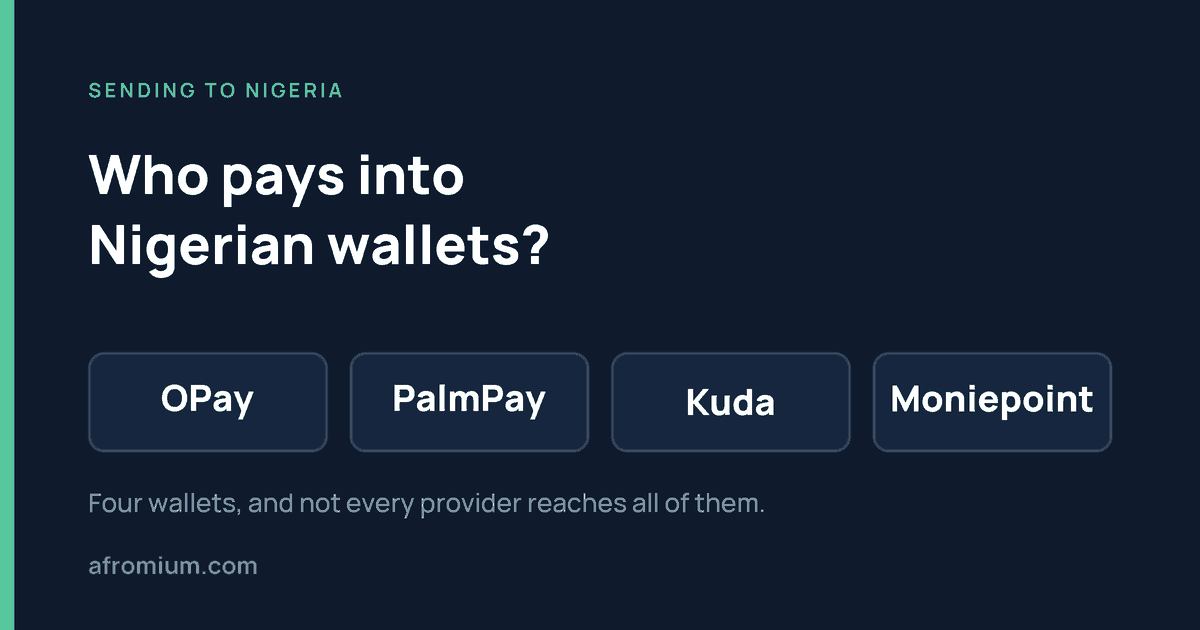
    It is not a special “mobile wallet” route requiring a special product. We set out which services pay into Moniepoint, OPay, PalmPay and Kuda, read from each provider’s own directory, in which transfer services pay into OPay, PalmPay, Kuda and Moniepoint. How the account number itself is structured is in Nigerian account numbers and bank codes.

    How money actually reaches a Moniepoint account

    Concretely: someone in Texas wants to send to their mother in Abuja, who uses Moniepoint.

    He does not need her Moniepoint app to accept dollars. He opens a provider that supports the corridor, picks Nigeria, selects MoniePoint as the receiving institution, enters her account details and funds it in USD. The provider carries the cross-border leg. Moniepoint is where the Nigerian payout lands.

    From her side, money arrived in Moniepoint from abroad. From the payment system’s side, a remittance company made a cross-border transfer and Moniepoint was the beneficiary institution. Both descriptions are of the same event, and the gap between them is where the confusion lives.

    “Can Moniepoint receive dollars?” — mind the word directly

    Three separate questions get compressed into this one, and compressing them is how people end up disappointed:

    QuestionAnswer
    Can the sender fund a transfer in USD?Yes, through a provider serving that corridor
    Can Moniepoint receive the resulting payout?Yes, where the provider supports it
    Does the recipient end up holding dollars?No — Remitly’s listed MoniePoint payout currency is NGN

    A remittance funded in dollars is not the same thing as a dollar account. An ordinary naira Moniepoint account is not a domiciliary account, and sending USD through a remitter will not turn it into one. The conversion happens on the way, at the rate quoted on the transaction.

    If holding foreign currency is the actual goal, a remittance into a naira account is the wrong instrument entirely, and no provider choice fixes that.

    What MonieWorld actually is

    MonieWorld is Moniepoint’s diaspora product, announced in 2025 for Nigerians in the UK sending money home. It is a separate UK-facing financial service, not the Nigerian app with an extra button.

    Moniepoint’s own terms define it precisely, and the definition answers the currency question outright:

    “The MonieWorld money transfer service, electronic money account, and card issuance service distributed by Moniepoint GB which allows a person domiciled in the United Kingdom to send GBP to a recipient domiciled in Nigeria, and is subsequently remitted in NGN.”

    Domiciled in the United Kingdom. GBP in, NGN out. That is the documented product as of 25 September 2026 — not a general USD, EUR or CAD remittance account, whatever secondary write-ups imply.

    Who can open a MonieWorld account

    MonieWorld’s own site states three requirements. You must:

    • be a UK resident
    • be at least 18 years old
    • have a UK mobile number

    There is also a sending ceiling that nobody mentions and that decides whether the product suits you at all: without a GBP account you are on a starting limit of up to £3,500 a year. A year, not a month. For regular family support that is a real constraint, and it is the single most practical fact on this page for a UK sender.

    Worth knowing too that two entities are involved: GBP accounts with sort code 04-35-91 are provided by Moniepoint GB, and those with sort code 04-19-29 by Moniepoint UK Limited. Moniepoint GB Limited trades as MonieWorld. Which one holds your account determines which terms apply to it.

    So which route is yours?

    You are in…Your route to a Moniepoint account
    United KingdomMonieWorld, if you meet its eligibility rules — or any provider supporting the corridor
    United StatesA provider serving US → Nigeria. Remitly lists MoniePoint.
    CanadaA provider serving Canada → Nigeria. Remitly lists MoniePoint.
    Germany or elsewhere in the EUNot MonieWorld — it requires UK residency. Check whether your provider lists Moniepoint.

    That last row is the one worth being blunt about. Being elsewhere in Europe does not qualify you. The requirement is UK residency and a UK mobile number, and no amount of wanting to send to a Moniepoint account changes it.

    How long each route takes, by provider and payout method, is in how long a transfer to Nigeria really takes.

    Does the Nigerian recipient need MonieWorld?

    No. This is the cleanest way to hold the whole distinction in your head.

    MonieWorld is for the sender in the UK. If someone is sending to your Nigerian Moniepoint account through Remitly or another provider, you do not need to create anything, download anything, or upgrade anything. You supply your account details. That is your entire role.

    Not every provider offers it

    A Moniepoint account being able to receive an international payout does not mean every transfer app in every country lists it. Coverage differs by provider and by sending country — the same provider can offer Moniepoint from one country and not another.

    Check inside the app before you pay, not in an article. You should be able to see MoniePoint in the institution list at the point of entering recipient details. A blog post saying a provider “supports Nigerian banks” is not a substitute, and directories change without announcement.

    What to check before pressing send

    • Recipient’s full name, as registered with Moniepoint
    • The ten-digit account number
    • Receiving institution shown as MoniePoint
    • The NGN amount your recipient will actually get
    • Exchange rate and fee, separately
    • Estimated delivery time

    Check the account number again even if you have sent to this person before through a different service. Having sent successfully once is not verification of anything — and if it does go to the wrong institution, what happens when you pick the wrong Nigerian bank or wallet sets out what can and cannot be recovered.

    If the account is under Post No Debit

    A Nigerian account can carry a Post No Debit restriction. Moniepoint’s support material says a PND blocks outgoing transactions while the account can still receive funds.

    Read that carefully before treating it as good news. Money will land — and then sit there. Your recipient will not be able to withdraw it, transfer it or spend it. Sending an urgent remittance into a PND account converts a problem you could have avoided into money you cannot reach.

    Clear the restriction first, or send to a different account.

    If the provider says it succeeded and nothing arrived

    Start with the provider, not with Moniepoint. Moniepoint cannot search for a transaction you cannot identify, and the international leg uses the provider’s own references until a Nigerian payout is created.

    Establish which of these it is: still processing, awaiting verification, paid into the Nigerian payout system, rejected, returned, or confirmed credited. Only the last one makes it Moniepoint’s problem.

    Once the provider confirms the Nigerian transfer completed, your recipient raises it with Moniepoint using the transaction details. For ordinary Nigerian transfers, Moniepoint’s guidance is to take the session ID to the receiving institution, and to escalate if it is unresolved after 24 hours. Keep both sets of references — the provider’s and the Nigerian one.

    The wider version of this, including what “delivered” means to a provider, is in Remitly says delivered but the money hasn’t arrived.

    Business accounts are a different question

    Do not assume a business collecting international customer payments follows the consumer remittance route. Moniepoint’s business material covers domestic channels — cards, bank transfers — and directs businesses needing international payment capability to its partnerships team, which is a different arrangement with different compliance requirements.

    Receiving support from a relative abroad: consumer remittance. Collecting payment from overseas customers: a commercial product. Treating the second as the first is how businesses end up with accounts under review.

    Questions people ask

    Can Moniepoint receive money from abroad?

    Yes, through a remittance provider that lists it as a Nigerian destination. Remitly lists MoniePoint MFB from several sending countries including the US and Canada. The Moniepoint app is not itself the international sending service.

    Is MonieWorld the same as Moniepoint?

    No. MonieWorld is the UK-facing diaspora product, distributed by Moniepoint GB, letting a person domiciled in the UK send GBP to a recipient in Nigeria who is paid in NGN.

    Can I use MonieWorld from the US or Germany?

    No. It requires UK residency, age 18 or over, and a UK mobile number. Use a provider serving your corridor and check whether it lists Moniepoint.

    How much can MonieWorld send?

    Without a GBP account, the starting limit is up to £3,500 a year. Check your own limit in the app — it is not the same for everyone.

    Will my recipient get dollars?

    No. Remitly lists NGN as the MoniePoint payout currency, and MonieWorld converts GBP to NGN before crediting. Funding a transfer in dollars does not deliver dollars.

    Does my recipient need to do anything?

    Give you their full name as registered and their ten-digit account number. Nothing else — they do not need MonieWorld.

    How we checked this

    Read on 25 September 2026: Moniepoint’s own MonieWorld terms and conditions, for the definition quoted above — a person domiciled in the United Kingdom sending GBP, remitted in NGN; monieworld.com, for the three eligibility requirements, the £3,500 annual starting limit without a GBP account, the two sort codes and their providing entities, and the fact that Moniepoint GB Limited trades as MonieWorld; Remitly’s MoniePoint destination pages for the United States and Canada, for the corridors and the NGN payout currency; Moniepoint’s blog announcement of MonieWorld, for its launch and purpose; Moniepoint’s knowledge base on Post No Debit restrictions and on successful transfers not yet credited, for the receive-but-not-send rule and the session ID escalation; and Moniepoint’s payments page, for the distinction between domestic business collection and international arrangements.

    What we left out

    Several write-ups of MonieWorld cite pages on a lolu.moniepoint.com subdomain for its eligibility rules and currency support. That host does not resolve, so nothing sourced to it can be checked. We verified every MonieWorld claim on this page against Moniepoint’s own terms and the live monieworld.com site instead, and dropped anything we could not find there.

    We have also not published a list of every provider that pays into Moniepoint. Directories change quietly and a stale list is worse than none — check inside your provider before you pay.

    Afromium does not make test transfers. Every claim here was read from the named source on the date given and is quoted, not estimated. Corridors, eligibility rules, limits and fees change — confirm the current options inside the provider before sending.
  • How long does a transfer to Nigeria really take, by provider and payout method?

    How long does a transfer to Nigeria really take, by provider and payout method?

    Last checked 23 September 2026

    Some transfers to Nigeria land in under two minutes. Others take most of a week. The provider matters — but two things most comparison pages leave out matter more: how you paid, and what the money has to do before the Nigerian leg even starts.

    “Money in minutes” is measuring one clock out of three

    When a provider advertises minutes, that almost never means minutes from when you press send. Three separate clocks run, usually in this order:

    1. Your money reaching the provider. A card payment can be instant. A bank transfer can take days.
    2. The provider converting it and running its checks.
    3. The Nigerian payout leg — the only one the headline usually describes.

    Wise separates these more clearly than anyone. Its published funding times are card usually instant, bank transfer 1–4 working days, and SWIFT 1–6 working days. Only after that does conversion and the Nigerian payout begin.

    So a provider can advertise a same-day Nigerian payout, tell the truth, and still leave your family waiting three days. You were reading the third clock and living the first one.

    Nigeria delivery times, by provider and payout method

    Every figure below was read from the provider’s own current pages on 23 September 2026. Where a provider does not publish a Nigeria-specific figure, the cell says so rather than borrowing an industry average.

    ProviderBank depositMobile walletCash pickup
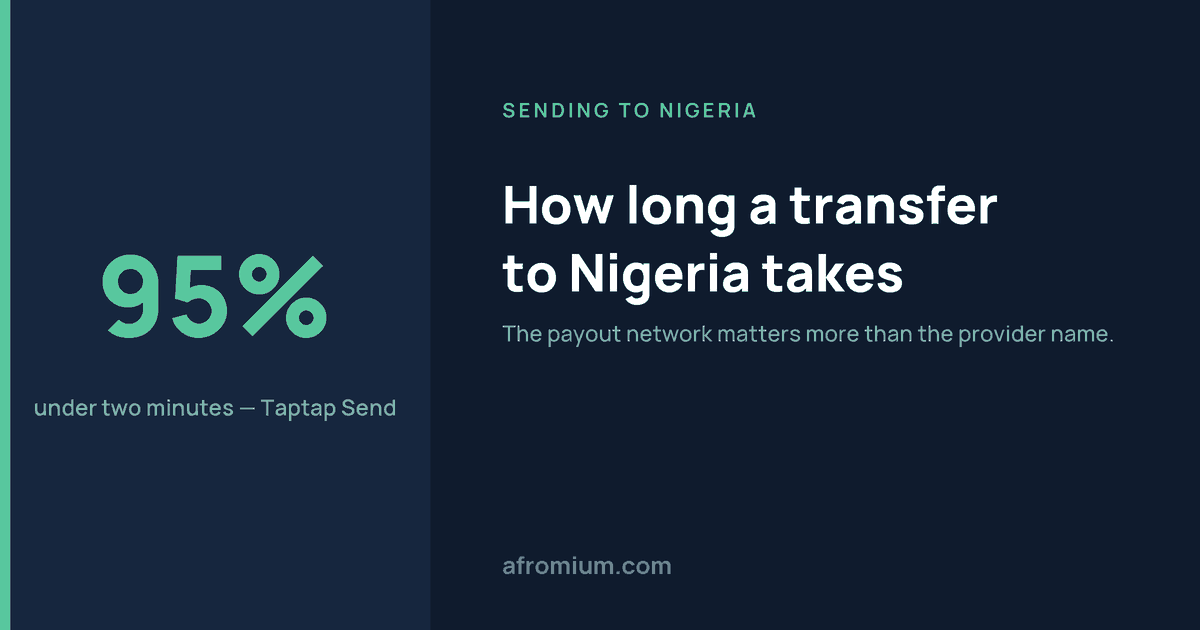
    Taptap SendUnder 2 minutes for 95% of transfers. But the bank may take up to 2 working days to show itNot listed for NigeriaNot listed for Nigeria
    WiseUsually same working day once Wise has received and converted your money. Conversion can take up to 2 working days, and NIBSS may take up to 24 hours to confirm statusNot offered — bank accounts onlyNot offered
    WorldRemit90% of Nigeria transfers reach its local partners within minutes, after which the money is ready for cash collection or goes on to the bank or mobile money account. Note the wording — reaching the partner is not the same moment as landing in the balance
    RemitlyNo Nigeria-wide figure publishedNo Nigeria-wide figure publishedNo Nigeria-wide figure published

    Two things stand out. Taptap Send publishes the most specific claim in the corridor — a percentage, not an adjective — and its Nigeria page was last updated on 18 September 2026. And Wise gives the most useful breakdown, because it tells you which stage each number belongs to.

    Remitly’s blank row is not an oversight. It supports bank deposit, cash pickup and mobile wallet in Nigeria but does not publish one figure covering them all, saying instead that the estimate shown before you confirm is the one that applies to your corridor, funding method and payout method. That is more honest than a single number pretending every route is the same.

    Read WorldRemit’s sentence twice

    “Sent to WorldRemit local partners in Nigeria within minutes” is carefully written, and worth understanding rather than resenting. It describes the money arriving at the Nigerian institution that will pay it out. The recipient seeing it in their balance is a later event that WorldRemit does not control.

    Most “the app says sent but nothing arrived” confusion in this corridor lives in that gap. WorldRemit also publishes one unusually candid figure on the front of the journey: identity verification takes up to four minutes at least 90% of the time.

    A worked example: why Friday costs you three days

    You are in London on Friday afternoon sending £500 to your mother in Lagos. The provider advertises Nigerian bank delivery in minutes. You fund it from your ordinary bank account.

    That bank payment does not clear to the provider until Monday. The Nigerian payout then takes two minutes, exactly as advertised — and your mother waited nearly three calendar days.

    Nothing was mis-sold. You were watching the wrong clock.

    Working days, in two countries

    Every estimate in this corridor counts working days, and there are two calendars involved. Wise states that its estimates use working days and that weekends and public holidays pause processing. Taptap Send warns specifically that Nigerian banks typically do not process transfers at weekends, so a Friday transfer may not show until Monday.

    A public holiday in your country delays the funding leg while Nigerian banks are open. A Nigerian holiday delays the payout while your bank is fine. That is how a transfer sold in minutes crosses four calendar days without ever being late.

    Most of the waiting happens before Nigeria

    This is the part worth checking before you switch providers in frustration.

    How you pay WiseTime for the money to reach Wise
    CardUsually instant
    Bank transfer1–4 working days
    SWIFT1–6 working days

    Look at the spread. The difference between the fastest and slowest funding method is larger than the entire Nigerian payout leg for every provider in the table above.

    Which is why “which provider is fastest?” is close to unanswerable. A bank-funded Wise transfer against a card-funded WorldRemit transfer is not a comparison of Wise and WorldRemit — you changed two variables, and the one you did not name is doing most of the work.

    Instant is a price, not a feature

    The fastest funding method is usually the most expensive one. A bank-funded transfer at £1.99 arriving Tuesday and a card-funded transfer at £4.99 arriving tonight are not a good provider and a bad one. They are the price of urgency, quoted honestly.

    For a hospital bill, pay it. For the money you send your parents every month, sending two days earlier by the cheaper route is the same thing for less. Compare all three numbers together — what lands, what you pay, and when it arrives — which is the argument in transfer fee versus exchange rate.

    What the table cannot tell you

    Published times describe a normal transfer. They do not survive a compliance review.

    Wise says additional checks usually take 2–10 working days and states plainly that it cannot speed them up. Once a provider asks you for identification or proof of funds, the speed table stops being the relevant clock — the review is the bottleneck, and no provider switch fixes it.

    Recipient details are the other common cause. A wrong bank or a mistyped account number does not produce a slow transfer so much as a failed or misdirected one, which is a different problem entirely: how Nigerian bank codes and the NUBAN work.

    When is it actually late?

    Use the estimate attached to your transfer, not the fastest number on this page.

    Taptap Send saying 95% of transfers arrive in under two minutes does not entitle you to declare yours missing at minute three — someone has to be the other 5%. Wise’s same-working-day Nigerian payout starts once Wise has your money and has converted it; if it is still waiting on your bank, the payout is not late because it has not begun.

    Start investigating when the provider’s own estimate has passed and the status no longer explains the delay. Then take the specific route:

    Which providers we left out, and why

    LemFi, Sendwave, MoneyGram and Western Union all run Nigerian routes and all belong in this comparison. They are not in the table because we could not open and read their current Nigeria-specific timings on the day of checking, and a stale speed claim on this page would cause exactly the wrong decision it is meant to prevent.

    We would rather publish four sourced rows than eight half-guessed ones. The table will grow as each is verified, and the date at the top tells you when it was last true.

    Common questions

    How long does it normally take to send money to Nigeria?

    Anywhere from under two minutes to several working days, and the spread is mostly about structure rather than provider quality. Taptap Send publishes 95% of Nigerian bank transfers under two minutes; Wise publishes same-working-day payout after it has received and converted your money, with funding alone taking 1–4 working days by bank transfer. Both are true. They measure different things.

    Which provider is fastest to Nigeria?

    There is not enough comparable published evidence to crown one. Taptap Send has the strongest Nigeria-specific statistic; WorldRemit publishes 90% to local partners within minutes; Wise publishes the clearest stage-by-stage breakdown. Your funding method can erase the difference between any of them.

    Is bank deposit slower than cash pickup?

    Not necessarily. Taptap Send sends straight to Nigerian bank accounts and reports 95% under two minutes. The payout network matters far more than the label on the method.

    Can money arrive in Nigeria at the weekend?

    Do not count on it. Taptap Send warns that Nigerian banks typically do not process transfers at weekends, and Wise counts working days in its estimates. Cash pickup additionally depends on the agent location being open.

    Why was my last transfer instant and this one isn’t?

    Something changed — funding method, amount, time of day, receiving bank, a holiday, or a verification check. One transfer arriving in forty seconds does not make forty seconds your provider’s commitment. Check the estimate on the new transaction.

    Does Wise send to Nigerian mobile wallets?

    No. Wise sends NGN to personal and business bank accounts only, and needs the recipient’s full name in English characters, the bank code and the 10-digit account number. For wallets, see which services pay into OPay, PalmPay, Kuda and Moniepoint.

    The only number that really applies to you

    This page is for deciding where to start. It tells you that Taptap Send publishes an unusually fast and unusually specific Nigerian bank figure, that Wise’s payout is normally same working day once funding and conversion are done, and that WorldRemit reaches its Nigerian partners within minutes 90% of the time.

    But when you are actually sending £500 today, the number that governs is the provider’s estimate for that exact transfer. Check it after choosing how you will pay, then check it again after choosing bank, wallet or cash — because those are the two choices the headline leaves out, and between them they account for most of the waiting.

    How we checked this

    Read on 23 September 2026, first-hand: Wise’s guide to NGN transfers for the same-working-day payout, the two-working-day conversion window, the NIBSS 24-hour note and the bank-accounts-only rule, plus its published funding times and its note on additional checks; Taptap Send’s Nigeria help page, last updated 18 September 2026, for the 95%-under-two-minutes figure, the two-working-day bank caveat and the weekend warning; WorldRemit’s Nigeria page for the 90%-to-local-partners figure, its payout methods and its identity-verification timing; and Remitly’s Nigeria material, which supports all three payout methods without publishing a single Nigeria-wide delivery time.

    We have not sent a test transfer. LemFi, Sendwave, MoneyGram and Western Union are absent because we could not read their current Nigeria timings on the day, and we do not fill gaps with averages. Delivery times in this corridor change, so treat this as a starting point and trust the estimate your provider shows you. This is general information about a process, not advice about your particular transfer — if something here no longer matches what your provider publishes, let us know and we will correct it.

    Related

  • I sent money to PalmPay instead of OPay — what now?

    I sent money to PalmPay instead of OPay — what now?

    Last checked 23 September 2026

    You meant to send to an OPay account, entered the ten digits correctly, and picked PalmPay. Everything now depends on one question: did the transfer fail, is it still being processed, or has it been credited to a real account at the institution you chose? The first two are usually fixable. The third is a recovery process with no guaranteed ending, and it gets weaker every hour you wait.

    This page is written around PalmPay and OPay because that is the pair people mix up most, but the mechanism is identical for any wrong Nigerian bank, fintech or wallet — Kuda instead of Moniepoint, GTBank instead of Zenith, any of them.

    Do this first, before reading the rest

    If the transfer has not completed, the fastest route to your money is to stop it — and that window is measured in minutes, not days. Open the app you sent from, check the status, and if it is anything other than completed, contact the provider now. Come back to this page afterwards.

    If it has completed, the rest of this page explains what actually happens next, including the parts most guides get wrong.

    Which of three situations are you in?

    What happenedWhat it meansWhat to do
    The transfer has not left the provider yetStill fixable at the sourceCancel or correct the recipient details now
    The number does not exist at the institution you pickedValidation fails; the money is rejected, held or returnedCheck the status, then correct or cancel
    The number exists there, under a different nameA real stranger has your moneyReport an erroneous transfer and request a recall immediately

    The third is the hard one, and whether you are in it was decided on the confirmation screen, by a piece of text most people never read.

    Why the institution is half the address

    A Nigerian account number is ten digits, and under the CBN’s NUBAN standard those digits only have to be unique within one institution. They are not unique across Nigeria. We set out the full mechanism in how Nigerian bank codes and the 10-digit NUBAN work.

    So if your recipient’s OPay account is 0123456789, there can also be a 0123456789 at PalmPay — belonging to somebody else entirely. The payment system is never asked who you meant to pay. It is asked who owns 0123456789 at PalmPay, and it answers correctly.

    Which is why the safeguard is not the digits. It is the name that comes back.

    The name on the confirmation screen is the whole safeguard

    Nigerian transfers resolve the institution and account number and return the account holder’s name before you confirm. The CBN’s own instant transfer regulation requires providers to “provide Name Enquiry support to minimize instances of wrong credits”. That returned name is the entire purpose of the step.

    People miss it, and the reason is ordinary rather than careless: you are concentrating on whether you copied ten digits correctly from WhatsApp, and the name appears in small grey text underneath at exactly that moment. If you meant to pay ADEYEMI OLAWALE and the screen returned CHIDI NWOSU, that was the warning — and once you confirm past it, you no longer have an invalid-account problem. You have a wrong-recipient problem, which is a much harder one.

    If you have not sent it yet

    The easy case. Go back, select the right institution, enter the ten digits again, and wait for the name.

    Do not simply switch PalmPay to OPay and press send on the basis that the number is definitely right. You have been handed a second chance to read the returned name. Use it. If the name still does not match, ask your recipient to open their app and send you the account details from inside it rather than retyping them into a chat.

    If you have sent it: check the status now

    Not tomorrow, on the chance that it somehow reaches the right person. Open the app and establish whether the transfer is still processing, failed, or completed. That single fact decides everything that follows.

    Still processing — try to stop it

    With an international provider the money may still be inside their system rather than in Nigeria. Contact them immediately and say you need the transfer stopped.

    Do not spend twenty minutes first working out whether PalmPay and OPay can share account numbers. They can. That question can wait; the window cannot.

    Failed — better than it feels

    A failed transfer usually means the institution you picked has no matching account, or the provider could not deliver on the details given. Check whether the provider says the money is being returned automatically, and confirm where it is going back to.

    Do not send a replacement until you know what happened to the first one. If both eventually land, you have sent the money twice and you are back in a recovery process by a different route.

    Completed — treat it as serious

    Find the account name shown on the original receipt. If it is not your intended recipient, report it in these words:

    I made an erroneous transfer to the wrong beneficiary. I need to request a transfer recall.

    Use erroneous transfer and wrong beneficiary. “My transfer went wrong” gets logged as a failed or delayed payment, which is a different queue with a different process. You are reporting a payment that succeeded exactly as instructed, to the wrong place.

    What actually happens when you report it

    Nigeria has a written procedure for this. The CBN’s Regulation on Instant (Inter-Bank) Electronic Funds Transfer Services in Nigeria, published July 2018, sets out what happens at section 10.4, Transfer Recall Due to Customer Error. It is worth knowing in detail, because it is both better and worse than people expect.

    1. If you know the beneficiary, the sending institution is to encourage you to contact them for an amicable settlement.
    2. If you do not know them, or a known beneficiary refuses to refund, the sending institution — having received what the regulation calls a tenable claim — notifies the receiving institution, which places a lien on the amount in that account and then obtains the beneficiary’s consent to execute the refund.
    3. If the beneficiary does not consent, the internal auditors of both institutions mediate between the two customers within two weeks, and the regulation says their decision is final. It also says the lien must not last longer than two weeks.
    4. If the money has already been spent so that no lien can be placed, and the beneficiary refuses to fund the account for a refund, the receiving institution’s internal auditors watch-list that person’s BVN, and the sending institution may report the matter to law enforcement.

    Read step 2 again. A lien can be placed quickly — but the refund still requires the stranger’s consent. That is the single most important thing on this page, and it is why “just call OPay, they will reverse it” is bad advice.

    Why your case is the weaker one

    The same regulation handles a different scenario far more decisively. Where a bank wrongly credits an account through its own error, and reversal is requested in writing within 14 working days, the receiving institution is to oblige within one business day, without recourse to the beneficiary, provided the funds are there. No consent required.

    That is not your situation. You authorised the transfer, and the system executed it as instructed. Institution error gets the fast automatic route; customer error gets the lien-and-consent route. The gap between those two paragraphs is the entire difference between a day and a fortnight, or between recovery and none.

    One provision worth quoting at anyone who says the money is theirs now

    In the wrong-credit section the regulation states that a receiving institution shall not use a wrong credit to settle the customer’s debts to it, and shall not consider such credit the property of the customer. Money that arrives by mistake is not a windfall, and Nigerian regulation says so plainly.

    If you sent from outside Nigeria

    An important practical point. This CBN process governs the Nigerian leg of the payment, between Nigerian institutions. If you sent from Germany or the UK through Remitly, Wise or Taptap Send, you are not the customer of a Nigerian sending institution, so you cannot walk into that process directly.

    Your route in is through the provider you paid, which deals with its Nigerian payout partner. Your intended recipient, who is in Nigeria, may also be able to raise it locally. Report it to your provider first, in writing, and ask specifically whether a recall can be raised with their Nigerian partner.

    If the stranger agrees — or refuses

    Agreement is the cleanest outcome, and the regulation itself pushes for it where the beneficiary is known to you. If you know them, contact them now.

    If you do not know them, do not go looking on social media for somebody based on a name a banking system returned. Report it through your provider and let the receiving institution make contact. And be careful with unusual proposals: if someone says send me ₦20,000 first and I will return the ₦100,000, stop. Keep the whole thing inside the documented process.

    A refusal does not end the case — that is what the two-week mediation and the BVN watch-listing provisions exist for. But be realistic about what those achieve. A watch-listing is a consequence for the other person. It is not a mechanism that puts money back in your account.

    If it has already been spent

    The worst of the outcomes. With nothing in the account, there is nothing to place a lien on.

    One detail is worth knowing: in the wrong-credit section the regulation says the receiving institution shall refund as soon as funds are partially or fully available. Partial recovery is contemplated. But a regulatory claim and an available balance are not the same thing, and no honest guide can promise that a completed transfer to a real stranger comes back.

    Which is the real argument for reporting within minutes rather than days. Report at 10:12 on a transfer made at 10:05 and the money is probably still sitting there. Discover it on Thursday and it may not be.

    What to give your provider

    Have these ready before you contact anyone:

    • transaction reference
    • amount, and the exact date and time
    • the institution you selected by mistake
    • the account number used, and the account name that was returned for it
    • the institution and account details you intended to use

    Then send something like this, in writing:

    I authorised this transfer but selected the wrong receiving institution. Please treat it as an erroneous transfer and initiate a recall immediately. The funds were intended for [correct institution] but were sent to [wrong institution]. Please give me a case reference and confirm whether the receiving institution has been notified.

    Keep the case reference. If this has to be escalated later, a dated reference tied to the transaction is worth far more than “I called someone on Tuesday.”

    What each provider says

    Wise

    Wise publishes the clearest ladder of the three, and it maps exactly onto the three situations above.

    StatusWhat Wise says
    Set up, not paidCancel it yourself
    Paid, status not updatedStill cancellable; the refund waits for your money to reach Wise
    Being processedButton gone. “We might still be able to cancel it for you, but we can’t guarantee it” — a “very small window”, so contact them at once
    Complete“The money is already in the recipient’s banking system and we have no way to bring it back”

    On wrong details specifically, Wise draws the same distinction this page does. If the details are simply wrong, it says the money will most likely be rejected by the bank and returned, after which you can correct them or take a full refund. But if the transfer reached the wrong account, Wise says you will need to contact that recipient yourself and ask them to return it.

    Remitly

    You can cancel any time before completion, and Remitly’s European terms define completion precisely: the recipient has claimed the money, or the funds have been credited to their bank account or mobile wallet. After that the transaction amount is not refundable.

    If it has already been delivered, do not open with “I want to cancel.” Say the transfer was delivered to the wrong recipient because the wrong receiving institution was selected, and ask what recall procedure exists through their Nigerian payout partner. More on the mechanics in why a Remitly transfer to Nigeria is still pending.

    Taptap Send

    Taptap Send says that where a transfer shows as cancelled, failed or refunded, the funds have already been sent back to your original payment method. It also notes that failures can come from the recipient’s end — incorrect account details, or a mobile money wallet that is full. Worth knowing, because a full wallet looks like a mistake on your side and is not one.

    So this does not happen again

    Not memorising bank codes. Reading the name.

    For a large payment there is one more safeguard worth the trouble: send a small amount first, ask the recipient to confirm they have it, and only then send the rest. On ₦500,000 that is a few minutes to protect the other ₦499,900. It is not free — your provider’s fees or minimums still apply, and on a small international transfer a fixed fee can make it uneconomic — but domestically it costs almost nothing.

    If a test transfer is not practical, at minimum read the returned name and check the institution against what your recipient actually sent you. Which services pay into OPay, PalmPay, Kuda and Moniepoint covers picking the right one in the first place.

    Common questions

    Can the same account number exist at both OPay and PalmPay?

    Yes. The NUBAN standard requires a ten-digit number to be unique within each institution, not across every institution in Nigeria. That is precisely why the institution forms part of the address, and why choosing the wrong one can send money to a different person.

    Will it just fail automatically?

    Not necessarily. If those digits match no account at the institution you picked, validation or delivery fails. If they match a real one, the money can be credited to it. The account name returned during validation is what tells you which happened.

    Does a wrong transfer come back automatically after 24 hours?

    No, and this is a costly thing to believe. A failed payment may reverse on its own. A successful payment to a real but unintended account does not — it requires the recall process. Waiting a day to find out makes the second case worse.

    Can the receiving institution freeze the money?

    It can place a lien on the disputed amount once your institution passes on a tenable claim, and it then seeks the beneficiary’s consent to refund. Two limits are worth knowing: the lien only covers what is still in the account, and the regulation says it must not last more than two weeks.

    Will I need a court order?

    Not as a first step. The regulation provides an institutional recall and mediation process that runs without one. In practice some institutions ask for further documentation when voluntary recovery fails. If yours does, ask precisely what document is required and why before spending money obtaining it.

    Should I go to the police?

    Start with the institution that sent the money. A selection mistake is not fraud, and your first job is to get the erroneous transfer documented fast enough for a lien to be worth placing. Law enforcement becomes relevant at the end of the process — the regulation provides for a report where the beneficiary has spent the money and refuses to make it good.

    The one line to take away

    Ten digits do not identify anybody in Nigeria. The institution completes the address, which makes 0123456789 at OPay and 0123456789 at PalmPay two different destinations with two different owners.

    Read the name that comes back. If it is not your recipient, stop there — that is the last moment this is free. And if you only notice afterwards, do not wait for a stranger to volunteer your money back. Save the receipt, report an erroneous transfer, and ask for the recall while there is still something in the account to place a lien on.

    How we checked this

    Read on 23 September 2026: the Central Bank of Nigeria’s Regulation on Instant (Inter-Bank) Electronic Funds Transfer Services in Nigeria, July 2018, in particular section 10.2 on wrong credits and section 10.4 on transfer recall due to customer error; the CBN’s NUBAN standard for the account-numbering rule; Wise’s help centre article on cancelling a transfer, including what it says about wrong recipient details; Remitly Europe Limited’s user agreement for customers in Germany, section 9.2, for the definition of completion; and Taptap Send’s help centre on common transfer problems.

    The CBN regulation quoted here dates from July 2018 and was read from a full-text republication, because the CBN’s own site was not reachable on the day of checking. If it has since been amended, the amended version governs. We have deliberately left out one bank’s published wrong-beneficiary procedure that we could not open and verify, and a reported individual recovery case, because a named private dispute is not evidence of what will happen to you. We have not sent a test transfer. This is general information about a process, not advice about your particular payment — if something here no longer matches what your provider or bank tells you, let us know and we will correct it.

    Related

  • “Invalid account number”: how Nigerian bank codes and the 10-digit NUBAN work

    “Invalid account number”: how Nigerian bank codes and the 10-digit NUBAN work

    Last checked 22 September 2026

    You paste in your brother’s Nigerian account number. Ten digits, exactly as he sent them. You pick his bank, tap continue, and get “invalid account number”. You try again and get the same thing. Before you ask him for a different account, check the bank you selected — in Nigeria the account number alone does not identify an account.

    The short version

    A Nigerian account number is ten digits, and the Central Bank of Nigeria’s standard says plainly that it is unique within each deposit-taking institution — not across the country. The same ten digits can exist at another institution and belong to somebody else entirely. That is why every transfer form makes you choose a bank as well.

    So an “invalid account number” error almost always means one of three things, and each needs a different fix: the number is wrong, the institution you selected is wrong, or the provider could not verify the account just then. Re-typing the same digits fixes none of them.

    What NUBAN actually is

    NUBAN stands for Nigeria Uniform Bank Account Number. The CBN first issued the standard in August 2010 to give every deposit money bank the same account-numbering structure, then replaced it with a revised standard covering Other Financial Institutions as well. That revision is why fintechs such as OPay, PalmPay, Kuda and Moniepoint issue account numbers that look and behave exactly like a traditional bank’s.

    The number you are given is ten digits: nine identifying the account, and a final check digit. That check digit is not decorative. It is calculated from the account serial together with a six-digit code identifying the institution — which is the single most important thing on this page, because it means a real account number can fail validation purely because the wrong bank was selected.

    Two things follow:

    • Mistyped digits usually get caught. Change one number and the check digit no longer agrees, so the form rejects it. That is the system working.
    • The institution is half the identification. Right digits, wrong bank, and the check fails exactly as though you had mistyped it.

    You never need to do this arithmetic yourself — the institution issues the number. If a digit looks wrong, ask the recipient to read it out again. Never try to work out a replacement check digit.

    Bank code, sort code, SWIFT, NUBAN — which is which

    TermWhat it identifiesWhen you need it
    NUBANThe recipient’s account — the ten digits they give youAlways, for a Nigerian bank deposit
    Bank / institution codeThe institution holding the account. Three digits for a bank, five for an other financial institutionAlongside the account number, for a naira payout
    Sort codeInstitution, state and branch, under Nigeria’s own sort-code structureOnly when a form specifically asks for a Nigerian sort code
    SWIFT / BICA bank in the international messaging networkOnly for an international wire — not a normal naira payout

    Wise, for example, asks for the recipient’s full name in English characters, a bank code, and the ten-digit account number. It does not ask for a SWIFT code for that payout method, and it does not ask for an IBAN — Nigeria does not use IBANs for naira deposits.

    Do not copy a code off an unrelated bank-code lookup site because the digits look about right. Use the institution exactly as it appears in your provider’s own recipient list.

    Six reasons a Nigerian account number gets rejected

    “Invalid account number” is a generic message. Providers run several different checks — does this look like a valid number, does this account exist, does the name match, can we even reach that institution — and the error rarely tells you which one failed. Work through these in order.

    1. A leading zero has vanished

    If the number is 0012345678 and it has passed through a spreadsheet, a notes app, or anything that treats it as a number rather than text, it arrives as 12345678 — eight digits instead of ten.

    This is the most common cause of all. Copy account numbers as text, and if digits are missing, go back to the original rather than guessing how many zeros to put back.

    2. The wrong institution is selected

    A real account number checked against the wrong institution fails, for the reason explained above. This happens constantly with the fintechs, whose names sit close together in a long dropdown.

    If your recipient uses PalmPay, select PalmPay — not the first plausible entry in the list. And if the institution is not in the list at all, that is a different problem: not every service reaches OPay, PalmPay, Kuda and Moniepoint.

    3. A digit is simply wrong

    The check digit catches many typing errors but not all of them. Compare the whole number against the recipient’s details one digit at a time. A number that passes validation can still belong to a stranger.

    4. The account-holder name does not match

    Nigeria’s interbank infrastructure includes a name-enquiry service that lets institutions confirm who an account belongs to before money moves. Many apps show you that name before you pay.

    Read it. If you are sending to Chinedu Okafor and the app returns a different name, stop. Do not edit the name to make a warning go away, and do not proceed because the digits look right. Ask the recipient to explain the name on the account — married names and business names have innocent explanations. A name you cannot account for means an account you should not pay.

    5. The provider does not reach that institution

    An account can be entirely valid, work perfectly for domestic Nigerian transfers, and still be unreachable through the service you are using. Wise documents naira payouts to Nigerian personal and business bank accounts but does not publish which institutions those are.

    If the institution is not in the provider’s recipient list, no amount of re-typing will help. You need a different provider, or a different account.

    6. Verification failed at that moment

    Sometimes nothing is wrong with the number — the provider simply could not reach the service that confirms it. A failed lookup is not proof of an invalid account.

    If you have checked everything and it still fails, ask support one specific question: is this a format problem, an unsupported institution, or a verification failure? Three different problems, three different fixes. What you must not do is keep submitting different combinations of details hoping one goes through.

    If you have already sent it to the wrong account

    Speed is the only advantage you have. Correcting details before the money moves is a completely different problem from recovering it afterwards.

    If the transfer is still processing, contact the provider now and ask whether it can be amended or cancelled. Once the money has left their system, that option usually closes. If it has already landed in the wrong account, ask for a recovery investigation and do not assume it will bounce back by itself — money that reaches a stranger’s account and is withdrawn is often gone, and where the wrong details came from you rather than the provider, what you can claim is narrower. What to do when a transfer says delivered but nothing arrived covers how that plays out.

    If the payment was rejected and returned, wait for written confirmation of the refund before sending again, or you risk paying twice.

    The actual rule, for anyone who wants it

    You do not need this to send money. It is here because it is hard to find stated correctly, and because it explains precisely why the wrong bank breaks a right number.

    Internally the standard defines a 16-digit structure, ABCDEF-GHIJKLMNO-P, even though the customer only ever sees ten digits:

    • ABCDEF — a six-digit institution identifier. A bank’s three-digit CBN code is padded with leading zeros (011 becomes 000011). An other financial institution’s five-digit code is prefixed with a 9 (50547 becomes 950547).
    • GHIJKLMNO — the nine-digit account serial number.
    • P — the check digit.

    The check digit is calculated across all fifteen preceding digits using alternating weights of 3, 7, 3:

    A×3 + B×7 + C×3 + D×3 + E×7 + F×3 + G×3 + H×7 + I×3 + J×3 + K×7 + L×3 + M×3 + N×7 + O×3
    then take modulo 10, and subtract the remainder from 10.
    If the result is 10, the check digit is 0.

    The standard’s own worked example: a bank with code 011 and account serial 000001457 gives a weighted sum of 81. The remainder on dividing by 10 is 1, and 10 minus 1 is 9 — so the check digit is 9 and the customer’s account number is 0000014579. For an other financial institution coded 50547 with serial 000021457, the sum is 211, the remainder is again 1, and the number is 0000214579.

    Notice what the institution identifier does in that sum. Change the institution and the weighted total changes, so the same nine-digit serial produces a different check digit. That is the arithmetic behind “right number, wrong bank, rejected”.

    Sort codes are a separate structure in the same standard: three-digit bank code, state code, branch code and a check digit for banks, and a leading 9 followed by the five-digit institution code, state code and check digit for other financial institutions. A sort code is not an account number and the two are not interchangeable.

    Common questions

    Are all Nigerian account numbers ten digits?

    For accounts at deposit-taking institutions covered by the standard, yes — it states that the number advised to a customer shall be ten digits. If someone gives you something longer, ask what it is; it may be an internal reference or a card number.

    Can two Nigerian institutions use the same account number?

    Yes. The standard requires uniqueness within each deposit-taking institution, not across all of them. That is exactly why the receiving institution must be identified separately.

    Can I tell which bank someone uses from their account number?

    No. The institution code goes into calculating the check digit but is not shown in the ten digits the customer hands out. The first three digits tell you nothing about the bank.

    Is NUBAN the same as a BVN?

    No, and the difference matters. A NUBAN identifies an account. A Bank Verification Number identifies a person across the Nigerian banking system. A BVN should never be typed into a field asking for an account number, and a sender should never be asked for one.

    Do I need an IBAN to send money to Nigeria?

    No. Nigeria does not use IBANs for naira bank deposits. Name, bank code and the ten-digit account number are what is asked for.

    Can a valid account number still be rejected?

    Yes. Passing a format check only says the number is well formed. It does not establish that the account exists, that it belongs to the person you named, or that your provider can pay into it. Those are separate questions and one error message covers them all.

    Can I check whether an account exists using just the number?

    Not on your own, and not through a random website. Verification runs through licensed payment institutions. Use your provider’s own name check, or ask the recipient’s bank. Typing someone’s banking details into an unfamiliar site is how those details get harvested.

    How we checked this

    The numbering rules, the check-digit algorithm and both worked examples on this page come from the Central Bank of Nigeria’s own document, Revised Standards on Nigeria Uniform Bank Account Number (NUBAN) for Banks and Other Financial Institutions, issued under circular PSM/DIR/CON/CWO/05/030. We read the standard itself rather than a summary of it, and we checked both of its worked calculations by hand before publishing them.

    The provider details — what Wise asks for on a naira transfer, and which institutions appear in a provider’s recipient list — were read from those providers’ own pages on 22 September 2026.

    This is general information, not advice about your particular transfer. If something here no longer matches what your provider tells you, let us know and we will correct it. Our methodology explains what we check and what we do not.

    Related

  • Why is my Remitly transfer to Nigeria still pending?

    Why is my Remitly transfer to Nigeria still pending?

    Last checked 22 September 2026

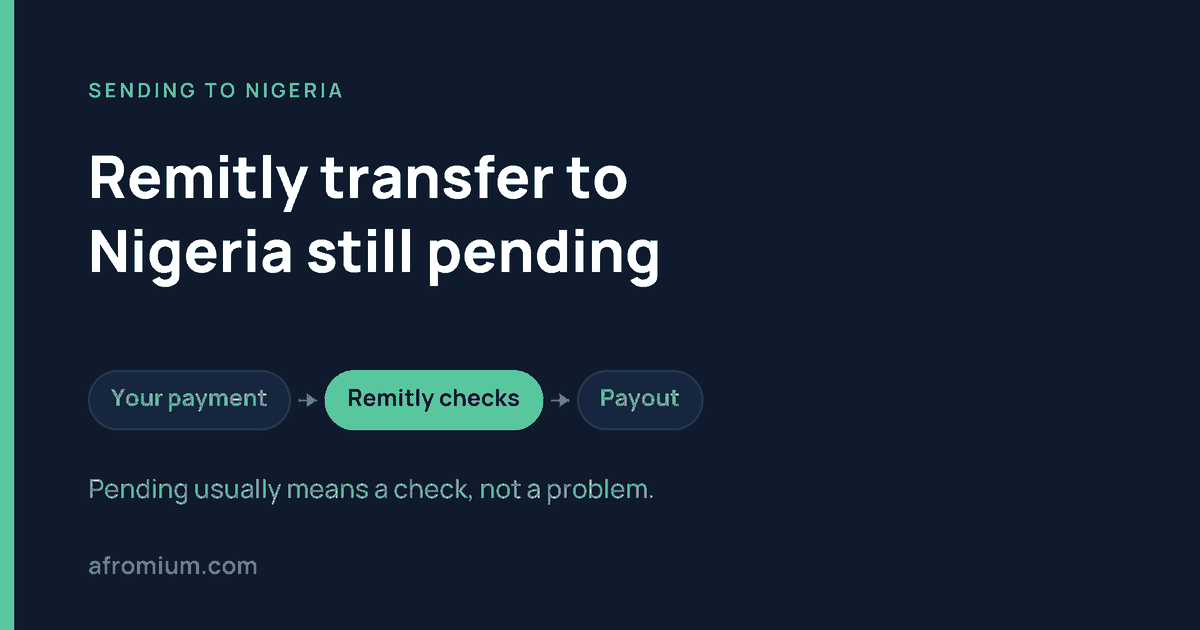
    Your bank has taken the money. The recipient in Nigeria is still waiting. The app has said the same thing for hours: pending. The useful question is not how long it usually takes — it is which of five stages your transfer is actually stuck at, because each one has a different fix.

    Before anything else

    Open the transfer in the app and find its estimated delivery time. Everything below depends on whether that moment has passed. A transfer that is late is a different conversation from one that is simply still in progress, and support will treat the two very differently.

    And do not send a replacement transfer while this one is unresolved. If the first payment later lands, you have sent the money twice, and recovering the second one is slower and weaker than fixing the first.

    What “pending” actually means

    Pending means the transfer is still being processed and has not reached the recipient. That is all it means. It is not a sign that anything has gone wrong, and it does not tell you where the money is.

    That single word covers at least five completely different situations — Remitly waiting for your payment to clear, a compliance review of you, a problem with the recipient’s details, the payment sitting with a Nigerian payout partner, or a banking cutoff. Support will only give you a useful answer if you ask which one applies.

    1. Remitly has not actually received your money yet

    Your banking app shows a debit, so surely Remitly has the money? Not necessarily. A debit on your side and cleared funds on theirs are two different events, sometimes separated by a day or more.

    This is the most common cause of a pending transfer that feels stuck on day one, and it is why the funding method matters so much. A card-funded transfer authorises in seconds. A bank-funded one waits for the payment to clear before Remitly will release anything to Nigeria. Same app, same amount, very different starting speed.

    What to do: ask Remitly directly whether it has confirmed receipt of your payment. If it has not, take it up with your sending bank. Never make a second payment unless Remitly explicitly tells you to.

    2. You are being checked, not the transfer

    A transfer can be held while Remitly verifies your identity or asks about the transaction. This typically happens on a first transfer, on an amount much larger than your usual pattern, or when something triggers an additional review.

    If you have been sending €100 a month and suddenly send €5,000 for a family emergency, expect questions. It is not an accusation, and it does not mean your money is at risk — but nothing moves until the review clears.

    What to do: check your email, your app notifications and your Remitly profile for an outstanding request. Documents go through Remitly’s own app or website and nowhere else. There is no published time limit on these reviews, so if you have submitted everything and the delivery estimate has passed, ask support plainly whether the review is complete or something is still missing.

    3. The recipient’s Nigerian details are not matching

    A ten-digit account number is not enough on its own. The receiving institution has to be right as well, and the account-holder name has to match what the bank holds.

    If your recipient gave you OPay details and you picked a different institution from the dropdown, the transfer can stall at validation or fail during delivery. Name mismatches do the same thing. This matters more in Nigeria than in most places because so many recipients use OPay, PalmPay, Kuda or Moniepoint, and not every service reaches all four — if the institution is not on the provider’s list at all, no amount of waiting will fix it.

    What to do: ask the recipient to read their details straight from their own banking app, then compare them against what is saved on the transfer. If something is wrong, contact Remitly before trying to fix it yourself — what can be changed depends on how far the payment has travelled, and you cannot assume the receiving bank can still be swapped.

    4. It has left Remitly and is with the Nigerian payout partner

    Remitly does not control every stage. Once the payment is handed to a receiving institution or a local partner, a delay there shows up in your app as the same word: pending.

    This is the stage where knowing which stage you are at changes what you do. If Remitly is still reviewing your identity, the recipient’s bank cannot help. If the payment is already with a Nigerian partner, Remitly has to chase it there — and the recipient is worth asking to check their transaction history, because occasionally the money has arrived and only the tracking status is stale.

    If the status has changed to delivered and there is still no money, stop here and read what to do when Remitly says delivered but nothing arrived. That is a different problem with a different escalation route.

    5. You sent it into a cutoff, a weekend or a holiday

    A Friday evening transfer does not behave like a Tuesday morning one. Banking cutoffs, weekends and public holidays in either country can push out delivery, and a Nigerian public holiday will do it even when it is an ordinary working day where you are.

    That said, do not accept “it’s the weekend” as a blanket explanation. Some payout methods run outside banking hours and some do not. Your own transfer’s estimate already accounts for this, which is why it beats any general rule about how long Nigeria takes. The general mechanics of transfer delays covers this in more detail.

    So what should you do right now?

    Where you areWhat to do
    The estimated delivery time has not passedCheck the transfer details for anything asking for action from you. Otherwise wait.
    Remitly has asked for documentsSubmit them through the official app or website. Nothing moves until you do.
    Your payment has not been confirmed as receivedCheck the debit with your sending bank, and ask Remitly whether it has the funds.
    The estimated delivery time has passedContact Remitly. Ask which stage it is at and request an updated estimate.
    Pending for several days with no explanationAsk for the transaction to be investigated, and get a case reference.

    If the money is needed for something genuinely time-critical, say so when you make contact. It will not skip a compliance review or make a Nigerian bank open on a holiday, but it can affect how a case is handled.

    Finding the real status yourself

    You do not need support for this. In the app, sign in, find the transfer on the home screen or under all transactions, and open it. On the website, sign in and open Transfer history.

    Look for four things: the current status, the reference number, the estimated arrival time, and any message asking you for information. That last one is the single most common reason a transfer sits still — a request nobody noticed, sitting in a spam folder.

    The one question worth asking support

    Remitly offers phone and chat 24 hours a day. “Where is my money?” gets you a reply explaining that transfers take time. Ask this instead:

    Have you received my payment, is the transaction under review, or is it waiting on the Nigerian receiving institution?

    Those are three different problems with three different owners, and the answer tells you who can actually move it.

    A message you can send

    My transfer to Nigeria is still pending and the estimated delivery time has passed.

    Transfer reference: [reference]
    Sending amount: [amount and currency]
    Recipient’s institution: [bank or wallet]
    Estimated delivery time given: [date and time]

    Please confirm whether you have received my payment, and tell me which stage is causing the delay. If any verification or action is needed from me, say what it is. Please also give me an updated delivery estimate, and a case reference if this needs investigating.

    If the reply just repeats that the transfer is processing, ask whether there is a specific outstanding step. Keep the reference number to hand for any follow-up.

    Can you cancel while it is still pending?

    Possibly — and the pending window is the only time it is realistic. Once money has been delivered or collected, cancellation is no longer the route and you are into a dispute instead.

    Remitly may need to confirm with its payout partner that delivery has not already happened before it refunds anything, so this is not instant. The exact terms — including how quickly a refund comes back — depend on which Remitly entity you contracted with: Remitly Europe Limited, regulated by the Central Bank of Ireland, if you sent from the EU or EEA, or Remitly U.K., Ltd, authorised by the Financial Conduct Authority, if you sent from the UK. Read the user agreement that applies to you rather than a refund timetable quoted from another country.

    If you have decided to use a different service because the recipient cannot wait, find out what happens to the original transfer first. Otherwise both payments arrive and you are chasing a refund instead of a delay.

    If it is late, ask for the fee back

    Remitly advertises a delivery-time promise on its Nigeria pages: transfers delivered on time, or it refunds the fee. If yours misses its promised delivery time, ask support whether it qualifies.

    Be clear about what that is worth. A fee refund is the fee — if you sent €200 and paid €2.99, the refund is €2.99, and the €200 is still on its way. It is not compensation and it is not a cancellation. Worth asking for, not worth confusing with getting your money back.

    It is also worth remembering that the fee was never the main cost. On most transfers to Nigeria the exchange-rate markup takes several times more than the fee does — see fee vs exchange rate.

    Common questions

    My bank has debited me. Why does Remitly still say pending?

    Because a debit on your statement is not the same as cleared funds on Remitly’s side, particularly with a bank-funded transfer. Ask Remitly whether it has confirmed receipt of your payment.

    Does pending mean my money is lost?

    No. It means the transfer is in progress and has not reached the recipient. It is not evidence of failure. But if the delivery estimate has passed, ask for an investigation rather than assuming it is normal.

    It has been pending 24 hours. Should I worry?

    Twenty-four hours on its own tells you nothing. Compare it against the estimate you were given. If that has passed, contact support. If it has not, check for an outstanding verification request and wait.

    Why is my first transfer slower?

    First transfers commonly trigger identity verification. Check your email and your Remitly profile for a request. If there is none and the estimate has passed, contact support.

    Can I change the recipient’s bank while it is pending?

    Sometimes, depending on how far it has progressed. Contact Remitly rather than assuming — and do it quickly, because the window closes as the payment moves.

    What if Remitly cancels my transfer?

    Read the cancellation message for the reason and the refund information. Refunds normally go back to the original payment method, and how long that takes depends on how you paid. If the cancellation was caused by wrong recipient details, confirm the correct ones before starting again.

    Cancelled, on hold and sending paused are three different situations with three different correct responses — we set out all of them, and the five official hold reasons, in why was my Remitly transfer cancelled, paused or put on hold.

    How we checked this

    Read on 22 September 2026 from Remitly’s own pages: its Nigeria transfer pages for senders in Germany and the United Kingdom, including the delivery-time promise and the published payout methods, and its help and complaints pages, including the regulated-entity details in their footers.

    We have not sent a test transfer through Remitly, and we have deliberately left out refund timetables quoted for countries other than your own, because those terms differ by the entity you contracted with. This is general information about a process, not advice about your particular transfer. If something here no longer matches what Remitly tells you, let us know and we will correct it. Our methodology explains what we check and what we do not.

    Related

  • Remitly says delivered but the money hasn’t arrived: what to do

    Remitly says delivered but the money hasn’t arrived: what to do

    Last checked 22 September 2026

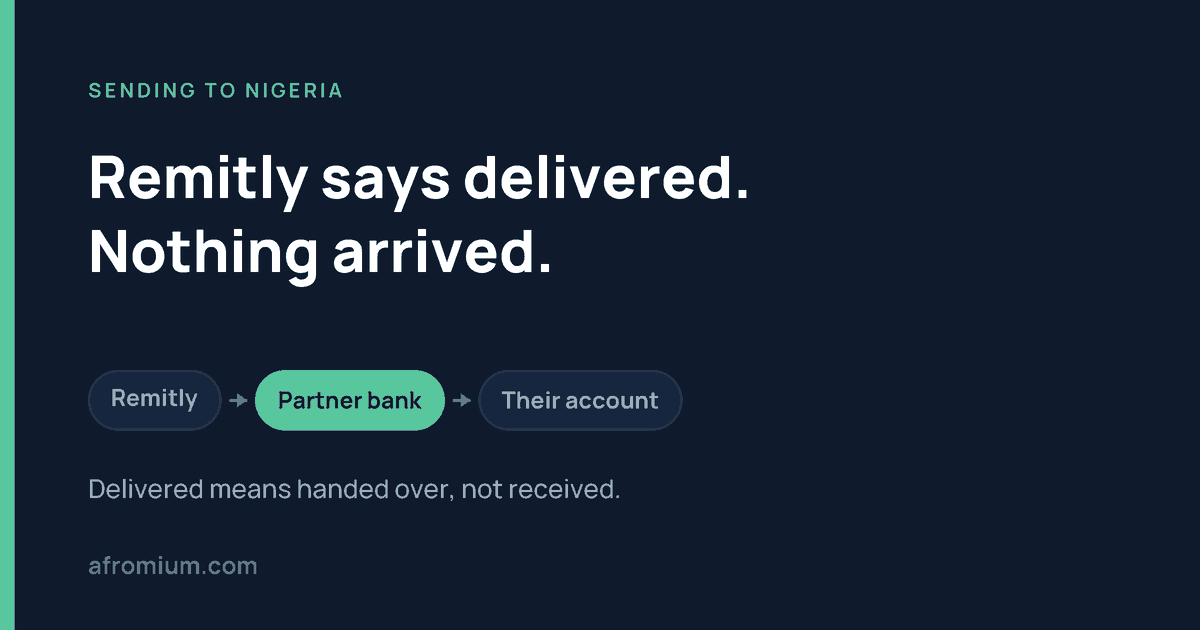
    The app says delivered. The confirmation email arrived. But the person you sent it to says there is nothing in their account. Here is how to find out what actually happened, how to make Remitly investigate rather than reassure you, and what you are entitled to depending on where you sent from.

    First: do not send it again

    The strongest instinct is to send the money a second time, especially if someone is waiting on it. Resist it until you know where the first payment went. If the original transfer later lands, you have paid twice, and getting the second one back is a slower and weaker process than sorting out the first.

    A transfer marked delivered when the recipient has no money is a discrepancy, not an ordinary delay. For a bank deposit, Remitly treats completion as meaning the funds have been credited to the receiving account. So either the money is in an account somewhere, or the status is wrong. Both are worth finding out about, and neither is fixed by sending more money.

    If the transfer is still showing as in progress or pending rather than delivered, that is a different problem — see why a transfer takes longer than promised.

    1. Check the account, not the text message

    A missing credit alert does not prove a payment failed. Alerts get delayed, silenced, sent to an old phone number, or never configured at all.

    Ask the recipient to open their banking app and look at the actual transaction history — not the notifications — for a credit matching the amount and date on your receipt. The description may name a local payment processor rather than Remitly, so tell them to look for the amount rather than the word “Remitly”.

    If you sent to an OPay, PalmPay, Kuda or Moniepoint account, the history has to be checked inside that institution’s own app. See which services actually reach those four — if the service you used does not list the institution, that is a likely cause in itself.

    2. Confirm which account was actually paid

    Open the completed transfer in the Remitly app or in Transfer history on the website, and compare the recipient details on the record against the details the person actually gave you.

    Look hardest at the account number and the receiving institution. A Nigerian account number can be a perfectly valid ten digits and still belong to a stranger. A missing leading zero, one transposed digit, or the wrong bank selected from a dropdown all produce a payment that completes successfully — into somebody else’s account.

    If you find a mistake, tell Remitly straight away and ask two things: which account received the payment, and whether it can be recalled. Speed matters here more than anywhere else in this process. Money that has reached the wrong account and been spent is often unrecoverable, and as you will see below, a mistake you made yourself changes what you are owed.

    3. Report it to Remitly as a discrepancy, not a delay

    Remitly offers phone and chat support 24 hours a day, and a written complaints form. How you word the first message matters. “When will my money arrive?” invites a reply explaining that transfers sometimes take time. That is not your situation.

    Say instead that the transfer is already marked delivered and the recipient has checked their account history and found no matching credit. Have this ready before you start:

    • Your transfer reference number
    • The date and time the delivery was reported
    • The amount and the receiving currency
    • The recipient’s name and receiving institution
    • Confirmation that the recipient has checked their transaction history, not just their alerts

    A message that gets an investigation opened

    My transfer is marked as delivered, but the recipient has not received the money.

    Transfer reference: [reference]
    Delivery date and time: [date]
    Amount and currency: [amount]
    Receiving institution: [bank or wallet]

    The recipient has checked their account balance and full transaction history. There is no matching credit.

    Please investigate the delivery with your payout partner, confirm which account was credited, and provide any transaction-tracking reference the receiving bank can use. Please also give me a case number and tell me when to expect the result of the investigation.

    Ask for the case number even if the agent sounds confident the matter is settled. If the first answer does not resolve it, that number is what stops you starting from the beginning with the next person.

    Share transfer details only through the official app, website or support line. Never post an unredacted receipt in a public forum or social media reply.

    4. Get the receiving bank involved — and keep both investigations joined up

    If Remitly confirms it paid the correct institution, the recipient should take it to that institution with the amount, the date, and any reference Remitly supplied.

    The common failure at this point is being passed back and forth. The bank says it has no record; you relay that to Remitly; Remitly repeats that the payment was delivered. Break the loop by carrying each answer to the other side in writing: give Remitly the bank’s exact response and ask it to reopen or escalate on the strength of it. A customer-facing reference number is often not enough for a receiving bank to trace anything, so ask Remitly specifically for a payout-partner or local transaction reference.

    A note on NIBSS

    For Nigerian payments you may hear NIBSS mentioned — the system that settles transfers between Nigerian banks. Your Remitly reference is not a NIBSS reference, and typing it into a domestic tracker will find nothing. If a bank asks for a local reference, that request goes back to Remitly or its payout partner.

    If Remitly insists the money was delivered

    A delivered status means Remitly considers its obligation met. It is not, by itself, a reason to stop. Ask what the conclusion rests on: which account was credited, at what timestamp, and what the payout partner confirmed. If the receiving bank cannot find the credit, that is new evidence and grounds to ask for the investigation to be reopened.

    At that point, stop relying on ordinary support chat and use the formal complaints route. Keep copies of everything, with dates. Which formal route applies depends entirely on where you sent the money from.

    Your escalation route, by where you sent from

    Sending from Germany or elsewhere in the EU or EEA

    Remitly Europe Limited is regulated by the Central Bank of Ireland. If you are not satisfied with Remitly’s final response, you can refer the complaint to the Financial Services and Pensions Ombudsman in Ireland. It is independent and free to use: info@fspo.ie, +353 1 567 7000, fspo.ie.

    Remitly names this route for customers in Germany, Ireland, Belgium, the Czech Republic, France, Liechtenstein, the Netherlands, Sweden, Poland, Denmark, Italy, Lithuania, Portugal, Slovakia, Austria, Cyprus, Finland, Greece, Latvia, Malta, Norway, Romania and Spain. You need Remitly’s final response first, so ask for it explicitly rather than waiting for one to arrive.

    Sending from the United Kingdom

    Remitly U.K., Ltd is authorised as an electronic money institution by the Financial Conduct Authority, register number 1047222. Remitly’s complaints page names the Irish ombudsman route for EU and EEA countries but does not name a UK scheme, so ask Remitly directly for its final response and which ombudsman scheme covers your complaint.

    Sending from the United States

    US senders have the clearest legal timetable of anyone, under the federal remittance transfer rules:

    • You have 180 days from the date the money was supposed to be available — the date printed on your receipt — to report the error.
    • The provider must investigate and determine whether an error occurred within 90 days of receiving your notice.
    • It must tell you the findings within three business days of finishing the investigation.

    The Consumer Financial Protection Bureau lists failure to deliver the funds at all, and delivery to the wrong recipient, among the errors a provider is responsible for correcting. Your receipt is required to carry the CFPB’s own phone number and website, and you can submit a complaint to the CFPB if Remitly’s answer does not resolve it. Note that some banks and credit unions are exempt from these rules, though that does not apply to a dedicated remittance provider.

    These are US protections. Do not assume the same deadlines apply to a transfer sent from Europe, the UK or Canada.

    The recipient’s side, in Nigeria

    The recipient’s complaint is against their own bank or wallet provider, and it starts there. If that institution does not resolve it, the Central Bank of Nigeria operates a consumer protection route for complaints against institutions it regulates. That runs in parallel with your complaint to Remitly; it does not replace it.

    Will you get your money back?

    Not automatically, and the answer turns on whose mistake it was.

    A transfer can normally be cancelled only before the money has been deposited or collected. Once it is delivered, cancellation is no longer the route — a disputed delivery is a different process with a different outcome.

    Where an investigation shows the funds were never delivered, a refund or a resent transfer is the usual remedy. Where the payment went astray because you supplied the wrong account number, the position is narrower. Under the US rules, a provider is not required to refund or resend if it took specific steps: checking that the routing number matched the institution name you gave before sending, and making reasonable efforts to retrieve the money quickly from the wrong recipient. If it did not take those steps, the exemption does not apply.

    Which is why two people with what looks like the same problem get different answers. Establishing what happened comes before arguing about the remedy.

    Nobody can release your payment for a fee

    A missing transfer makes people desperate, and desperation attracts a particular kind of offer: someone in a comment thread, a WhatsApp group or a search advert who can recover your money or unlock the payment once you pay a charge.

    There is no such service. Contact Remitly only through its own app or website. Never hand over a password, a verification code or a banking PIN, and never pay a fee to release a payment. If someone contacts you claiming to be from Remitly, verify it through the app before you do anything they ask.

    Common questions

    Does delivered definitely mean the money is in the account?

    For a bank deposit, Remitly describes completion as the funds having been credited to the receiving account. Cash pickup and other payout methods complete under different conditions. If there is no matching credit, investigate the delivery rather than trusting the label.

    Can the recipient contact Remitly themselves?

    They can ask, but you are the customer and you hold the reference. Under the US error-resolution process in particular, it is the sender notifying the provider that starts the clock. The recipient’s job is the other half: pursuing their own bank when no credit has arrived.

    How long should I wait before reporting it?

    Do not wait. Waiting is sensible when a transfer is still in progress. Once it says delivered and the recipient has genuinely checked, the discrepancy exists now and reporting it starts the investigation sooner. The investigation itself may take weeks.

    What if I sent it to the wrong account?

    Tell Remitly immediately and ask for recovery to be attempted. Be realistic: money that has landed in a stranger’s account and been withdrawn is often gone, and a sender’s own error limits what you can claim. Speed is the only real advantage you have.

    How we checked this

    Read on 22 September 2026 from primary sources: Remitly’s own help and complaints pages for Ireland and the United Kingdom, including the regulated-entity details published in their footers, and the Consumer Financial Protection Bureau’s guidance on reporting a remittance error, last reviewed by the CFPB in October 2024.

    This is general information about a process, not legal advice, and not advice about your particular transfer. Rules and contact routes change; if you find something here that no longer matches what you are told, tell us and we will correct it. Our methodology explains what we check and what we do not.

    Related

  • Which money transfer services pay into OPay, PalmPay, Kuda and Moniepoint?

    Which money transfer services pay into OPay, PalmPay, Kuda and Moniepoint?

    Last checked 22 September 2026

    Your recipient uses OPay rather than a traditional bank. Will Remitly accept the account? What if they use PalmPay, Kuda or Moniepoint? We checked what five transfer services actually publish, and only one of them answers the question properly.

    The short answer

    • Taptap Send names all four. Its Nigeria help page lists Opay, Palmpay, Kuda Bank and Moniepoint among 24 supported banks for naira deposits.
    • Remitly names three of the four. OPay, PalmPay and Moniepoint each have their own page in Remitly’s destination directory. Kuda does not appear anywhere in it.
    • Wise, WorldRemit and Sendwave publish nothing. All three send to Nigeria, none of them name a single one of these four institutions on their public pages.

    What each service publishes

    ServiceOPayPalmPayKudaMoniepointPayout methods for Nigeria
    Taptap SendListedListedListedListedBank transfer only
    RemitlyListedListedNot listedListedBank deposit, cash pickup, mobile wallet
    WiseNot publishedNot publishedNot publishedNot publishedBank accounts only
    WorldRemitNot publishedNot publishedNot publishedNot publishedBank transfer, cash pickup, mobile money, airtime
    SendwaveNot publishedNot publishedNot publishedNot publishedNot stated on its Nigeria page
    Listed means the service names that institution in its own published material. Not listed means we searched its published directory and the name is absent. Not published means the service does not publish a list at all. Checked 22 September 2026 · No test transfers were made

    Why this question is so hard to answer

    OPay, PalmPay, Kuda and Moniepoint are usually described as apps or wallets, which makes people assume they need a special “mobile wallet” payout option. In practice all four issue an ordinary ten-digit Nigerian account number in the NUBAN format, and most transfer services treat them as banks — entries in a long alphabetical list alongside Access Bank and Zenith.

    That is why searching for “can Remitly send money to OPay” turns up nothing useful. The answer is rarely an article. It is a line item in a dropdown that only appears halfway through setting up a transfer.

    Taptap Send: the only one that names all four

    Taptap Send’s Nigeria help page, last updated on 18 September 2026, lists the banks it supports for naira deposits. Opay, Palmpay, Kuda Bank and Moniepoint all appear, alongside Access Bank, GTBank, Zenith, UBA, Sterling, Providus, Jaiz, Keystone and the rest of the 24 it names.

    Three details from that page are worth knowing before you use it:

    • Bank transfer only. For Nigeria, Taptap Send does not offer cash pickup or a separate wallet payout. Everything goes to a ten-digit NUBAN account number.
    • No transfer fee, but that is not the same as free. Taptap Send states that it charges no fee for Nigeria and that the cost is built into the exchange rate instead. A zero-fee transfer is not automatically the cheapest one — see fee vs exchange rate.
    • Recalls freeze the recipient’s account. If you ask for a transfer to be reversed, Taptap Send says the Nigerian bank places a lien on the recipient’s account while the funds are recovered — a freeze that lifts automatically after two weeks. Worth knowing before you request a recall over a simple mistake.

    Taptap Send also publishes a delivery figure: 95% of its Nigerian bank transfers arrive in under two minutes, though a payment can take up to two working days to show up. That is the company’s own reported performance, not a guarantee about your transfer.

    Remitly: three of the four, and Kuda’s absence

    Remitly publishes the most detailed destination directory of any service we checked — 489 Nigerian institutions on the version shown to senders in Germany, each with its own page. OPay, PalmPay, Moniepoint and Paga are all there, along with a long tail of microfinance and payment service banks: Fairmoney, Sparkle, Carbon, Renmoney, VFD, Airtel/Smartcash PSB, MoMo PSB, 9 Payment Service Bank, GoMoney and KongaPay among them.

    We checked the directory shown to senders in both Germany and the United Kingdom. OPay, PalmPay and Moniepoint appear on both. Kuda appears on neither.

    That is a stronger finding than “we could not confirm it”. Remitly publishes several hundred destinations including obscure microfinance banks, and Kuda is not among them. If your recipient banks with Kuda, do not assume Remitly will reach them — check the recipient selector for your own sending country before you pay.

    Remitly lists bank deposit, cash pickup and mobile wallet as its delivery methods for Nigeria, and its OPay pages exist for senders in the United States as well as the UK and Germany.

    Wise: bank accounts only, and no list

    Wise sends naira to personal and business bank accounts in Nigeria. Its published requirements are the recipient’s full name in English characters, a bank code, and a ten-digit account number. There is no cash pickup and no wallet payout.

    What Wise does not publish is which institutions its bank-code list covers. Since it asks for exactly what these four issue — a bank code and a ten-digit NUBAN — it is worth checking inside the app rather than assuming it works or assuming it does not.

    Wise says a Nigerian bank deposit usually arrives on the same working day once it has received and converted your money, that the conversion itself can take up to two working days, and that NIBSS can take up to 24 hours to confirm a payment’s status. Those estimates only matter once you have established that Wise accepts the receiving account.

    WorldRemit, Sendwave and everyone else

    WorldRemit offers bank transfer, cash pickup, mobile money and airtime top-up to Nigeria. It does not name which mobile money services it reaches. Sendwave, operated by the same parent company, Zepz, does not state its receive methods on its Nigeria page at all.

    The same applies to LemFi, NALA, Western Union and the others people ask about. A service saying it “supports bank deposits to Nigeria” is not evidence that it reaches any particular one of these four. Until a provider names the institution, treat it as unverified rather than as a yes or a no.

    How to check any service yourself in thirty seconds

    1. Open the service and start a transfer to Nigeria as though you were going to send.
    2. Set your real sending country and amount, and choose NGN as the receiving currency.
    3. When it asks for the recipient, open the list of banks and type “opay”, “palmpay”, “kuda” or “moniepoint”.
    4. If the name appears, that service reaches it. Close the app. You have not sent anything and you have not paid anything.

    Do this on the day you are sending. Destination lists change without announcement, and they differ by the country you send from.

    If the account number is rejected

    A valid Nigerian account number does not guarantee that an international service can pay into it. An OPay account that receives transfers from other Nigerian banks without trouble can still be refused by a provider whose payout partner does not reach OPay.

    So check two separate things: whether the details are right, and whether the provider reaches that institution. Look first for a missing leading zero, a mistyped digit, or the wrong institution selected. If the details are correct and it still fails, ask the provider’s support whether that specific institution is supported.

    Do not work through the bank list trying different institutions in the hope one goes through. Money sent to the wrong account is very hard to get back.

    Business accounts are a separate question

    Support for a personal Moniepoint account does not automatically extend to every Moniepoint business account. Remitly names Moniepoint as a destination and separately runs a business product, but neither statement establishes that any given business account is eligible for any given transfer product.

    If you are paying a Nigerian supplier, check that the service permits commercial payments and accepts that exact account type. The same applies to business accounts at OPay, PalmPay and Kuda.

    Common questions

    Can I send money from abroad straight to OPay?

    Yes. Taptap Send lists Opay among its supported Nigerian banks, and Remitly publishes OPay destination pages for senders in Germany, the UK and the US. Check what is available for your own sending country before you pay.

    Which service can send to Kuda?

    Of the five we checked, only Taptap Send names Kuda Bank as a supported destination. Remitly’s published directory does not include it. Wise, WorldRemit and Sendwave publish no list either way.

    Does my recipient need an account with the transfer service?

    Not for a bank deposit. Taptap Send states plainly that the recipient does not need to do anything — the money goes to the account number you supply.

    Will they receive naira or the currency I sent?

    Naira. Every payout described here is an NGN deposit. Sending euros or pounds does not mean euros or pounds arrive in a Nigerian account. If your recipient specifically needs dollars, that is a different product and you need to confirm it rather than assume.

    The service says delivered but nothing arrived. What now?

    Ask the recipient to check the account’s transaction history, then confirm the account details that were actually used. If there is no incoming credit, contact the service with the transfer reference and ask for an investigation. Do not send the money a second time while the first transfer is unresolved.

    How we checked this

    Everything above was read on 22 September 2026 from the providers’ own published pages: Taptap Send’s Nigeria help article, Remitly’s Nigerian destination directory as shown to senders in Germany and the United Kingdom, Wise’s naira transfer guide, and the Nigeria pages of WorldRemit and Sendwave.

    We did not send money through any of these services to confirm that a payment into these accounts completes. A provider can list an institution and a payment can still fail for reasons on the receiving side. Our methodology sets out what we check and what we do not.

    If a provider now shows you something different from what is on this page, tell us and we will correct it.

    Related

  • Before You Send Money from Germany to Nigeria: 6 Things to Check

    Before You Send Money from Germany to Nigeria: 6 Things to Check

    Last reviewed 19 September 2026 · Sources checked on the publication date

    Sending money to Nigeria involves more than finding the lowest advertised fee. Before choosing a service, decide how the recipient will collect the money, compare the final amount they will receive, and check when it is expected to arrive. These steps matter whether you send €50 or €500.

    This guide is the checklist. It does not rank providers or display live quotes — our Germany → Nigeria comparison will do that once our provider quotes are published. Exchange rates, fees, and delivery methods can change between the time you read this page and the time you send.

    1. Ask the recipient how they want to receive the money

    A bank deposit may be convenient if the recipient has an account they use regularly. Cash pickup may suit someone who can reach a participating location and bring the required identification. A mobile wallet works only if the recipient has a supported wallet and the chosen service offers that payout option for the transfer.

    Provider options differ. For example, Wise describes NGN transfers to Nigerian bank accounts, while Remitly lists bank deposit, cash pickup, and mobile wallet options on its Germany → Nigeria page. Check the exact option and participating bank, wallet, or pickup network inside the provider’s quote before proceeding. Our guide to bank deposit, cash pickup and mobile wallet walks through the trade-offs.

    Choose the delivery method first. Comparing a bank deposit from one provider with a cash pickup from another may hide differences in cost and convenience.

    2. Set one total budget

    Decide how much you can spend in euros including any transfer fee. Some services include their fee within the amount you enter; others show a fee added at checkout. If you enter “€500 to send” in both places without checking the total debit, you may end up comparing two different purchases.

    The clearest figure is NGN the recipient will receive for the same total EUR paid. A low fee does not automatically mean more money arrives — the exchange rate matters as much. Transfer fee vs exchange rate shows the arithmetic with a worked example.

    3. Keep the payment method the same

    Paying by bank transfer, debit card, or another method can change the fee and delivery estimate. Compare providers using the same funding method wherever possible. If a faster card-funded transfer costs more, treat it as a separate choice: you may decide the extra cost is worthwhile, but it should be visible.

    Look closely at the quote summary immediately before confirming. The final amount can differ from an earlier marketing example or a rate shown on a provider’s home page.

    4. Separate the welcome offer from the standard rate

    New-customer rates and fee waivers are real savings on a first transfer, but they are not the price you will pay next month. Note whether a quote is a promotion or the standard rate, and if you send regularly, compare both — first-transfer offers explains why the winner can change.

    5. Check recipient details

    Ask the recipient to confirm their legal name and their bank, wallet, or pickup details. For a Wise NGN bank transfer, Wise says it needs the recipient’s full name, bank code, and 10-digit account number. Other services and payout methods have different requirements. Never assume that an old saved recipient record is still correct.

    6. Treat the arrival time as an estimate

    Funding method, identity checks, bank processing, weekends, and holidays may affect delivery. Wise explains several common reasons for delays, and Remitly says delivery times vary by payment and delivery method, transaction review, and system availability. If timing is critical, look at the estimate for your exact transfer at checkout and tell the recipient that it may change. If a transfer is already late, this guide covers what to check.

    A quick check before you press Send

    • Is the total EUR you will pay within your budget?
    • Is the NGN the recipient will receive clearly shown?
    • Does the quote use the correct payment and payout methods?
    • Are you looking at a new-customer offer or the standard rate?
    • Has the recipient confirmed the name and account, wallet, or pickup details?
    • Have you saved the provider’s final quote and expected delivery time?

    The cheapest suitable option can change with the amount, payment method, payout method, and available promotions. Take a fresh quote each time you send rather than relying on the provider that was cheapest last month.

    Related

  • Bank Deposit, Cash Pickup, or Mobile Wallet: How Should Money Arrive in Nigeria?

    Bank Deposit, Cash Pickup, or Mobile Wallet: How Should Money Arrive in Nigeria?

    Last reviewed 19 September 2026 · Sources checked on the publication date

    Before comparing exchange rates for a transfer to Nigeria, ask the recipient a more basic question: How can they receive the money comfortably? Bank deposit, cash pickup, and mobile wallet are different services. Their availability, requirements, prices, and delivery estimates may differ even within the same provider.

    Remitly lists all three delivery categories for transfers from Germany to Nigeria. That does not mean every category is available for every recipient or location. Check the provider’s live quote and payout network for the exact transfer you intend to make.

    Bank deposit

    With bank deposit, the provider sends the payout to an eligible account in Nigeria. This may be convenient for a recipient who already uses that account: they do not need to travel to collect cash. It also creates a clear account record for the recipient to check.

    The main preparation is getting the bank details right. Ask the recipient to confirm the account holder’s name, bank, and account number. Requirements vary by provider. As one example, Wise’s NGN guide lists a full name, bank code, and 10-digit account number for its bank payouts. A typo can delay a transfer or cause it to be returned; Wise explains what happens when recipient bank details are wrong.

    Bank deposit is a sensible first option when the recipient has a usable account and does not need physical cash immediately. Check the provider’s supported banks and current estimated arrival time before paying.

    Cash pickup

    Cash pickup allows a recipient to collect money at a participating location. It can be useful when they prefer cash or cannot conveniently receive a bank deposit. The practical details matter: the pickup location must be reachable, open when the recipient can visit, and able to pay out through the provider’s network.

    The recipient generally needs valid identification and transfer information. Remitly’s explanation of cash pickup says a recipient typically presents photo ID and a tracking number, with the name on the ID matching the transfer details. Requirements can vary by partner and location, so confirm them in the sending flow and share the collection instructions with the recipient securely.

    Ask about travel time and any inconvenience before choosing a quote that looks better by a small amount. A higher payout on paper may be less useful if collecting it is difficult.

    Mobile wallet

    A mobile wallet payout goes to a supported wallet rather than directly to a conventional bank account or a cash counter. In Nigeria, the wallets people commonly use are fintech accounts such as OPay, PalmPay, Moniepoint and Kuda rather than telecom-run mobile money. Which of them a transfer service can pay out to varies by provider and can change, so this option only exists when the service supports that exact wallet for the chosen route and the recipient has the details required to receive the funds.

    Do not assume that “mobile money available in Nigeria” means every wallet, phone number, or recipient is eligible. Confirm the exact wallet in the provider’s checkout flow. Ask the recipient whether they can use or withdraw the funds in the way they need; that practical step can matter as much as the quoted payout.

    Compare like with like

    Pick the method that works for the recipient, then compare providers within that method — same total EUR paid, same funding method — and record the final NGN payout and the delivery estimate. Transfer fee vs exchange rate explains how to read those numbers, and first-transfer offers why a welcome rate should be judged separately.

    If one method is unavailable, run the comparison again for the alternative. The answer can change when you switch from bank deposit to cash pickup or from a bank-funded payment to a card-funded one. The best delivery method is the one the recipient can actually use, at a cost and speed both of you understand.

    Related