Last checked 22 September 2026
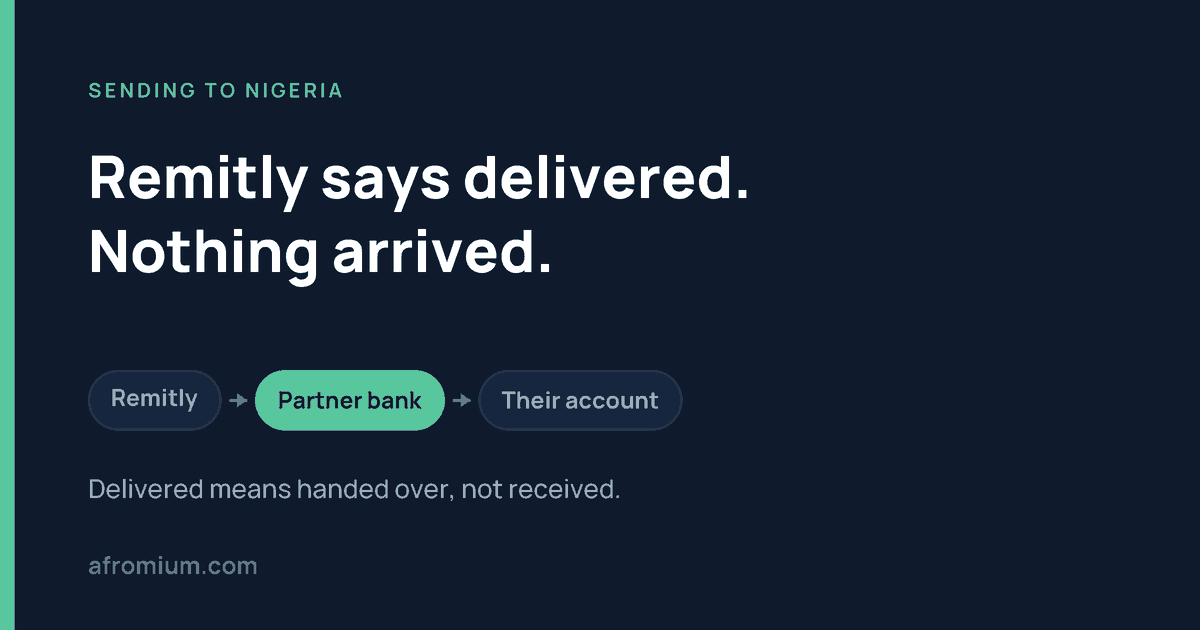
The app says delivered. The confirmation email arrived. But the person you sent it to says there is nothing in their account. Here is how to find out what actually happened, how to make Remitly investigate rather than reassure you, and what you are entitled to depending on where you sent from.
First: do not send it again
The strongest instinct is to send the money a second time, especially if someone is waiting on it. Resist it until you know where the first payment went. If the original transfer later lands, you have paid twice, and getting the second one back is a slower and weaker process than sorting out the first.
A transfer marked delivered when the recipient has no money is a discrepancy, not an ordinary delay. For a bank deposit, Remitly treats completion as meaning the funds have been credited to the receiving account. So either the money is in an account somewhere, or the status is wrong. Both are worth finding out about, and neither is fixed by sending more money.
If the transfer is still showing as in progress or pending rather than delivered, that is a different problem — see why a transfer takes longer than promised.
1. Check the account, not the text message
A missing credit alert does not prove a payment failed. Alerts get delayed, silenced, sent to an old phone number, or never configured at all.
Ask the recipient to open their banking app and look at the actual transaction history — not the notifications — for a credit matching the amount and date on your receipt. The description may name a local payment processor rather than Remitly, so tell them to look for the amount rather than the word “Remitly”.
If you sent to an OPay, PalmPay, Kuda or Moniepoint account, the history has to be checked inside that institution’s own app. See which services actually reach those four — if the service you used does not list the institution, that is a likely cause in itself.
2. Confirm which account was actually paid
Open the completed transfer in the Remitly app or in Transfer history on the website, and compare the recipient details on the record against the details the person actually gave you.
Look hardest at the account number and the receiving institution. A Nigerian account number can be a perfectly valid ten digits and still belong to a stranger. A missing leading zero, one transposed digit, or the wrong bank selected from a dropdown all produce a payment that completes successfully — into somebody else’s account.
If you find a mistake, tell Remitly straight away and ask two things: which account received the payment, and whether it can be recalled. Speed matters here more than anywhere else in this process. Money that has reached the wrong account and been spent is often unrecoverable, and as you will see below, a mistake you made yourself changes what you are owed.
3. Report it to Remitly as a discrepancy, not a delay
Remitly offers phone and chat support 24 hours a day, and a written complaints form. How you word the first message matters. “When will my money arrive?” invites a reply explaining that transfers sometimes take time. That is not your situation.
Say instead that the transfer is already marked delivered and the recipient has checked their account history and found no matching credit. Have this ready before you start:
- Your transfer reference number
- The date and time the delivery was reported
- The amount and the receiving currency
- The recipient’s name and receiving institution
- Confirmation that the recipient has checked their transaction history, not just their alerts
A message that gets an investigation opened
My transfer is marked as delivered, but the recipient has not received the money.
Transfer reference: [reference]
Delivery date and time: [date]
Amount and currency: [amount]
Receiving institution: [bank or wallet]
The recipient has checked their account balance and full transaction history. There is no matching credit.
Please investigate the delivery with your payout partner, confirm which account was credited, and provide any transaction-tracking reference the receiving bank can use. Please also give me a case number and tell me when to expect the result of the investigation.
Ask for the case number even if the agent sounds confident the matter is settled. If the first answer does not resolve it, that number is what stops you starting from the beginning with the next person.
Share transfer details only through the official app, website or support line. Never post an unredacted receipt in a public forum or social media reply.
4. Get the receiving bank involved — and keep both investigations joined up
If Remitly confirms it paid the correct institution, the recipient should take it to that institution with the amount, the date, and any reference Remitly supplied.
The common failure at this point is being passed back and forth. The bank says it has no record; you relay that to Remitly; Remitly repeats that the payment was delivered. Break the loop by carrying each answer to the other side in writing: give Remitly the bank’s exact response and ask it to reopen or escalate on the strength of it. A customer-facing reference number is often not enough for a receiving bank to trace anything, so ask Remitly specifically for a payout-partner or local transaction reference.
A note on NIBSS
For Nigerian payments you may hear NIBSS mentioned — the system that settles transfers between Nigerian banks. Your Remitly reference is not a NIBSS reference, and typing it into a domestic tracker will find nothing. If a bank asks for a local reference, that request goes back to Remitly or its payout partner.
If Remitly insists the money was delivered
A delivered status means Remitly considers its obligation met. It is not, by itself, a reason to stop. Ask what the conclusion rests on: which account was credited, at what timestamp, and what the payout partner confirmed. If the receiving bank cannot find the credit, that is new evidence and grounds to ask for the investigation to be reopened.
At that point, stop relying on ordinary support chat and use the formal complaints route. Keep copies of everything, with dates. Which formal route applies depends entirely on where you sent the money from.
Your escalation route, by where you sent from
Sending from Germany or elsewhere in the EU or EEA
Remitly Europe Limited is regulated by the Central Bank of Ireland. If you are not satisfied with Remitly’s final response, you can refer the complaint to the Financial Services and Pensions Ombudsman in Ireland. It is independent and free to use: info@fspo.ie, +353 1 567 7000, fspo.ie.
Remitly names this route for customers in Germany, Ireland, Belgium, the Czech Republic, France, Liechtenstein, the Netherlands, Sweden, Poland, Denmark, Italy, Lithuania, Portugal, Slovakia, Austria, Cyprus, Finland, Greece, Latvia, Malta, Norway, Romania and Spain. You need Remitly’s final response first, so ask for it explicitly rather than waiting for one to arrive.
Sending from the United Kingdom
Remitly U.K., Ltd is authorised as an electronic money institution by the Financial Conduct Authority, register number 1047222. Remitly’s complaints page names the Irish ombudsman route for EU and EEA countries but does not name a UK scheme, so ask Remitly directly for its final response and which ombudsman scheme covers your complaint.
Sending from the United States
US senders have the clearest legal timetable of anyone, under the federal remittance transfer rules:
- You have 180 days from the date the money was supposed to be available — the date printed on your receipt — to report the error.
- The provider must investigate and determine whether an error occurred within 90 days of receiving your notice.
- It must tell you the findings within three business days of finishing the investigation.
The Consumer Financial Protection Bureau lists failure to deliver the funds at all, and delivery to the wrong recipient, among the errors a provider is responsible for correcting. Your receipt is required to carry the CFPB’s own phone number and website, and you can submit a complaint to the CFPB if Remitly’s answer does not resolve it. Note that some banks and credit unions are exempt from these rules, though that does not apply to a dedicated remittance provider.
These are US protections. Do not assume the same deadlines apply to a transfer sent from Europe, the UK or Canada.
The recipient’s side, in Nigeria
The recipient’s complaint is against their own bank or wallet provider, and it starts there. If that institution does not resolve it, the Central Bank of Nigeria operates a consumer protection route for complaints against institutions it regulates. That runs in parallel with your complaint to Remitly; it does not replace it.
Will you get your money back?
Not automatically, and the answer turns on whose mistake it was.
A transfer can normally be cancelled only before the money has been deposited or collected. Once it is delivered, cancellation is no longer the route — a disputed delivery is a different process with a different outcome.
Where an investigation shows the funds were never delivered, a refund or a resent transfer is the usual remedy. Where the payment went astray because you supplied the wrong account number, the position is narrower. Under the US rules, a provider is not required to refund or resend if it took specific steps: checking that the routing number matched the institution name you gave before sending, and making reasonable efforts to retrieve the money quickly from the wrong recipient. If it did not take those steps, the exemption does not apply.
Which is why two people with what looks like the same problem get different answers. Establishing what happened comes before arguing about the remedy.
Nobody can release your payment for a fee
A missing transfer makes people desperate, and desperation attracts a particular kind of offer: someone in a comment thread, a WhatsApp group or a search advert who can recover your money or unlock the payment once you pay a charge.
There is no such service. Contact Remitly only through its own app or website. Never hand over a password, a verification code or a banking PIN, and never pay a fee to release a payment. If someone contacts you claiming to be from Remitly, verify it through the app before you do anything they ask.
Common questions
Does delivered definitely mean the money is in the account?
For a bank deposit, Remitly describes completion as the funds having been credited to the receiving account. Cash pickup and other payout methods complete under different conditions. If there is no matching credit, investigate the delivery rather than trusting the label.
Can the recipient contact Remitly themselves?
They can ask, but you are the customer and you hold the reference. Under the US error-resolution process in particular, it is the sender notifying the provider that starts the clock. The recipient’s job is the other half: pursuing their own bank when no credit has arrived.
How long should I wait before reporting it?
Do not wait. Waiting is sensible when a transfer is still in progress. Once it says delivered and the recipient has genuinely checked, the discrepancy exists now and reporting it starts the investigation sooner. The investigation itself may take weeks.
What if I sent it to the wrong account?
Tell Remitly immediately and ask for recovery to be attempted. Be realistic: money that has landed in a stranger’s account and been withdrawn is often gone, and a sender’s own error limits what you can claim. Speed is the only real advantage you have.
How we checked this
Read on 22 September 2026 from primary sources: Remitly’s own help and complaints pages for Ireland and the United Kingdom, including the regulated-entity details published in their footers, and the Consumer Financial Protection Bureau’s guidance on reporting a remittance error, last reviewed by the CFPB in October 2024.
This is general information about a process, not legal advice, and not advice about your particular transfer. Rules and contact routes change; if you find something here that no longer matches what you are told, tell us and we will correct it. Our methodology explains what we check and what we do not.