Last checked 25 September 2026
Yes — GCash receives money from abroad, and several major services pay into it directly. The part that catches people is not the sending service. It is the receiving wallet: whether it is fully verified, how much room is left in it, and the fact that your provider’s ceiling and GCash’s ceiling are two different numbers.
Do not start with “does this service send to the Philippines?” That is too broad. A provider can support Philippine bank accounts without supporting GCash, and one that does support GCash can still impose a lower limit than your recipient’s wallet allows.
Three ceilings, and you hit the lowest one
This is the whole page in one idea. A transfer into GCash has to clear three separate limits, and the one that stops you is whichever is smallest:
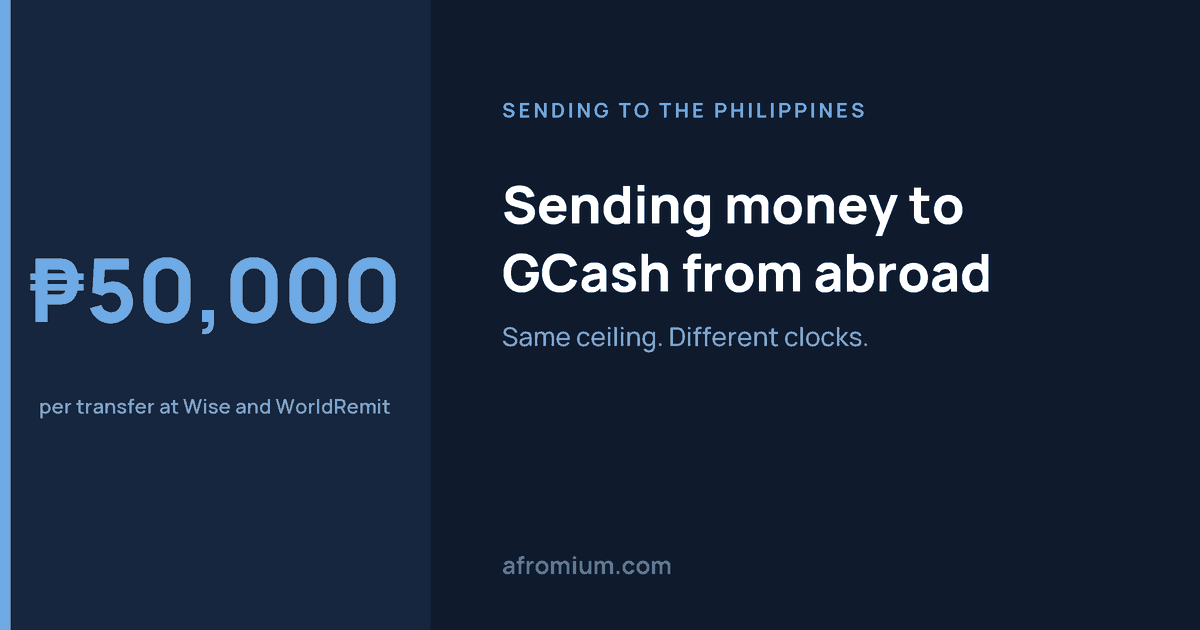
- The provider’s per-transfer wallet cap — Wise and WorldRemit both stop at ₱50,000
- The recipient’s monthly incoming limit — how much their profile may receive this month
- The room left in the wallet — a balance cap, not a flow cap
Most failed GCash remittances are one of these three, and none of them is visible on the provider’s marketing page.
What GCash itself allows
Your recipient’s profile decides two of the three ceilings. These are GCash’s own published figures:
| Profile | Wallet limit (balance at any time) | Incoming per month |
|---|---|---|
| Basic | ₱10,000 | ₱5,000 |
| GCash Jr. | ₱50,000 | ₱10,000 |
| Fully Verified | ₱100,000 | ₱100,000 |
| GCash Plus | ₱500,000 | ₱500,000 |
| GCash Platinum | ₱1,000,000 | ₱1,000,000 |
Two details that matter more than the numbers. Limits reset on the first day of the next month, not on a rolling basis — so a recipient who has used up their monthly allowance is blocked until the 1st, and knowing that saves a week of guessing. And if someone holds several GCash accounts, the highest limit applies to all of them, but the limits are not added together.
GCash Plus is Fully Verified plus a linked bank account or investment. Platinum is for eligible Globe Platinum subscribers.
Check this before you compare a single exchange rate
GCash’s own instructions for claiming an overseas remittance begin: claim overseas remittances to the Philippines in your Fully Verified GCash account. WorldRemit puts the same requirement in its own words — the receiving wallet must be fully registered and active.
So when your recipient says “my GCash works fine, I use it every day”, that is not the answer to the question. A Basic account works fine for everyday use and still has a ₱5,000 monthly incoming limit.
Ask them to open the app and check Profile → Profile Limits, and to tell you three things: their profile tier, their current balance, and how much of this month’s incoming limit is left.
The wallet is a bucket, not a pipe
The limit people forget is the balance cap, because it has nothing to do with the size of your transfer.
Your recipient is Fully Verified, so their wallet holds ₱100,000. They already have ₱85,000 in it. You send ₱30,000 — comfortably under every per-transfer cap on this page. It would take the balance to ₱115,000, and the wallet cannot hold that.
Nothing about your transfer was wrong. There was simply no room.
A worked example with all three ceilings
You want to send ₱48,000. Your recipient is Fully Verified, has ₱62,000 in the wallet, and has already received ₱55,000 this month.
It looks fine — ₱48,000 is under Wise’s per-transfer cap. It is not fine. They have ₱38,000 of wallet capacity left and ₱45,000 of monthly incoming limit left. The binding constraint is ₱38,000, and no exchange rate changes that.
Which services pay into GCash
Checked first-hand on 23 September 2026. We have limited this table to routes we could verify from the provider’s own current pages — see the note further down about what we left out.
| Service | Pays into GCash? | Published per-transfer cap | Speed |
|---|---|---|---|
| Wise | Yes | ₱50,000 to a mobile wallet | Instant once Wise has your money and has converted it — conversion itself can take up to 2 working days |
| WorldRemit | Yes | ₱50,000 | 90% of its mobile money transfers arrive in under 10 minutes |
| Remitly | Yes | No universal figure published — limits depend on your country, verification, payout method and partner | Depends on funding method and any review |
Wise also names Maya, GrabPay, Starpay, Bayad Wallet and TayoCash. WorldRemit names GCash, GrabPay, Maya and ShopeePay.
Same ceiling, different clocks
Look at the first two rows again. Both stop at ₱50,000. The ceiling is not what separates them — the timing is.
WorldRemit says 90% of its mobile money transfers arrive in under ten minutes. Wise says instant too, but only once it has received and converted your money, and it puts conversion at up to two working days. Identical caps, and for an urgent payment a materially different experience. If the money is needed today, that distinction matters more than the cap does.
Which is the real lesson of this table: read the provider’s own current limit and its own wording on timing, rather than a summary of either — including this one. Caps move, and a figure that was right last month can quietly stop being right.
It is also why splitting a payment to get under a cap is a bad habit. If the amount genuinely exceeds what your recipient may receive, breaking it up does not create headroom — it just fails twice.
Two ways money reaches a GCash wallet
This trips people up when the money “hasn’t arrived”. Some transfers are pushed straight into the wallet and the recipient does nothing. Others have to be claimed by the recipient, inside the app.
GCash’s claim path is Cash In → Global Banks and Partners, then choose the remittance partner and enter the expected amount, the reference number and the purpose, confirm, and enter the six-digit code sent by text. GCash says that if everything is correct the money appears instantly.
If your recipient is waiting for money to appear by itself on a transfer that has to be claimed, it will wait there indefinitely. Establish which of the two you used before troubleshooting anything else.
Two deadlines on claimed remittances
- 90 days. GCash says to claim within 90 days before the reference number expires.
- Three attempts. After three incorrect reference numbers, GCash locks claiming for 24 hours.
So do not let your recipient guess at the reference. Send them the original confirmation, privately, and let them copy it exactly.
The name has to match exactly
GCash instructs senders to use the exact name you registered with GCash. WorldRemit says the same about the name held by the wallet.
Maria Santos and Maria Lourdes Santos are the same person to you. They are not necessarily the same customer to a remittance system. Use whatever is stored in the app, not what you call them.
What to ask your recipient for
- their exact registered name
- their GCash-registered mobile number
- confirmation the account is Fully Verified
- current balance and remaining monthly incoming limit, if the amount is large
Not their GCash card number. A normal remittance addresses the wallet through the registered mobile number and name. If someone asks you for a 16-digit card number to receive a remittance, that is not how this works — check with the provider before sending anything.
Four reasons a GCash transfer fails
In the order worth checking:
- The account is not Fully Verified. Fix this before trying another provider — switching services will not get round it.
- The provider’s cap is lower than the wallet’s. A ₱500,000 GCash Plus wallet does not help if Wise stops at ₱50,000.
- The wallet is too full. A balance problem, not a transfer problem.
- The name does not match. Exactly as registered, not as you say it.
If money was supposed to arrive in minutes and has not, resist resending. Check the recipient’s transaction history and remaining limits first — a duplicate payment is a slower problem to unwind than a late one. The same reasoning as in why a money transfer takes longer than you were told.
If a transfer has already gone wrong rather than being planned, two pages pick up from here: money sent to GCash from abroad hasn’t arrived, and sent money to the wrong GCash number from abroad.
One cost this page does not cover is what your recipient pays to turn the balance into cash — a flat 2% on GCash, at any amount. We set that alongside Bangladesh and Pakistan in what it costs to take money out of a mobile wallet.
What we could not verify
Plenty of pages will tell you the exact GCash limits for Western Union, Xoom, PayPal, Taptap Send, Ria, LemFi and Revolut, broken down by sending country. We could not confirm those figures from the providers’ own current pages on the day of checking, so they are not here.
Two things are worth saying about them anyway.
PayPal to GCash means two different things. Linking your own PayPal account to your own GCash wallet to withdraw your own balance is not the same transaction as sending money from abroad to somebody else’s wallet, and the requirements are not the same either. If you are searching for one, be sure which you mean before you start.
“Supports the Philippines” is not “supports GCash.” That is the single most common mistake in this corridor. A provider can offer excellent Philippine bank transfers and no mobile wallet route at all. Look for GCash named as a payout option at checkout, for your actual sending country, before you pay for anything.
Common questions
Can an unverified GCash account receive money from abroad?
Do not rely on it. GCash’s own instructions for claiming an overseas remittance specify a Fully Verified account, and a Basic profile is capped at ₱5,000 incoming per month regardless. Get the wallet verified before the sender pays.
What is the most I can send to a GCash wallet?
There is no single answer, because three limits apply at once. A Fully Verified profile holds ₱100,000 and may receive ₱100,000 a month; GCash Plus raises both to ₱500,000. But your provider can cap you lower — both Wise and WorldRemit stop at ₱50,000 per wallet transfer — and the wallet’s remaining headroom can cut it lower still.
When do the limits reset?
On the first day of the following month. If your recipient has used up this month’s incoming limit, the options are to wait for the 1st or to upgrade the profile — sending again through a different service will not help.
Will the recipient get pesos or the currency I sent?
Pesos. These routes deliver PHP into the wallet. Paying in euros, pounds or dollars does not give your recipient a foreign-currency balance — which is why the number worth comparing between providers is the pesos that land, not the fee. That is the whole argument in transfer fee versus exchange rate.
Does my recipient have to do anything?
It depends which of the two delivery models your provider uses. Some push the money into the wallet with no action needed. Others require the recipient to claim it through Cash In → Global Banks and Partners with the reference number. If the sender says it has gone and nothing has appeared, find out which one applies before anything else.
Check the wallet before you compare rates
Comparing what actually lands, across providers, for the same amount you pay, is the right way to choose — but it is the second question.
The first is three questions to your recipient: is the account Fully Verified, what is the current balance, and how much of this month’s incoming limit is left. Then check your provider’s own wallet cap.
A service can have the best rate on the market, genuinely support GCash, and still be the wrong route for a ₱70,000 payment — because its mobile wallet ceiling stops at ₱50,000. That is the part the “send money to GCash” landing pages never put in the headline.
Correction
25 September 2026. This page previously gave Wise’s mobile wallet cap as ₱49,999 and built a section around the one-peso gap against WorldRemit’s ₱50,000. On rechecking, Wise’s own “Guide to PHP transfers” states the limit per transfer to a mobile wallet is 50,000 PHP, with no mention of 49,999 anywhere on the page. Every figure has been corrected and that section rewritten. Either the limit changed or the original reading was of a different page; we cannot tell which, so we are saying plainly what we found and when.
How we checked this
Read on 23 September 2026, first-hand: the GCash help centre on wallet and transaction limits, and on claiming an overseas remittance, for the profile table, the reset date, the Fully Verified requirement, the exact-name rule, the 90-day reference expiry, the three-attempt lock and the claim path; Wise’s Philippines transfer page for the mobile wallet cap and supported wallets; WorldRemit’s Philippines mobile money page for its cap, its fully-registered-wallet requirement and its delivery-time figure; and Remitly’s Philippines destination directory, which lists GCash.
We have not sent a test transfer. We have deliberately left out per-country limit figures for providers whose current pages we could not open and read on the day — a wrong ceiling on this page would cause exactly the failed transfer it is meant to prevent. Limits and partner lists in this corridor change often, so check the figure shown in your own app for your own sending country before you pay. This is general information about a process, not advice about your particular transfer — if something here no longer matches what your provider tells you, let us know and we will correct it.
Related
- Which services pay into OPay, PalmPay, Kuda and Moniepoint?
- Transfer fee versus exchange rate: what your recipient actually gets
- Why a money transfer takes longer than you were told
- Bank deposit, cash pickup or mobile wallet?
- Money sent to GCash from abroad hasn’t arrived? What to check
- Sent money to the wrong GCash number from abroad?