Category: Sending to the Philippines

Sending money to the Philippines: wallets, limits and what actually stops a transfer.

  • Money Sent to GCash From Abroad Hasn’t Arrived? What to Check

    Money Sent to GCash From Abroad Hasn’t Arrived? What to Check

    Last checked 25 September 2026 · GCash limits re-checked 21 November 2026

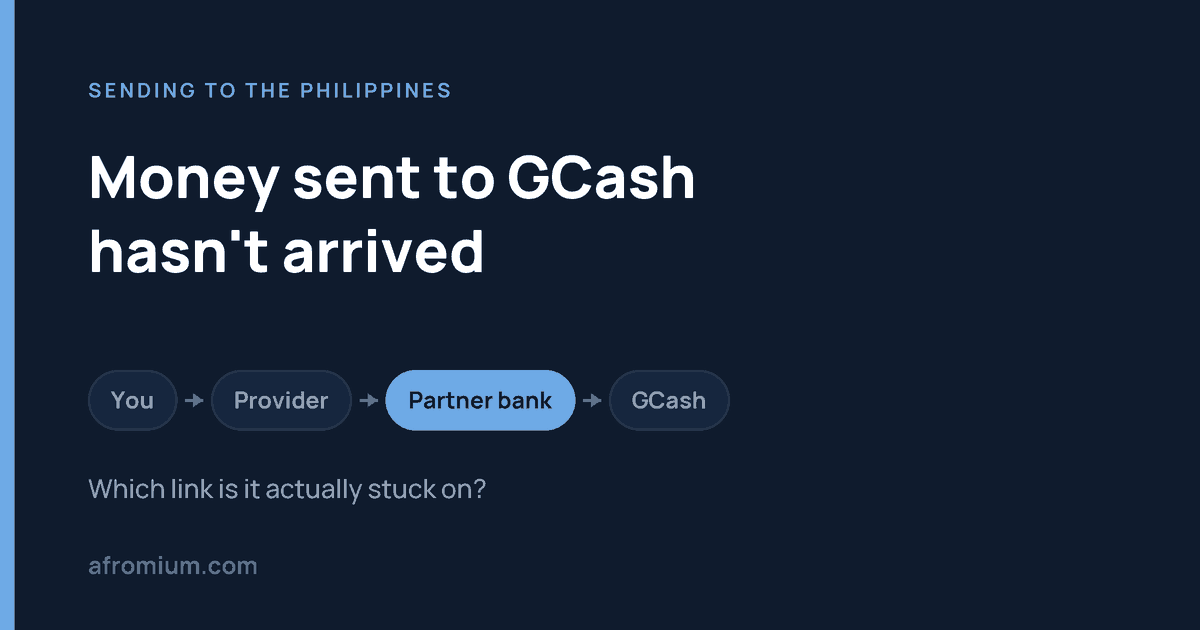
    You sent money to a GCash wallet. Your card or bank account has been charged. The recipient opens GCash and sees nothing. The useful question is not “where did the money go” — it is which part of the chain is it still sitting in, because that single answer decides who can actually fix it.

    An overseas transfer to GCash is not one payment. It is a sequence: you pay a remittance provider, the provider processes and converts it, the provider’s Philippine payout route delivers it, and only then is the wallet credited. A transfer can be “sent” from where you are standing and not yet exist from where your recipient is standing.

    If you have not sent yet, or you want the limits explained before they bite, start with sending money to GCash from abroad. This page is for when something has already gone quiet.

    Do this first: read the status, not your bank statement

    Open the remittance app or website and find the transfer itself.

    A charge on your card proves only that the provider took or reserved your money. It says nothing about whether GCash was ever credited. People routinely send a screenshot of their bank statement to support and wonder why it does not help — that screenshot is evidence about the wrong end of the chain.

    Remitly’s own glossary sets out the three statuses plainly: pending means the transfer is still processing and has not reached the recipient; completed means the funds have been delivered according to the chosen delivery method; canceled means it was stopped before completion, by you, by the provider, or because of a problem with the details.

    Those three words split this page in two.

    If it says pending, processing or in review

    The money is still on the provider’s side. GCash cannot make a payout appear that the provider has not yet made, and contacting GCash at this stage will get you a correct but useless answer: they have no record of it, because there is nothing to have a record of.

    Contact the provider once the estimated delivery time shown on that transfer has actually passed — not once it feels late.

    “In review” is a different animal again: it usually means additional verification, sometimes of you rather than of the recipient, and it can require a document before the transfer moves. We set out the five official hold reasons and what each one wants from you in why was my Remitly transfer cancelled, paused or put on hold.

    If it says completed or delivered

    Now you have a genuine contradiction, and it should be treated as one. The provider says the money was delivered. The wallet says it was not. One of those is wrong, and finding out which is the entire job.

    Do not send the money again yet. Have the recipient check, in this order:

    1. The transaction history inside the GCash app — not the notifications. Notifications fail; the ledger does not.
    2. The mobile number on your receipt, against the number actually registered to their wallet.
    3. The name you entered, against the name registered on the account.
    4. Whether the account is Fully Verified.
    5. Their incoming limit and remaining wallet headroom, under Profile → Profile Limits.

    If all five check out, go back to the provider with a specific sentence rather than a vague one:

    “The transfer shows completed, but the recipient’s GCash wallet has not been credited. Please trace this specific transaction.”

    That opens a trace. “My transfer is late” opens a queue.

    Check the number against the screen, not against your memory

    For a remittance the mobile number is the wallet. Get one digit wrong and the money has gone somewhere real.

    Say you meant to send ₱15,000 to a number ending 4821 and the receipt shows 4281. Waiting another day will not fix that, and every hour spent waiting makes it worse. That is no longer a delay — it is a wrong-recipient case, and it has its own page: sent money to the wrong GCash number from abroad.

    Compare the receipt to the recipient’s screen. Not to what you believe their number is.

    Is the account Fully Verified?

    This catches people whose recipient uses GCash happily every day for small amounts and therefore assumes the account is fine. Overseas remittances are claimed through a Fully Verified account, and the sender should use the recipient’s name exactly as registered.

    WorldRemit puts the same requirement in its own words: the mobile money account must be fully registered and active.

    So if transfers to one particular wallet keep failing, have the recipient check their verification status before you try a different provider. Switching services will not get round it.

    The limit that stops a transfer nobody thought was large

    A perfectly valid, fully verified wallet can still refuse money. GCash publishes limits by profile tier, raised from 1 October 2026. These are the figures on its limits page as we last read it, on 21 November 2026:

    ProfileWallet limit
    (held at any time)
    Incoming
    (per month)
    Outgoing
    (per day)
    Basic₱10,000₱5,000No limit
    GCash Jr.₱100,000₱100,000₱100,000
    Fully Verified₱1,000,000₱1,000,000₱500,000
    5M₱5,000,000₱5,000,000₱1,000,000
    10M₱10,000,000₱10,000,000₱1,000,000

    The figure that traps people is not the size of the transfer. It is the monthly incoming total.

    Since 1 October 2026 a Fully Verified recipient may receive ₱1,000,000 a month, so for most families this ceiling is far away. It still stops a recipient who is not Fully Verified: a Basic profile may receive only ₱5,000 in a whole month, so a ₱10,000 remittance fails however ordinary it looks. The transfer is not too big; the month is too full. Our GCash limits guide has the full table, and what happens when the recipient’s account cannot receive covers a Basic or held account.

    One detail worth knowing before anyone upgrades anything in a panic: these limits reset on the first day of the following month. If it is the 28th and the amount is not urgent, waiting a few days may be simpler than everything else on this page.

    Note also that linked GCash accounts do not pool their limits. The highest limit among them applies to all — they are not added together.

    What each provider publishes

    ProviderCap per transfer to a walletStated speed
    Wise₱50,000Instant up to ₱50,000 — but only once Wise has received and converted your money, and conversion can take up to 2 working days
    WorldRemit₱50,000, and ₱100,000 total into the wallet per monthWithin minutes

    Read the Wise row twice. “Instant” describes the last leg only. The clock does not start when you press send; it starts when Wise has your money and has converted it. A transfer that is entirely on schedule can look motionless for two days.

    Wise also notes that mobile wallet providers impose their own receiving limits, and that if a payment is rejected the recipient should check with their provider — which is the table above.

    Both figures were read from the providers’ own pages on 25 September 2026. We list only providers whose current published limit we could read ourselves. Others support GCash; we are not going to print a number we cannot see.

    Choosing a provider for the next transfer? We compared what six of them paid into GCash for the same euro amounts, and which ones cap a wallet transfer: Germany to GCash, six providers compared.

    Who to contact, by what you see

    What the transfer saysContact first
    Pending or processingThe remittance provider
    In review, or a document requestedThe remittance provider
    Failed or cancelledThe remittance provider
    Wrong GCash number enteredThe remittance provider, immediately
    Completed, wallet not creditedThe provider, then GCash
    Verification or limit problem on the walletGCash

    The pattern behind the table: you have the contract, the receipt and the reference number with the provider. Your recipient has none of those. That makes you the one who can open a case, and it is why “tell them to sort it out with GCash” so often goes nowhere.

    What to have ready before you contact anyone

    • The provider’s transfer reference number
    • Amount paid, and the peso amount expected
    • Date and time you submitted it
    • Recipient’s registered GCash name and number
    • Current status, and a screenshot of any error
    • Confirmation that the recipient checked their transaction history, not just notifications

    Write down who you spoke to and what they said, with the date. If this runs past the first conversation, that record is what the next stage runs on.

    Escalating a GCash complaint to BSP

    GCash is operated by G-Xchange, Incorporated (GXI), which appears as entry 12 on the Bangko Sentral ng Pilipinas list of supervised Electronic Money Issuers, in the non-bank section, as of 31 May 2026. So there is a regulator — but it is not your first call, and arriving there early will cost you time.

    BSP’s Consumer Assistance Mechanism is expressly a second-level recourse. Every BSP-supervised institution is required by law to run its own Financial Consumer Protection Assistance Mechanism, and that is the first level. You must go there first.

    If that fails, escalate through the BSP Online Buddy (BOB) chatbot — reachable from the robot icon on the BSP website or the Message button on BSP’s official Facebook page. Keep chatting until you are given a reference number in the format BSPCMS-2024-ABC1234; that number is what confirms the complaint was actually processed.

    Without access to BOB, there is a Complaint/Inquiry/Reply form emailed to consumeraffairs@bsp.gov.ph. Note the condition most people miss: it must include proof that you already used GCash’s own complaints channel. Office hours are Monday to Friday, 8am to 5pm.

    One thing BSP states plainly, and it is worth repeating because scammers exploit exactly this moment: BSP does not need your PIN, password, account number, card number or identification documents to process a complaint. Anyone asking for those while “helping” with your complaint is not helping.

    And if your dispute is with the foreign provider rather than with GCash, BSP is not your regulator at all. Use that provider’s formal complaints procedure in the country you sent from — the routes differ, and we set out the EU, UK and US ones in Remitly says delivered but the money hasn’t arrived.

    Do not send it again until you know what the first one did

    This is the expensive mistake, and it is made calmly, by reasonable people, because the money is needed today.

    The first transfer looks stuck. You send a second. Two days later the first one completes as well. You are now out twice the money and trying to recover half of it from a wallet that has every right to keep it.

    Unless the provider has confirmed the first transfer failed or was cancelled, find out what it did before replacing it. A pending transfer is not a dead one.

    The checklist

    1. Open the transfer in the sending app and read its status.
    2. Pending, in review, cancelled or completed — everything follows from which.
    3. Compare the number on the receipt with the recipient’s actual number.
    4. Confirm the name matches the registered name.
    5. Confirm the account is Fully Verified.
    6. Check the monthly incoming limit and remaining wallet headroom.
    7. Have the recipient read their transaction history, not notifications.
    8. Contact the provider if it has not been delivered correctly.
    9. Contact GCash if the provider insists the payout landed.
    10. Escalate to BSP only after GCash’s own channel has failed, and keep the proof.

    Questions people ask

    How long should a transfer to GCash take?

    Use the estimate on your specific transfer rather than a general figure. WorldRemit says within minutes. Wise says instant up to ₱50,000 — after it has received and converted your money, which is the part that can take up to two working days. Timing also depends on your sending country, how you paid, and whether the transfer is under review.

    Can a GCash limit stop money arriving from abroad?

    Yes, and it is one of the most common causes. Since 1 October 2026 a Fully Verified profile can hold ₱1,000,000 and receive ₱1,000,000 a month; a Basic one can receive only ₱5,000. What matters is how much of that monthly allowance is already used, not how large your transfer is. Limits reset on the first of the next month.

    Does my recipient need a verified account?

    For an overseas remittance, yes — GCash claims them through a Fully Verified account, and WorldRemit separately requires the wallet to be fully registered and active.

    Should I contact the provider or GCash first?

    The provider, in almost every case. The exception is a wallet-side problem — verification or a limit — which only GCash can resolve. If the provider shows completed and the correct wallet still shows nothing, report the contradiction to the provider and keep that case open while the recipient also asks GCash.

    Can I track it with the reference number?

    Through the provider that accepted the transfer, yes. GCash cannot look up a reference number belonging to another company’s system. Keep it regardless — support will ask for it first.

    Correction

    10 and 26 October 2026. GCash raised its wallet and transaction limits from 1 October 2026. This page previously gave a Fully Verified profile’s limits as ₱100,000 and listed a GCash Plus tier. On 10 October the table showed ₱500,000 for Fully Verified; on 26 October it showed ₱1,000,000 and no Platinum column. The table, the example and the answers now use the 26 October reading.

    How we checked this

    Read on 25 September 2026: the GCash help centre on wallet and transaction limits, for the full profile table and the monthly reset (the table re-read on 10 and 26 October and 21 November 2026, after GCash raised its limits from 1 October; unchanged on 21 November); Wise’s guide to PHP transfers, for the ₱50,000 mobile wallet cap, the conversion window and the note on wallet providers’ own limits; WorldRemit’s United Kingdom page for mobile money to the Philippines, for the ₱50,000 per transfer and ₱100,000 monthly wallet figures, the “fully registered and active” requirement and the stated speed; Remitly’s glossary of transfer statuses, for the definitions of pending, completed and canceled; the Bangko Sentral ng Pilipinas list of supervised Electronic Money Issuers as of 31 May 2026, for G-Xchange, Incorporated; and BSP’s “How to file a complaint against a BSP-Supervised Institution” (September 2025), for the second-level recourse rule, the BOB route and the reference number format.

    We used WorldRemit’s UK page rather than one written for another sending country, because these limits and terms are set per sending market. If you send from elsewhere, check your own country’s version — the figures are not guaranteed to match.

    Sources

    Afromium does not make test transfers. Every figure on this page was read from the named source on the date given and is quoted, not estimated. Providers change limits, timings and support routes without notice — check the current page before you act on anything here.
  • Can you send money to GCash from abroad?

    Can you send money to GCash from abroad?

    Last checked 25 September 2026 · GCash limits re-checked 21 November 2026

    Yes — GCash receives money from abroad, and several major services pay into it directly. The part that catches people is not the sending service. It is the receiving wallet: whether it is fully verified, how much room is left in it, and the fact that your provider’s ceiling and GCash’s ceiling are two different numbers.

    Do not start with “does this service send to the Philippines?” That is too broad. A provider can support Philippine bank accounts without supporting GCash, and one that does support GCash can still impose a lower limit than your recipient’s wallet allows.

    Three ceilings, and you hit the lowest one

    This is the whole page in one idea. A transfer into GCash has to clear three separate limits, and the one that stops you is whichever is smallest:

    1. The provider’s per-transfer wallet cap — Wise and WorldRemit both stop at ₱50,000
    2. The recipient’s monthly incoming limit — how much their profile may receive this month
    3. The room left in the wallet — a balance cap, not a flow cap

    Most failed GCash remittances are one of these three, and none of them is visible on the provider’s marketing page.

    What GCash itself allows

    Your recipient’s profile decides two of the three ceilings. These are GCash’s own published figures, in force from 1 October 2026, as shown on GCash’s limits page when we last read it on 21 November 2026. Our GCash limits guide has the full table, including the outgoing limits:

    ProfileWallet limit (balance at any time)Incoming per month
    Basic₱10,000₱5,000
    GCash Jr.₱100,000₱100,000
    Fully Verified₱1,000,000₱1,000,000
    5M₱5,000,000₱5,000,000
    10M₱10,000,000₱10,000,000

    Two details that matter more than the numbers. Limits reset on the first day of the next month, not on a rolling basis — so a recipient who has used up their monthly allowance is blocked until the 1st, and knowing that saves a week of guessing. And if someone holds several GCash accounts, the highest limit applies to all of them, but the limits are not added together. The full table, with the daily limits, is in our GCash limits guide.

    GCash raised these limits on 1 October 2026. Before that, a Fully Verified profile could hold and receive ₱100,000. GCash tells users to update the app to the latest version to get the new limits. The table no longer has a Platinum column; the 5M and 10M profiles are for eligible customers with active GSave, GFunds, GBonds, GStocks or GCrypto, subject to GCash’s approval.

    Check this before you compare a single exchange rate

    GCash’s own instructions for claiming an overseas remittance begin: claim overseas remittances to the Philippines in your Fully Verified GCash account. WorldRemit puts the same requirement in its own words — the receiving wallet must be fully registered and active.

    So when your recipient says “my GCash works fine, I use it every day”, that is not the answer to the question. A Basic account works fine for everyday use and still has a ₱5,000 monthly incoming limit.

    Ask them to open the app and check Profile → Profile Limits, and to tell you three things: their profile tier, their current balance, and how much of this month’s incoming limit is left.

    The wallet is a bucket, not a pipe

    The limit people forget is the balance cap, because it has nothing to do with the size of your transfer.

    Your recipient is Fully Verified, so their wallet holds ₱1,000,000. They keep their savings in it and already have ₱980,000 there. You send ₱30,000 — comfortably under every per-transfer cap on this page. It would take the balance to ₱1,010,000, and the wallet cannot hold that. Since the October increase this takes a large balance, but it is still the check nobody makes.

    Nothing about your transfer was wrong. There was simply no room.

    A worked example with all three ceilings

    You want to send ₱70,000. Your recipient is Fully Verified, has ₱62,000 in the wallet, and has already received ₱55,000 this month.

    GCash has room: ₱938,000 of wallet capacity and ₱945,000 of this month’s incoming limit are left. Your provider does not. Wise and WorldRemit both stop at ₱50,000 per wallet transfer, so ₱70,000 cannot go in one transfer through either, and no exchange rate changes that. Under GCash’s old ₱100,000 limits the wallet would have blocked this transfer; under the new ones, the provider does.

    Which services pay into GCash

    Checked first-hand on 23 September 2026. We have limited this table to routes we could verify from the provider’s own current pages — see the note further down about what we left out.

    ServicePays into GCash?Published per-transfer capSpeed
    WiseYes₱50,000 to a mobile walletInstant once Wise has your money and has converted it — conversion itself can take up to 2 working days
    WorldRemitYes₱50,00090% of its mobile money transfers arrive in under 10 minutes
    RemitlyYesNo universal figure published — limits depend on your country, verification, payout method and partnerDepends on funding method and any review

    Wise also names Maya, GrabPay, Starpay, Bayad Wallet and TayoCash. WorldRemit names GCash, GrabPay, Maya and ShopeePay. If your recipient uses Maya rather than GCash, the services and their caps are different: see sending money to Maya from abroad.

    For what each provider actually paid into GCash on the same day, at €100, €500 and €1,000, see sending money from Germany to GCash: six providers compared.

    Same ceiling, different clocks

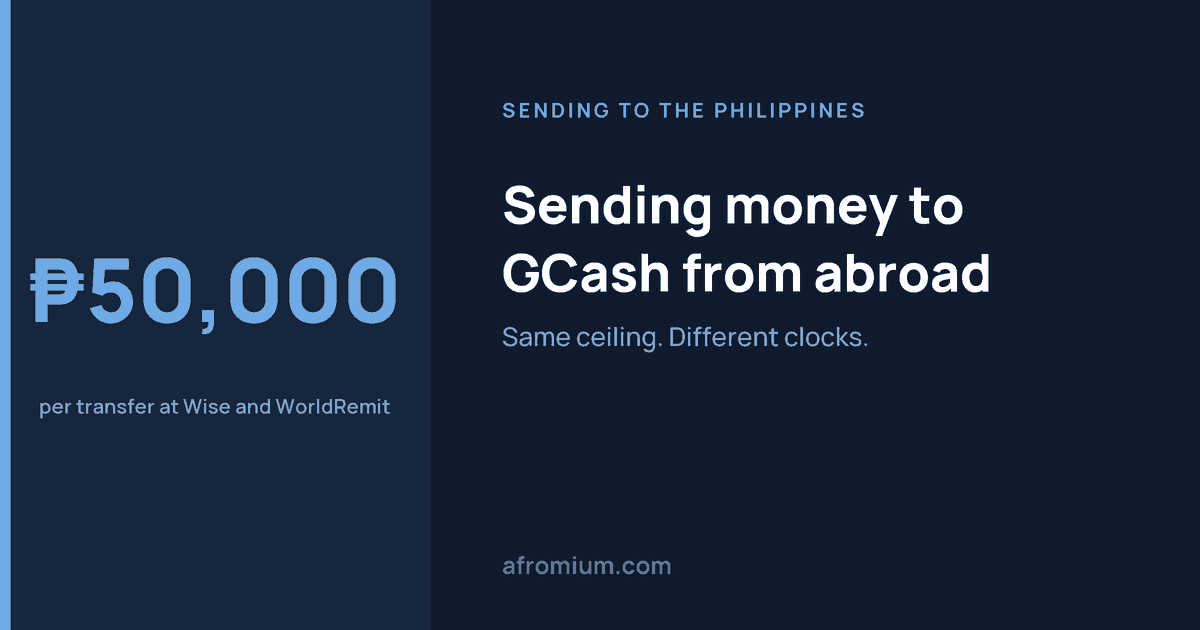
    Look at the first two rows again. Both stop at ₱50,000. The ceiling is not what separates them — the timing is.

    WorldRemit says 90% of its mobile money transfers arrive in under ten minutes. Wise says instant too, but only once it has received and converted your money, and it puts conversion at up to two working days. Identical caps, and for an urgent payment a materially different experience. If the money is needed today, that distinction matters more than the cap does.

    Which is the real lesson of this table: read the provider’s own current limit and its own wording on timing, rather than a summary of either — including this one. Caps move, and a figure that was right last month can quietly stop being right.

    It is also why splitting a payment to get under a cap is a bad habit. If the amount genuinely exceeds what your recipient may receive, breaking it up does not create headroom — it just fails twice.

    Two ways money reaches a GCash wallet

    This trips people up when the money “hasn’t arrived”. Some transfers are pushed straight into the wallet and the recipient does nothing. Others have to be claimed by the recipient, inside the app.

    GCash’s claim path is Cash In → Global Banks and Partners, then choose the remittance partner and enter the expected amount, the reference number and the purpose, confirm, and enter the six-digit code sent by text. GCash says that if everything is correct the money appears instantly.

    If your recipient is waiting for money to appear by itself on a transfer that has to be claimed, it will wait there indefinitely. Establish which of the two you used before troubleshooting anything else.

    Two deadlines on claimed remittances

    • 90 days. GCash says to claim within 90 days before the reference number expires.
    • Three attempts. After three incorrect reference numbers, GCash locks claiming for 24 hours.

    So do not let your recipient guess at the reference. Send them the original confirmation, privately, and let them copy it exactly.

    The name has to match exactly

    GCash instructs senders to use the exact name you registered with GCash. WorldRemit says the same about the name held by the wallet.

    Maria Santos and Maria Lourdes Santos are the same person to you. They are not necessarily the same customer to a remittance system. Use whatever is stored in the app, not what you call them.

    What to ask your recipient for

    • their exact registered name
    • their GCash-registered mobile number
    • confirmation the account is Fully Verified
    • current balance and remaining monthly incoming limit, if the amount is large

    Not their GCash card number. A normal remittance addresses the wallet through the registered mobile number and name. If someone asks you for a 16-digit card number to receive a remittance, that is not how this works — check with the provider before sending anything.

    Four reasons a GCash transfer fails

    In the order worth checking:

    1. The account is not Fully Verified. Fix this before trying another provider — switching services will not get round it.
    2. The provider’s cap is lower than the wallet’s. A ₱1,000,000 Fully Verified wallet does not help if Wise stops at ₱50,000.
    3. The wallet is too full. A balance problem, not a transfer problem.
    4. The name does not match. Exactly as registered, not as you say it.

    If money was supposed to arrive in minutes and has not, resist resending. Check the recipient’s transaction history and remaining limits first — a duplicate payment is a slower problem to unwind than a late one. The same reasoning as in why a money transfer takes longer than you were told.

    If a transfer has already gone wrong rather than being planned, two pages pick up from here: money sent to GCash from abroad hasn’t arrived, and sent money to the wrong GCash number from abroad.

    One cost this page does not cover is what your recipient pays to turn the balance into cash — a flat 2% on GCash, at any amount. We set that alongside Bangladesh and Pakistan in what it costs to take money out of a mobile wallet.

    What we could not verify

    Plenty of pages will tell you the exact GCash limits for Western Union, Xoom, PayPal, Taptap Send, Ria, LemFi and Revolut, broken down by sending country. We could not confirm those figures from the providers’ own current pages on the day of checking, so they are not here.

    Two things are worth saying about them anyway.

    PayPal to GCash means two different things. Linking your own PayPal account to your own GCash wallet to withdraw your own balance is not the same transaction as sending money from abroad to somebody else’s wallet, and the requirements are not the same either. If you are searching for one, be sure which you mean before you start.

    “Supports the Philippines” is not “supports GCash.” That is the single most common mistake in this corridor. A provider can offer excellent Philippine bank transfers and no mobile wallet route at all. Look for GCash named as a payout option at checkout, for your actual sending country, before you pay for anything.

    Common questions

    Can an unverified GCash account receive money from abroad?

    Do not rely on it. GCash’s own instructions for claiming an overseas remittance specify a Fully Verified account, and a Basic profile is capped at ₱5,000 incoming per month regardless. Get the wallet verified before the sender pays.

    What is the most I can send to a GCash wallet?

    There is no single answer, because three limits apply at once. Since 1 October 2026 a Fully Verified profile holds ₱1,000,000 and may receive ₱1,000,000 a month. But your provider can cap you lower — both Wise and WorldRemit stop at ₱50,000 per wallet transfer — and the wallet’s remaining headroom can cut it lower still.

    When do the limits reset?

    On the first day of the following month. If your recipient has used up this month’s incoming limit, the options are to wait for the 1st or to upgrade the profile — sending again through a different service will not help.

    Will the recipient get pesos or the currency I sent?

    Pesos. These routes deliver PHP into the wallet. Paying in euros, pounds or dollars does not give your recipient a foreign-currency balance — which is why the number worth comparing between providers is the pesos that land, not the fee. That is the whole argument in transfer fee versus exchange rate.

    Does my recipient have to do anything?

    It depends which of the two delivery models your provider uses. Some push the money into the wallet with no action needed. Others require the recipient to claim it through Cash In → Global Banks and Partners with the reference number. If the sender says it has gone and nothing has appeared, find out which one applies before anything else.

    Check the wallet before you compare rates

    Comparing what actually lands, across providers, for the same amount you pay, is the right way to choose — but it is the second question.

    The first is three questions to your recipient: is the account Fully Verified, what is the current balance, and how much of this month’s incoming limit is left. Then check your provider’s own wallet cap.

    A service can have the best rate on the market, genuinely support GCash, and still be the wrong route for a ₱70,000 payment — because its mobile wallet ceiling stops at ₱50,000. That is the part the “send money to GCash” landing pages never put in the headline.

    Correction

    10 and 26 October 2026. GCash raised its wallet and transaction limits from 1 October 2026. A Fully Verified profile could previously hold and receive ₱100,000 a month. When we corrected this page on 10 October, GCash’s table showed ₱500,000 for Fully Verified and a separate Platinum profile. When we read it again on 26 October it showed ₱1,000,000 for Fully Verified and no Platinum column, and GCash’s page on raising limits said an adult can increase the limit to ₱1,000,000. The table, both worked examples and the answer on the maximum now use the 26 October reading. See also our GCash limits guide.

    25 September 2026. This page previously gave Wise’s mobile wallet cap as ₱49,999 and built a section around the one-peso gap against WorldRemit’s ₱50,000. On rechecking, Wise’s own “Guide to PHP transfers” states the limit per transfer to a mobile wallet is 50,000 PHP, with no mention of 49,999 anywhere on the page. Every figure has been corrected and that section rewritten. Either the limit changed or the original reading was of a different page; we cannot tell which, so we are saying plainly what we found and when.

    How we checked this

    Read on 23 September 2026, first-hand (the GCash limits table re-read on 10 October 2026): the GCash help centre on wallet and transaction limits, and on claiming an overseas remittance, for the profile table, the reset date, the Fully Verified requirement, the exact-name rule, the 90-day reference expiry, the three-attempt lock and the claim path; Wise’s Philippines transfer page for the mobile wallet cap and supported wallets; WorldRemit’s Philippines mobile money page for its cap, its fully-registered-wallet requirement and its delivery-time figure; and Remitly’s Philippines destination directory, which lists GCash.

    We have not sent a test transfer. We have deliberately left out per-country limit figures for providers whose current pages we could not open and read on the day — a wrong ceiling on this page would cause exactly the failed transfer it is meant to prevent. Limits and partner lists in this corridor change often, so check the figure shown in your own app for your own sending country before you pay. This is general information about a process, not advice about your particular transfer — if something here no longer matches what your provider tells you, let us know and we will correct it.

    Sources

    Related