Last checked 30 September 2026
The rate looks worse than it did last week, so waiting feels sensible. It might pay off. It might not. The useful question is not whether the rate could improve — it is how much an improvement would actually be worth in money, and whether that is worth delaying the transfer.
If the recipient needs the money soon, send on the best quote available now. If there is no deadline, work out what a realistic rate change would mean for your amount, pick a target, and set a date when you will send regardless.
Start with what the recipient would gain
Rate movements look large on a chart. Their effect on an ordinary transfer is often smaller than it feels. Take €500 to Nigeria, with made-up round numbers — these are illustrations, not quotes:
| Rate today | A better rate | |
|---|---|---|
| Amount converted | €500 | €500 |
| Exchange rate | 1 EUR = ₦1,550 | 1 EUR = ₦1,575 |
| Recipient gets | ₦775,000 | ₦787,500 |
| Difference | ₦12,500 |
A move from 1,550 to 1,575 is about 1.6%, and on €500 it is worth ₦12,500 to the recipient — if nothing else changes. Now there is something concrete to decide with. Would you hold the money back for the chance of ₦12,500? For rent due tomorrow, probably not. For money that is not needed for a few weeks, maybe.
Compare today’s providers before waiting for tomorrow
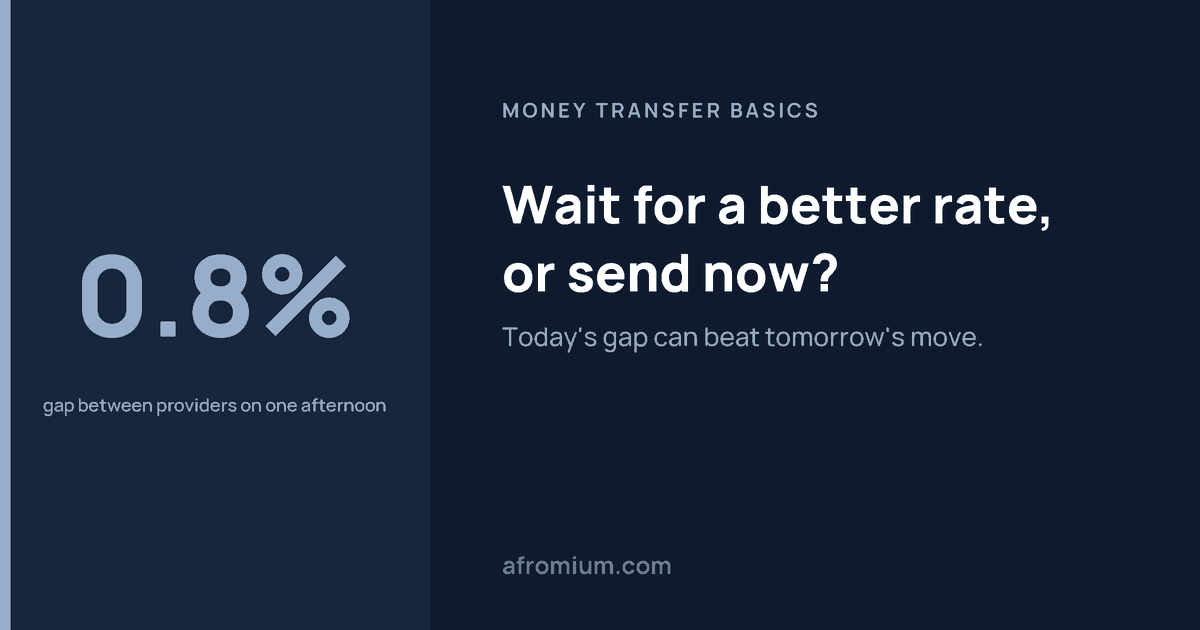
The gap between two providers today is often as large as the market move you are hoping for. When we captured Germany-to-Nigeria quotes on 29 September 2026, the best and worst quotes we could rank for €500 were ₦777,500 and ₦771,494.79 — a difference of ₦6,005 on the same afternoon. That is the same effect as the rate moving by about 0.8%, and you did not have to wait for it. The full table is in our Germany to Nigeria comparison.
Fees and rates also pull in opposite directions. Two more made-up quotes for the same €500 budget:
| Provider A | Provider B | |
|---|---|---|
| Total you pay | €500 | €500 |
| Fee | €4 | €0 |
| Amount converted | €496 | €500 |
| Exchange rate | ₦1,570 | ₦1,540 |
| Recipient gets | ₦778,720 | ₦770,000 |
Provider A charges a visible fee and still delivers ₦8,720 more. Before waiting days for the market, compare the quotes you can get now — switching provider may save more than waiting would. Our “Recipient gets” calculator takes the fee and rate from each quote and shows the final payout side by side; transfer fee vs exchange rate explains why the fee alone misleads.
Decide how urgent it really is
Some transfers have a real deadline. Others only feel urgent because the app is already open. Send now when delay costs the recipient more than a better rate could save: rent, school fees, a bill near its due date, an immediate family need. Waiting to save the equivalent of €5 makes no sense if lateness brings a €20 penalty.
When there is no deadline, there is room to wait — but give the wait an end. For example:
“I can send €500 any time in the next two weeks. If the recipient would get at least ₦785,000, I send. Otherwise I send on the last day anyway.”
Without an end point, checking the rate can go on indefinitely while the money sits still.
Work out the rate you are actually waiting for
Turn “until it gets better” into a number. Say waiting is only worth it if the recipient gets at least ₦790,000 from €500 with no separate fee:
₦790,000 ÷ €500 = ₦1,580 per euro.
Against the illustrative 1,550, that is a rise of about 1.9%. Now you know what you are waiting for. If the provider charges a fee, divide by the amount left after the fee instead — or simply compare the final “recipient gets” figure the provider shows.
The same move is worth more on a bigger transfer
Using the same illustrative move from 1,550 to 1,575:
| Amount converted | At ₦1,550 | At ₦1,575 | Difference |
|---|---|---|---|
| €100 | ₦155,000 | ₦157,500 | ₦2,500 |
| €500 | ₦775,000 | ₦787,500 | ₦12,500 |
| €1,000 | ₦1,550,000 | ₦1,575,000 | ₦25,000 |
| €2,000 | ₦3,100,000 | ₦3,150,000 | ₦50,000 |
A 1.6% move matters far less on €100 than on €2,000. That is why there is no useful universal rule like “always wait when the rate is falling”. Calculate your own transfer.
Last week’s rate is not an offer
A common trap is remembering one good rate and treating it as normal. If you saw 1,600 last week and see 1,550 today, it feels like losing ₦50 on every euro. That only matters if 1,600 comes back before you need to send — and nobody knows whether it will. The old rate is history. The quote on your screen is the only one you can accept.
If you wait, record the whole quote
The market rate and a provider’s rate are different numbers. The market can improve while a provider’s quote barely moves, and a provider can change a fee, a markup or a promotion at any time. So write down the full quote, not just the rate:
- The total you will pay.
- Any transfer fee.
- The exchange rate.
- What the recipient gets.
- The payout method.
- The date and time you checked.
The payout method matters more than it looks: bank deposit, cash pickup and mobile wallet can be priced differently by the same provider, so compare like with like. We explain the three in bank deposit, cash pickup or mobile wallet.
Promotions and guarantees do not wait for you
If today’s quote includes a new-customer rate or a fee waiver, read the conditions before assuming it will still be there when you come back. On 29 September, Remitly’s Germany-to-Nigeria calculator showed a welcome rate that applied to the first €500 only, for new customers only, as a “limited time offer”. We explain how these offers distort comparisons in first-transfer offers.
The same goes for rate guarantees. Wise’s calculator showed its rate as “Guaranteed for 47h” on the same day. A guarantee like that lasts as long as the provider’s terms say, and no longer — it is not a promise that the rate will be there next week.
A practical rule
- Money needed soon: compare providers now, and choose on what the recipient receives, the payout method they need and the delivery estimate.
- No deadline: decide what improvement would make waiting worthwhile, work out the recipient amount at that target, and set a date when you send regardless.
- Either way: weigh the possible saving against what waiting costs the person receiving the money.
A €500 transfer does not become a reason to speculate on currencies just because a rate chart is available. The point of it is still to get money to the person who needs it.
How we checked this
Every table marked as an illustration uses round, made-up numbers so the arithmetic is easy to follow; we checked each sum. The real figures — the ₦6,005 gap between providers, Remitly’s welcome-rate conditions and Wise’s 47-hour guarantee — come from the public calculators we captured for our Germany-to-Nigeria comparison between 15:05 and 15:21 UTC on 29 September 2026, and are dated there. Nothing on this page predicts where any exchange rate will go.
Sources
- Afromium: Germany to Nigeria comparison, quotes captured 29 September 2026
- Remitly: send money to Nigeria from Germany (welcome-rate conditions)
- Wise: send money to Nigeria from Germany (rate guarantee)
Afromium does not make test transfers and does not give financial or investment advice. This page explains how to weigh a rate change against the cost of waiting; it does not forecast exchange rates. Confirm the final amount on the provider’s own screen before you pay.